Footnote 5 – An Army At Dawn

Footnote 5 – Rick Atkinson, An Army At Dawn: The War in North Africa, 1942-43 (New York: Henry Holt, 2001), pp. 33-34, 40-41, 413-415.

Perhaps it is appropriate to consider the battles waged across 1,000 miles of North African coastline 70 years ago in early 1943. Though the “timeline” is segmented by identifiable battles such as Kasserine Pass (28 February 1943) and el Guettar (23 March 1943), the genesis of the conflict occurred months before.  Perhaps modern Americans can only imagine how much went into the conflict, even in terms of sheer material goods, as described by Pulitzer Prize-winner Rick Atkinson:

“Dawn on October 24 revealed a forest of masts and fighting tops across Hampton Roads, where the greatest war fleet ever to sail from American waters made ready…..Young men, fated to survive and become old men dying abed half a century hence, would forever remember this hour, when an army at dawn made for the open sea in a cause none could yet comprehend.”

In addition to 33,843 soldiers, the holds of this flotilla carried “tanks and cannons, rubber boats and outboard motors, ammunition and machine guns, magnifying glasses and stepladders, alarm clocks and bicycles.  Into the holds went: tractors, cement, asphalt, and more than a million gallons of gasoline, mostly in five-gallon tins.  Into the holds went: thousands of miles of wire, well-digging machinery, railroad cars, 750,000 bottles of insect repellant, and 7,000 tons of coal in burlap bags.  Into the holds went: black basketball shoes, 3,000 vehicles, loudspeakers, 16,000 feet of cotton rope, and $100,000 in gold coins, entrusted to George Patton personally.  And into the holds went: a platoon of carrier pigeons, six flyswatters and and sixty rolls of flypaper for each 1,000 soldiers, plus five pounds of rat poison per company.

“A special crate, requisitioned in a frantic message to the War Department, held a thousand Purple Hearts… Phrase books with pronunciation keys, to be distributed at sea, perfectly captured Allied ambivalence, giving the French for both, ‘I am your friend’ and ‘I will shoot you if you resist.’  A propaganda radio station, cobbled together with a transmitter salvaged in Jersey City and a generator from a South Carolina cotton mill, was secretly installed in the U.S.S. Texas … Quartermasters had rounded up 10 million salt tablets and 67,000 American flag armbands, with 138,000 safety pins to secure them to uniform sleeves….Using a Michelin commercial road guide to Morocco, a government printing plant outside Washington had spent weeks reproducing sixty tons of maps, which were manhandled into the holds along with sealed bundles of Baedeckers, old issues of National Geographic, French tourist guidebooks, and volume ‘M’ of various encyclopedias….”

All this in addition to 72,000 troops and half a million tons of cargo previously shipped to England for the “shorter” sea journey to North Africa…. “In late January, Eisenhower had pleaded with Washington for more trucks.  Less than three weeks later, a special convoy of twenty ships sailed from Norfolk, New York, and Baltimore with 5,000 two-and-a-half-ton trucks, 2,000 cargo trailers, 400 dump trucks, 80 fighter planes, and, for ballast, 12,000 tons of coal, 16,000 tons of flour, 9,000 tons of sugar, 1,000 tons of soap, and 4,000 submachine guns, all of which arrived in Africa on March 6 ….”

“’The battle,’ Rommel famously observed, ‘is fought and decided by the quartermasters before the shooting begins.’  The shooting had begun months before in northwest Africa, but now the quartermasters truly came into their own.  The prodigies of American industrial muscle and organizational acumen began to tell.  In Oran, engineers built an assembly plant near the port and taught local workers in English, French, and Spanish how to put together a jeep from a box of parts in nine minutes. That plant turned out more than 20,000 vehicles.  Another factory nearby assembled 1,200 railcars, which were among 4,500 cars and 250 locomotives ultimately added to North African rolling stock.”

“In Africa, total supply requirements amounted to thirteen tons per soldier each month. …From late February to late March, 130 ships sailed from the United States for Africa with 84,000 soldiers, 24,000 vehicles, and a million tons of cargo….The Americans’ genius ‘lay in creating resources rather than using them economically,’ a British study observed astutely….’The American Army does not solve its problems,’ one general noted, ’it overwhelms them.‘   There was prodigal ineconomy – of time, of motion, of stuff – but beyond the extravagance lay a brisk ability to get the job done.  After Kasserine, American aviation engineers built five new airfields around Sbeitla – in seventy-two hours.  More than one hundred fields would be built during the Tunisian campaign.  The enemy would not be ‘solved’ in Tunisia.  He would be overwhelmed.”

And, above and beyond the material cost, at the expense  of more than 70,000 Allied casualties, “a continent has been redeemed,” to use Churchill’s memorable phrase.
A HYMN FOR TODAY — Be Thou My Vision

A HYMN FOR TODAY

Be Thou my vision, O Lord of my heart;
Naught be all else to me, save that Thou art.
Thou my best thought, by day or by night,
Waking or sleeping, Thy presence my light.

Be Thou my wisdom and Thou my true word;
I ever with Thee and Thou with me, Lord;
Thou my great Father, I Thy true son;
Thou in me dwelling, and I with Thee one.

Riches I heed not, nor man’s empty praise,
Thou my inheritance, now and always:
Thou and Thou only, first in my heart,
High King of heaven, my treasure Thou art.

High King of heaven, my victory won,
May I reach heaven’s joys, O bright heav’n’s Sun!
Heart of my heart, whatever befall,
Still be my vision, O Ruler of all.

10.10.9.10 – Dallan Forgaill, 750
tr. Mary Elizabeth Byrne, 1905; alt. Eleanor H. Hull, 1912

from Irish Folk Hymn, 750

Joyce’s Old Irish Folk Music and Songs, 1909 – arr. C. E. Couchman (2011)

#318 in Psalms, Hymns, and Spiritual Songs, 2012

The tune SLANE is also used for the modern Timothy Dudley-Smith hymn, “Christ, Be My Leader,”  which, in observance of copyright protections, cannot be reproduced here.

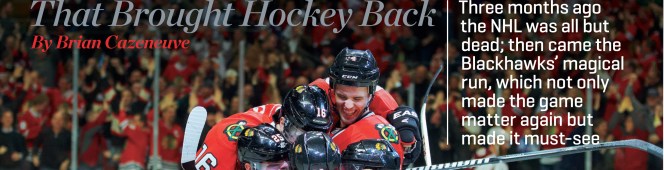
Chicago Blackhawks Streak

Chicago Blackhawks Streak

12cov18nat_promoHere’s an unusually perceptive analysis of what ails hockey — and its fans.

http://www.cbssports.com/nhl/blog/eye-on-hockey/21861059/sports-illustrateds-chicago-blackhawks-cover-irks-hockey-fans?fb_action_ids=579868138703975&fb_action_types=og.likes&fb_source=aggregation&fb_aggregation_id=288381481237582

Footnote 4 – A Brief History of Hymns and Hymnals

Footnote 4 – A Brief History of Hymns and Hymnals, by Steve Wolfgang, in Great Texts of the Old Testament: The 2007 Truth Lectures (Bowling Green, KY: Truthbooks, 2007), pp. 116-159.

Scott Harp has posted an article I wrote several years ago on the history of hymns, particularly in the context of the “Restoration Movement” on his page at http://www.therestorationmovement.com/recent.htm 

Guidelines for Bloggers

The Blogs, the Battles and the Gospel


A HYMN FOR TODAY – I Sing the Mighty Power of God

A HYMN FOR TODAY

I sing the mighty pow’r of God
That made the mountains rise,
That spread the flowing seas abroad
And built the lofty skies.
I sing the wisdom that ordained
The sun to rule the day;
The moon shines full at His command,
And all the stars obey.

I sing the goodness of the LORD,
Who filled the earth with food,
Who formed the creatures through His Word
And then pronounced them good.
LORD, how Thy wonders are displayed
Where’er I turn my eye,
If I survey the ground I tread
Or gaze upon the sky.

In heav’n He shines with beams of love,
With wrath in hell beneath;
‘Tis on His earth I stand or move,
And ’tis His air I breathe.
His hand is my perpetual guard,
He keeps me with His eye;
Why should I then forget the LORD,
Who is forever nigh?

There’s not a plant or flow’r below
But makes Thy glories known,
And clouds arise and tempests blow
By order from Thy throne;
While all that borrows life from Thee
Is ever in Thy care;
And everywhere that man can be
Thou, God, art present there.

CMD (8.6.8.6.D) – Isaac Watts, 1715

Tune: ELLACOMBE – Wurttemberg Gesangbuch, 1784
arr. William H. Monk, 1868

#74 in Psalms, Hymns, and Spiritual Songs, 2012

I SING THE MIGHTY POWER OF GOD declares God’s power, wisdom, and goodness displayed in His creation. The intricate workings of nature demonstrate that God is still in control and present with His people. (Genesis 1:1-31; Psalm 65:6-7, 9-13; 136:8-9; Jeremiah 31:35; 51:15-16).  Watts wrote this as a hymn for children, and published it first in his Divine Songs Attempted in Easy Language, for the Use of Children (1715) — a stunning commentary by itself of the state of children’s education today, and our expectations for them!

Locusts still plague the Bible lands

From Ferrell Jenkins’ excellent Travel Blog

Ferrell Jenkins's avatarFerrell's Travel Blog

References to locusts in the Bible are scattered from the time when the Israelites were in Egyptian bondage to the book of Revelation. Several Hebrew terms are used to describe locusts, perhaps of different species, or because of the various stages through which the locusts grow.

The prophet Joel uses the illustration of a locust invasion upon the land.

What the cutting locust left, the swarming locust has eaten. What the swarming locust left, the hopping locust has eaten, and what the hopping locust left, the destroying locust has eaten. (Joel 1:4 ESV)

Was he speaking of literal locusts, or of the invasion of a foreign enemy?

The prophet Amos speaks of the punishments brought by the LORD upon the northern kingdom of Israel prior to the Assyrian invasion.

“I struck you with blight and mildew; your many gardens and your vineyards, your fig trees and your olive trees the…

View original post 301 more words

Footnote 3 – Explanatory Footnote

Footnote 3 – Explanatory Footnote

When in the Course of human events, it becomes necessary to create yet another weblog and thus add to the verbiage already cluttering the blogosphere, exercising the verbal and mental abilities which the Laws of Nature and of Nature’s God have bestowed upon us, a decent respect to the opinions of mankind requires that one should declare the causes which impel him to do such a thing (shamelessly paraphrased from someone much smarter than me).

This personal blog is something I have pondered doing for several years, and finally, “impelled” by wife, daughter and others, have taken the plunge. Will anyone read it? I hope so – but that’s not really the point of this blog.  It’s for me as much as anyone else – my interests, my thoughts and words (and the thoughts and words of others), and my interactions with the thoughts and words of others.

It’s “eclectic” – from the Greek ἐκλεκτικός, which can be defined as “deriving ideas, style, or taste from a broad and diverse range of sources (adjective); or, a person who derives ideas, style, or taste from a broad and diverse range of sources (noun); selecting what appears to be best in various doctrines, methods, or styles; or, composed of elements drawn from a variety of sources, systems, or styles.”

Because I spent the last seven years co-editing a new hymnal – Psalms, Hymns, and Spiritual Songs – much of my consciousness is still oriented in that direction.  I will continue posting my “Hymn For Today” feature which has been a regular aspect of my Facebook page since last June.

But my interests are broader and more diverse (eclectic) than hymnology, extending to history, religion, language, broadcast media, sports, and more: much of the broad range of human endeavor and achievement. I taught history in a state university for a number of years (history of religion, journalism, science and technology, the history and impact of “significant events,” e.g., World War II or the American Civil War, as well as the obligatory “survey” courses) before “declaring victory” and retiring from the field.  History is arguably the broadest of the liberal arts, since one can, after all, write a history of nearly anything.  Additionally, in a brief spurt of insanity during my long and checkered past, I did some news broadcasting (NPR and CBS affiliates).

Partly my “eclecticism” is due to my more-or-less typical baby-boomer career path of eight different jobs in three different “careers.” Some people have said that I just haven’t decided what I want to be when I grow up.  My retort is: “Why grow up? No future in that!”

But the one common interest which binds all these eclectic disciplines together is, for me, religion – and the quest to understand the meaning of it all.  Much of my adult life has been spent working as a minister – sometimes “bi-vocational,” supporting my family by working in the “secular” marketplace; often fully supported by churches.  Much of my work has been with small-to-medium-sized, independent congregations whose stated intent is to be “Christians only” and attempt to follow the teachings of Jesus and his first disciples – those He sent out as apostles to spread and share the gospel of God’s grace.  Thus, this blog has a decidedly Christian orientation.

Some individual blogs will celebrate the joys and hazards of living in suburban Chicago and the diverse (eclectic) advantages of a truly global city – as well as the agonies and ecstasies of following daBears, Bulls, Blackhawks and, of course, the Cubbies (World Champions, 1908).

The format of some of the blog , a series of “Footnotes,” is a nod to my former academic career.  I cite a source in more-or-less standard academic format, and then reproduce a quotation or segment from some eclectic source. Sometimes I may feel a need to comment; sometimes not.   Some of them may be “explanatory” footnotes, like this one.  I stole this format shamelessly a few decades ago from one of my academic mentors who long ago abandoned the practice.  Perhaps I will re-cycle portions of a series of “Footnote” articles I wrote several years ago in the “popular” (non-academic) press.  At this stage it’s probably too late to come up with something else which is new and clever.

Help yourself.

A Hymn For Today: Lord, Enthroned in Heavenly Splendor


A Hymn For Today

Lord, enthroned in heav’nly splendor, 
First begotten from the dead, 
You alone, our strong defender, 
Now lift up Your people’s head. 
Here we kneel, our homage paying, 
Here in loving rev’rence bow; 
Here for faith’s discernment praying, 
Lest we fail to know You now. 

Though the lowly form may veil You 
As of old in Bethlehem, 
Here as there Your angels hail You, 
Branch and flow’r of Jesse’s stem. 
Paschal Lamb, Your off’ring finished 
Once for all when You were slain, 
In its fullness undiminished 
Shall forevermore remain. 

Great High Priest of our profession, 
Through the veil You entered in, 
By Your mighty intercession, 
Grace and peace for us to win. 
Life-imparting heav’nly manna, 
Smitten rock with streaming side, 
Heav’n and earth with loud hosanna 
Worship You, the Lamb who died. 

8.7.8.7.D – vv. 1, 2, George H. Bourne, 1874 
vs. 3 – Unknown 

Tune: HYFRYDOL – Rowland H. Prichard, 1831

#243 in Psalms, Hymns, and Spiritual Songs, 2012 

Billy Joel at Vanderbilt University

Billy Joel at Vanderbilt University

Billy Joel was recently doing a Q&A at Vanderbilt University (one of my “alma maters”) when a student asked if he could play “New York State of Mind” with him. Then, this pretty amazing moment happened.