Logos (not the software)

Logos (not the software)

Logos

Posted on May 13, 2013 by Hal Hammons

Call me unreasonable, call me paranoid, but I have to say, I feel a bit weird sharing the road with drivers who have NASCAR logos on their vehicles.  If Tony Stewart sticker guy thinks I should have used my turn signal more judiciously, will he feel justified in getting me loose and putting me into the wall?  And what if I find myself between him and Jeff Gordon sticker guy?  Maybe that would be a good time for me to make a pit stop.

I get it, though.  Logos are intended to imply affiliation, not direct identification.  If I put a Houston Astros sticker on my car, it would not make my neighbors fear I might get out of my car and swing at their heads with a baseball bat — and miss, pulling a hamstring.  It would just tell them I like a team with a lower winning percentage than the batting average of its best player.  Chicago Cub fans out there, from all of us Astros fans, you’re welcome.

The associations we claim say a great deal about us.  If I wear a restaurant’s logo on my shirt, people can safely assume I like the restaurant.  It may be that I hate the place, that it’s my wife’s shirt, and that it’s the only clean shirt in the house.  But it’s unlikely anyone will assume that.

No one is going to hell for plugging the wrong restaurant or driver.  But if we are promoting a product, person or industry that is actively opposed to the principles of God, are we not a partaker in evil deeds (2 John 11)?  Can we expose the deeds of darkness (Ephesians 5:11) while shilling for them?

Don’t let your attachment to carnal things cover up your attachment to Jesus.  That’s all I’m saying.

Lexington Theological Seminary Sells Campus to UK

Lexington Theological Seminary Sells Campus to UK

University of Kentucky to buy campus of Lexington Theological Seminary

Published: May 13, 2013

By Linda B. Blackford — lblackford@herald-leader.com

The University of Kentucky will buy the Lexington Theological Seminary’s 7-acre campus on South Limestone for $13.5 million, officials announced late Monday.

The UK Board of Trustees is expected to approve the deal at its meeting Tuesday, adding room for expansion on the west side of Limestone. The seminary has moved almost all of its instruction online since 2011 and plans to relocate to a smaller campus in Lexington.

“When high-quality space adjacent to your campus becomes available, the responsible thing is to explore the possibilities,” UK President Eli Capilouto said. “The Lexington Theological Seminary space represents great potential for the university as we grapple with how to grow and manage within our existing footprint.”

In the immediate future, UK plans to use seminary buildings as “swing space” for the Gatton School of Business as it starts a major renovation and expansion across the street.

The 63-year-old seminary property includes 131,000 square feet of built space, including four classroom buildings, 44 apartments, 16 townhouses, a maintenance building and a parking lot. For the past 20 years, about 75 percent of the seminary’s housing has been rented to UK students, said seminary President Charisse Gillett. UK officials said they would honor any current leases made with Lexington Theological Seminary for the next academic year, then fold those spaces into UK Housing.

Gillett said the seminary’s move — which she hopes will be to a downtown location — is part of the school’s new identity.

“Change for every academic institution is inevitable, and change has been our mantra,” she said Monday. “This is another step in our transformation and revitalization.”

Eric Monday, UK’s vice president of finance and administration, said the sale would be a cash deal, paid for with $13.5 million in excess funds created by increased enrollment last fall. Going forward, recurring money from increased enrollment will be used to soften budget cuts across campus, Monday said.

Bob Wiseman, UK’s vice president for facilities, said the seminary’s buildings probably would become a temporary home for various programs during the next five to 10 years as UK embarks on construction and renovation projects throughout campus.

Wiseman said the seminary’s academic buildings and housing spaces were in good physical shape. “With the amount of building we are doing, we have a great need for swing space,” he said. “This is very helpful for short-term.”

In addition, the 284-space parking lot will help ease UK’s chronic parking woes, he said. Wiseman said the new property would be folded into UK’s ongoing master planning process, but there are no immediate plans to designate a permanent use for the land. Although the property is across the street from UK’s law school, which is looking to expand, “you couldn’t easily reconfigure the space for a law school,” he said.

Lexington Theological Seminary was founded in 1865 as part of the Christian Church (Disciples of Christ). Gillett said the seminary once was on the campus of Transylvania University, then moved closer to UK when it became a residential seminary.

The 2008 economic downturn hit the seminary’s finances and enrollment hard, pushing the school to put much of its instruction online by 2011. Today, enrollment has climbed to about 110 students, 55 of whom are full-time. Most still seek a master’s degree in divinity, Gillett said, but a growing number of students are seeking certificates in pastoral ministry.

Half the coursework is online and half is done in congregations. Students also come to campus twice a year for two weeks of intensive residential instruction.

The seminary’s 23 full-time employees were notified about the sale Monday.

Gillett said the $13.5 million from the sale of the property would help establish a new location for the seminary and give the school more financial stability.

Linda Blackford: (859) 231-1359. Twitter: @lbblackford.
Footnote 19 – Richard John Neuhaus: Jesus and the Druid Princess

Footnote 19 – Richard John Neuhaus, ed. Theological Education and Moral Formation (Grand Rapids, MI: William B. Eerdmans Publishing Company, 1992), pp. 146-147.

Richard John Neuhaus was editor of the journal First Things, as well as the Encounter Series of volumes published by Eerdmans, of which this is Volume 15. Readers of this blog might also be interested in other volumes in the series, particularly volume 2 (Unsecular America) and volume 5 (The Bible, Politics, and Democracy).

Typically, each volume reports a conference in which four to six featured speakers delivered prepared addresses, following which those speakers and perhaps a dozen others joined in a panel discussion of the issues raised in the prepared speeches. This particular volume reports a conference at Duke University and offers some rare insight into the state of the denominational mentality in America, and I offer excerpts from three different sections of the round-table discussion for your amazement.

Philip Turner, Dean of Berkeley Divinity School, Yale University, speaking of the crisis of authority in the Episcopal church:

“My wife is a priest. In her diocese recently there was another priest who got into New Age channeling. One day she announced that her particular spirit had informed her that Jesus didn’t really die; he married a druid princess, and they had a little druids. This was the content of this priest’s teaching to a group in her church.  The senior warden of the parish thought that maybe something was wrong, so he called the bishop. The bishop, bless his heart, told the priest that she had three choices: she could recant, she could resign her orders, or she could undergo a heresy trial. Well, the bishop is the one who took the flak, because the dominant reaction was, ‘We’re Episcopalians, so we can believe what we want, and a bishop has no rights here.’”

A HYMN FOR TODAY – Living Water, Bread of Life

A HYMN FOR TODAY

Living Water, Bread of Life

God sends springs into the valleys,
Flowing softly through the hills.
God sends streams down from the mountains,
Leaping over rocks and rills.
He fills rivers; He fills oceans.
Oh! what bounty overflows!
But His gift of living water
Quenches thirst within my soul.

God makes seed we plant for harvest,
Grows the seedling in the field,
Ripens grain for us to gather,
For the good bread it will yield.
He made manna sent from heaven.
Oh! what bounty He bestows!
Yet the bread of life He gives me
Feeds the hunger of my soul.

God provides in great abundance;
Of His bounty He has said:
“I’ll not see the saints forsaken
Or the righteous begging bread.”
Father, keep it still before me:
Greatest bounty You bestow
Is the Christ, the living water,
Bread of life to fill my soul.

8.7.8.7.D – Gayle D. Garrison, 1999
From Psalm 37:25-26; 104:10-15; 107:35-37

Tune: Gayle D. Garrison, 1999

Arr. R.J. Stevens, 1999

#56 in Psalms, Hymns, and Spiritual Songs, 2012

LIVING WATER, BREAD OF LIFE thanks God for water and bread. Then, in contrast, it thanks God for the greater gift of spiritual nourishment through Christ, who is the Living Water and Bread of Life. (Exodus 16:14-15; Psalm 37:25-26; 65:9-13; 104:10-14; Isaiah 55:10; John 4:10-14; 6:27-58; 2 Corinthians 9:10)

Why Men Have Stopped Singing in Church

Why Men Have Stopped Singing in Church

Why men have stopped singing in church

May 8, 2013 By 

Worship BandIt happened again yesterday. I was attending one of those hip, contemporary churches — and almost no one sang. Worshippers stood obediently as the band rocked out, the smoke machine belched and lights flashed. Lyrics were projected on the screen, but almost no one sang them. A few women were trying, but I saw only one male (other than the worship leader) making the attempt.

A few months ago I blogged, “Have Christians Stopped Singing?” I did some research, and learned that congregational singing has ebbed and flowed over the centuries. It reached a high tide when I was a young man – but that tide may be going out again. And that could be bad news for men.

First, a very quick history of congregational singing.

Before the Reformation, laypersons were not allowed to sing in church. They were expected to stand mute as sacred music was performed by professionals (priests and cantors), played on complex instruments (pipe organs), and sung in an obscure language (Latin).

Reformers gave worship back to the people in the form of congregational singing. They composed simple tunes that were easy to sing, and mated them with theologically rich lyrics. Since most people were illiterate in the 16th century, singing became an effective form of catechism. Congregants learned about God as they sang about God.

A technological advance – the printing press – led to an explosion of congregational singing. The first hymnal was printed in 1532, and soon a few dozen hymns became standards across Christendom. Hymnals slowly grew over the next four centuries. By the mid 20th century every Protestant church had a hymnal of about 1000 songs, 250 of which were regularly sung. In the church of my youth, everyone picked up a hymnal and sang every verse of every song.

About 20 years ago a new technological advance – the computer controlled projection screen – entered America’s sanctuaries. Suddenly churches could project song lyrics for all to see. Hymnals became obsolete. No longer were Christians limited to 1,000 songs handed down by our elders.

At first, churches simply projected the songs everyone knew – hymns and a few simple praise songs that had come out of the Jesus Movement. People sang robustly.

But that began to change about ten years ago. Worship leaders realized they could project anything on that screen. So they brought in new songs each week. They drew from the radio, the Internet, and Worship conferences. Some began composing their own songs, performing them during worship, and selling them on CD after church.

In short order we went from 250 songs everyone knows to 250,000+ songs nobody knows.

Years ago, worship leaders used to prepare their flocks when introducing a new song. “We’re going to do a new song for you now,” they would say. “We’ll go through it twice, and then we invite you to join in.”

That kind of coaching is rare today. Songs get switched out so frequently that it’s impossible to learn them. People can’t sing songs they’ve never heard. And with no musical notes to follow, how is a person supposed to pick up the tune?

And so the church has returned to the 14th century. Worshippers stand mute as professional-caliber musicians play complex instruments, sung in an obscure language. Martin Luther is turning over in his grave.

What does this mean for men? On the positive side, men no longer feel pressure to sing in church. Men who are poor readers or poor singers no longer have to fumble through hymnals, sing archaic lyrics or read a musical staff.

But the negatives are huge. Men are doers, and singing was one of the things we used to do together in church. It was a chance to participate. Now, with congregational singing going away, and communion no longer a weekly ordinance, there’s only one avenue left for men to participate in the service – the offering. Is this really the message we want to send to men? Sit there, be quiet, and enjoy the show. And don’t forget to give us money.

There’s nothing wrong with professionalism and quality in church music. The problem isn’t the rock band, or the lights, or the smoke machine. The key is familiarity. People enjoy singing songs they know.

How do I know? When that super-hip band performed a hymn, the crowd responded with gusto. People sang. Even the men.

Biblical Archaeology Society

Biblical Archaeology Society

Try the Latest Technology for Yourself

Biblical Archaeology Society Staff   •  10/14/2011

Bruce Zuckerman

Bruce Zuckerman

In Biblical Archaeology Review (BAR)’s November/December 2011 issue, Biblical scholar and digital imaging expert Bruce Zuckerman introduces readers to RTI (Reflectance Transformation Imaging), a revolutionary imaging technology that is changing the way scholars read and interpret ancient texts.

In “New Eyeballs on Ancient Texts,” Zuckerman explains why RTI images, created by merging a series of pictures taken with multiple light sources at different angles and distances around an object, are much more powerful than standard digital photographs. When viewed on a computer, RTI images of ancient texts can be virtually manipulated to reveal subtle details invisible to the naked eye, such as the thickness of a letter inked on a Dead Sea Scroll or the impressed signs of an ancient and worn cuneiform tablet.

But, as Zuckerman writes, “it’s hard to explain what an RTI image looks like in mere words,” which is why we’ve put together this guide to help you better understand RTI and experience these impressive images for yourself.

New Eyeballs on Ancient Texts

RTI images can help reveal hidden details in ancient texts, such as this 4,000-year-old cuneiform tablet (top). In an RTI image (bottom), almost all of the tablet’s wedge-shaped characters can be clearly discerned.

First, click here to download the InscriptiFact standalone RTI image viewer developed by the West Semitic Research Project (WSRP).*

Next, click here to download some RTI images to your computer. The WSRP has made these three RTI image files available especially for BAR readers. The first image (Coin_10534_Obv) is a first-century C.E. Jewish coin dated to the third year of the First Jewish Revolt; the second image (DSS_SOC1Q34BISDobv) is a fragment of a Dead Sea Scroll containing an ancient Jewish prayer of atonement; and the third image (USCARC_6711_OBV) is a 4,000-year-old administrative tablet written in early cuneiform.

To download and save an image to your computer, click on the file name and, when directed, save the file to an easily accessible location on your hard drive, such as the desktop. The RTI files will be downloaded to your computer as compressed .zip files, so it may take a few minutes to complete each image download. You should then “unzip” the files once they are downloaded to your computer.

Now you can start viewing the images. Open the InscriptiFact viewer and click “Open” in the viewer’s menu bar. Navigate to the location where you saved the downloaded RTI image onto your computer’s hard drive and then click the Open button. The RTI image will then appear in a window within the viewer. At this point, you can begin experimenting with a variety of tools (especially those found under “Options” and “Effects” in the menu bar) that allow you to virtually manipulate the artifact image. Click below to watch a YouTube video that details the viewer’s various tools and how they work.

PLEASE NOTE: Neither the Biblical Archaeology Society nor the West Semitic Research Project will address or resolve questions, problems, error messages or any other issues that arise out of reader attempts to access, download, save, view or otherwise use the InscriptiFact RTI viewer or the RTI images.

If you want to learn more about RTI and its uses, you can also watch the informative YouTube video below that details how art conservators with the Fine Arts Museums of San Francisco are using RTI to better understand and conserve centuries-old paintings within their collections.

Permalink: http://www.biblicalarchaeology.org/daily/biblical-artifacts/dead-sea-scrolls/new-eyeballs-on-ancient-texts/

Herculaneum: the unknown city

via the British Museum Blog

A HYMN FOR TODAY – I Will Wake the Dawn With Praises

A HYMN FOR TODAY

I Will Wake the Dawn With Praises

Dawn and sunset, fierce and joyful,
Each reflects His mighty ways.
With the sea and sky before me,
I will give Him all my praise.

Stars will joy in praises from me;
“Lesser light” will know my voice.
When I give my God His glory,
Night will hear me and rejoice.

Shout His glory, brothers, sisters;
Laud His name and do His will.
Like the sands upon the shoreline
Are the praises due Him still.

[Chorus]
I will wake the dawn with praises!
I will speak His name abroad.
I will worship Him forever,
He my Lord, my only God.

8.7.8.7 with chorus – Sarah J. Furhman, 2001

Tune – Glenda B. Schales, 2001

#143 in Psalms, Hymns, and Spiritual Songs, 2012

I WILL WAKE THE DAWN WITH PRAISES borrows exuberant language from the Psalms to praise the Creator. Just as the dawn, the sunset, and the starry night praise God, so too the worshiper is overcome with the desire to glorify Him and encourage others to do the same. (Psalm 19:1-6; 57:7-11; 108:1-2)

Guardian: Hanging Gardens of……

Guardian: Hanging Gardens of……

Babylon’s hanging garden: ancient scripts give clue to missing wonder

A British academic has gathered evidence suggesting garden was created at Nineveh, 300 miles from Babylon

Babylon’s hanging garden: ancient scripts give clue missing wonder

Stephanie Dalley pieced together ancient texts to reveal a garden that recreated a mountain landscape. Photograph: Bettmann/Corbis

The whereabouts of one of the seven wonders of the ancient world – the fabled Hanging Garden of Babylon – has been one of the great mysteries from antiquity. The inability of archaeologists to find traces of it among Babylon’s ancient remains led some even to doubt its existence.

Now a British academic has amassed a wealth of textual evidence to show that the garden was instead created at Nineveh, 300 miles from Babylon, in the early 7th century BC.

After 18 years of study, Stephanie Dalley of Oxford University has concluded that the garden was built by the Assyrians in the north of Mesopotamia – in modern Iraq – rather than by their great enemies the Babylonians in the south.

She believes her research shows that the feat of engineering and artistry was achieved by the Assyrian king, Sennacherib, rather than the Babylonian king, Nebuchadnezzar.

The evidence presented by Dalley, an expert in ancient Middle Eastern languages, emerged from deciphering Babylonian and Assyrian cuneiform scripts and reinterpreting later Greek and Roman texts. They included a 7th-century BC Assyrian inscription that, she discovered, had been mistranslated in the 1920s, reducing passages to “absolute nonsense”.

She was astonished to find Sennacherib’s own description of an “unrivalled palace” and a “wonder for all peoples”. He describes the marvel of a water-raising screw made using a new method of casting bronze – and predating the invention of Archimedes’ screw by some four centuries.

Dalley said this was part of a complex system of canals, dams and aqueducts to bring mountain water from streams 50 miles away to the citadel of Nineveh and the hanging garden. The script records water being drawn up “all day”.

Location of the 'Hanging Gardens'

Recent excavations have found traces of aqueducts. One near Nineveh was so vast that Dalley said its remains looked like a stretch of motorway from the air, and it bore a crucial inscription: “Sennacherib king of the world … Over a great distance I had a watercourse directed to the environs of Nineveh …”

Having first broached her theory in 1992, Dalley is now presenting a mass of evidence in a book, The Mystery of the Hanging Garden of Babylon, which Oxford University Press publishes on 23 May. She expects to divide academic opinion, but the evidence convinces her that Sennacherib’s garden fulfils the criteria for a wonder of the world – “magnificent in conception, spectacular in engineering, and brilliant in artistry”.

Dalley said: “That the Hanging Garden was built in Babylon by Nebuchadnezzar the Great is a fact learned at school and … ‘verified’ in encyclopaedias … To challenge such a universally accepted truth might seem the height of arrogance, revisionist scholarship … But Assyriology is a relatively recent discipline … Facts that once seemed secure become redundant.”

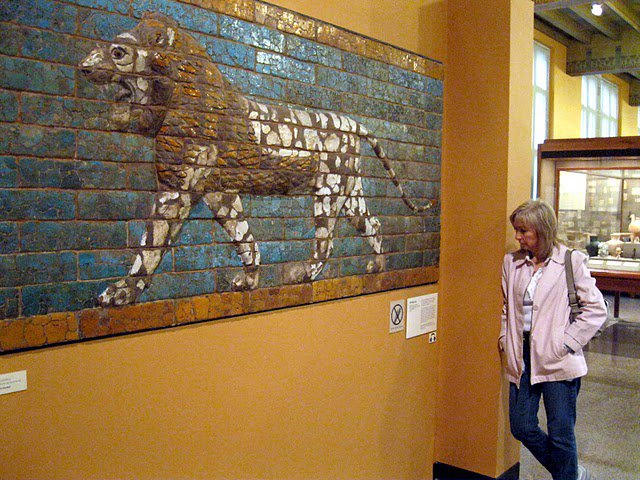
Sennacherib’s palace, with steps of semi-precious stone and an entrance guarded by colossal copper lions, was magnificent. Dalley pieced together ancient texts to reveal a garden that recreated a mountain landscape. It boasted terraces, pillared walkways, exotic plants and trees, and rippling streams.

The seven wonders appear in classical texts written centuries after the garden was created, but the 1st-century historian Josephus was the only author to name Nebuchadnezzar as creator of the Hanging Garden, Dalley said. She found extensive confusion over names and places in ancient texts, including the Book of Judith, muddling the two kings.

Little of Nineveh – near present-day Mosul – has so far been explored, because it has been judged too dangerous until now to conduct excavations.

New Testament Documents – Authorship and Dates

New Testament Documents – Authorship and Dates

Expository Files 20.5 – May 2013

New Testament Documents – Date & Authorship — By Steve Wolfgang

“In my opinion, every book of the New Testament was written by a baptized Jew between the forties and the eighties of the first century (very probably sometime between about A.D. 50 and 75).” – William F. Albright, Johns Hopkins University (1963, p.4)

Almost a half-century ago, when I first began to think seriously about various controversies over the dating and authorship of New Testament documents, one of the first things I encountered was this then-newly-minted comment by one of the world’s leading archaeologists, William F. Albright. While that comment was made a few years before his death in an interview in the evangelical magazine, Christianity Today, it was by no means a spur-of-the moment interjection common in interviews. Albright had previously written, in light of archaeological discoveries (his area of scholarly expertise), that “[t]hanks to the Qumran discoveries [the Dead Sea Scrolls], the New Testament proves to be in fact what it was formerly believed to be: the teaching of Christ and his immediate followers between circa 25 and circa 80 A.D” (Albright, 1957, p. 23).

What I have learned since encountering Albright’s comment has only caused me to see more clearly why this accomplished archaeologist said what he did. Interestingly, Albright’s assessment is not unique among unlikely sources of such assessments. Possibly the most unlikely source is the staunch atheist and eugenics advocate H.G. Wells (unfortunately much more widely known and read than Albright), who also acknowledged that the four gospels “were certainly in existence a few decades after [Christ’s] death” (498). Unless one reads documents through the lens of a apriori assumptions, the evidence supports the conclusions that the historical accounts, letters, biography, and other genres found in the New Testament were written by eyewitnesses and other persons living in that historical period with access to written sources and persons knowledgeable about the events

Expository Files May 2013    25

described. The New Testament is not the stuff of mythology or fiction, as the early and wide accessibility of the documents attest.

Background: Various Theories and Proposals

Obviously, the dates and time frames for the authorship of the various documents are significant issues in an apologetic argument for Christianity. Confidence in the historical accuracy of these documents depends partly on whether they were written by eyewitnesses and contemporaries to the events described, as many New Testament texts claim. Some critical scholars have attempted to strengthen their contentions by separating the actual events from the writings by as much time as possible. For this reason radical scholars (for example, the “Jesus Seminar”) argue for late first century or even second century dates for the original manuscripts. Invoking these dates barely opens the door to argue that the New Testament documents, especially the Gospels, are “mythological” and that the writers created the events contained in them, rather than simply reporting them. As Oxford historian A.N. Sherwin White has demonstrated, using documents from antiquity even less well-attested and with much wider composition-to-earliest-copy spans than the New Testament documents, “even two generations are too short a span to allow the mythical tendency to prevail over the hard historic core of the oral tradition” (Sherwin-White, 190).

In the 19th century, Ferdinand Christian Baur (1792–1860), founder of the “Tubingen School” of theology, maintained that the majority of the New Testament documents were pseudonymous works and gave little weight to the evidence of numerous citations provided by the early Christian writers (commonly known as “church fathers”). Proposing that the New Testament documents were written within a frame of perhaps120 years, his suggested dates ranged from ca. 50–60AD for Paul’s genuine letters (i.e., Romans, 1–2 Corinthians, Galatians) to about 170AD for the Gospel and letters of John. Baur’s proposal was remained influential for later attempts to date and identify authorship of the New Testament documents (Harris, 237, 248–62; Ellis, Appendix VI).

Expository Files May 2013    26

More recent dating proposals have reflected the impact, among both “liberal” and “conservative” scholars, of various lines of evidence which indicate earlier dates for the New Testament documents. For example, the notorious “death-of-God” proponent John A.T. Robinson (1976) contended that all 27 documents were composed prior to 70AD. He proposed a compositional span of approximately 20 years: from about 47–48AD (Galatians) to late 68–70AD (Revelation; Redating, 352). He mainly based his argument on the fact that the New Testament documents do not reference the fall of Jerusalem (70AD; Redating, 13–30).

More recently, influential Roman Catholic scholar Raymond E. Brown (1997) proposed a date range for the New Testament documents that spanned approximately 80 years: from 50–51AD for 1 Thessalonians, to 130AD for 2 Peter – although favoring a first-century date for almost all documents other than 2 Peter and 2 John (Introduction, 396, 457, 762).

Evangelical scholar E. Earle Ellis (1995), reflecting views accepted and espoused by many “conservative” Biblical writers, has proposed that the New Testament documents were the result of four streams of apostolic sources: Peter, James, John, and Paul. He dated all the New Testament documents within the first century: 49AD (for Galatians) to 85–95AD (Gospel of John), with the majority of the documents dated to the 50s and 60s (Making, 319), considering 70AD key for setting the upper limit dating for a majority of the New Testament documents.

Outer Limits – Manuscript Evidence and Quotations in early Christian Writers

The speculative efforts various negative critical scholars to “late-date” various New Testament documents are confronted by some “stubborn facts.” For example, every New Testament book is quoted by the “Apostolic Fathers” (as the early Christian writers down to 150AD are commonly known). Almost every book of the New Testament is explicitly cited as Scripture by these early writers. By around 300, nearly every verse in the New Testament was cited in one or more of over 36,000 citations found in the writings of the Church Fathers (Geisler and Nix 108, 155). The distribution of those writings are important evidence because of their early date, the wide geographic distribution of where these authors lived, where their recipients lived, and the large number of New Testament references

Expository Files May 2013    27

they contain. Evidence from these early Christian writers is explored in greater detail in other articles in this series, providing external evidence that from the beginning, churches and Christians recognized the authority of the apostolic writings which were soon disseminated and widely known.

Given the amount and early dates of these extensive quotations of the New Testament documents, it is impossible to argue seriously for the sort of “late-dating” and alleged pseudonymous composition of the documents composing the corpus of the New Testament. This stream of evidence is, of course, in addition to the various manuscript copies in Greek (to say nothing of early translations) of the New Testament documents.

Among these are the John Rylands papyri (p52), the earliest undisputed manuscript of a New Testament book, dated from 117 to 138AD. This fragment of John’s Gospel survives from within a generation of composition. Furthermore, inasmuch as the book was composed in Asia Minor while this fragment was found in Egypt, some circulation time is demanded, which surely places the composition of John within the first century. Entire books (Bodmer Papyri) are available from about 200AD. The Chester Beatty Papyri, from 150 years after the New Testament was finished (ca. 250), include all the Gospels and most of the New Testament. It is beyond dispute that no other book from the ancient world has as small a time span between composition and earliest manuscript copies, as does the New Testament.

Indeed, as has often been noted by many who have spent their lives pondering ancient evidence pertaining to the Scripture, “No work from Graeco-Roman antiquity is so well attested by manuscript tradition as the New Testament. There are many more manuscripts of the New Testament than there are of any classical author, and the oldest extensive remains of it date only about two centuries after their original composition” (Albright 1971, 238). Those who would question the integrity of the New Testament texts, by the same token destroy confidence in the integrity of any ancient document which has been handed down through the copying process.

Specific Instances and Particulars

While it is not possible in this short article to include a detailed explication of the date and authorship of every New Testament book, some samples will have to

Expository Files May 2013    28

suffice for the present. As these articles are expanded and collected for publication in book form, more details may be added to what originally appears here.

Luke and Acts. The Gospel of Luke was written by the same author as the Acts of the Apostles, who refers to Luke as the “former account” of “all that Jesus began to do and teach” (Acts 1:1). The style, vocabulary and recipient (Theophilus) of the two books betray a common author. Roman historian Colin Hemer has provided powerful evidence that Acts was written between 60AD and 62AD. This evidence includes these observations: There is no mention in Acts of the crucial event of the fall of Jerusalem in 70, or of the outbreak of the Jewish War in 66, and no hint of serious deterioration of relations between Romans and Jews before that time, nor of the deterioration of Christian relations with Rome during the Neronian persecution of the late 60s. There is no mention of the death of James at the hands of the Sanhedrin in ca. 62, as recorded by Josephus in Antiquities of the Jews (20.9.1.200). Controversies described in Acts presume that the Temple was still standing; and the relative prominence and authority of the Sadducees in Acts reflects a pre-70 date, before the collapse of their political cooperation with Rome. Likewise, the prominence of “God-fearers” in the synagogues may point to a pre-70 date, after which there were few Gentile inquirers and converts to Judaism. Additionally, the confident “tone” of Acts seems unlikely during the Neronian persecution of Christians and the Jewish War with Rome during the late 60s.

If Acts was written in 62 or before, and the gospel according to Luke was written before Acts (possibly 60AD or even before), then Luke was written only about thirty years after the death of Jesus. This is obviously contemporary to the generation who witnessed the events of Jesus’ life, death, and resurrection – which precisely what Luke claims in the prologue to his Gospel:

Many have undertaken to draw up an account of the things that have been fulfilled among us, just as they were handed down to us by those who from the first were eye-witnesses and servants of the word. Therefore, since I myself have carefully investigated everything from the beginning, it seemed good also to me to write an orderly account for you, most excellent

Expository Files May 2013    29

Theophilus, so that you may know the certainty of the things you have been taught. [Luke 1:1–4]

While so far considering only Luke of the four gospels (due to Luke’s authorship of Acts as well), it is commonly accepted as factual by the preponderance of those who have examined the evidence in detail – whether “conservative” or “liberal” scholars – that other gospels, particularly Mark, were committed to writing even earlier. In all such deliberations, it is good to remember that, for believers, there is in reality one gospel, recalled and recorded by four different evangelists (“according to Matthew” etc.) as each was empowered by the Spirit to remember and reveal what God wishes for us to know, expressed as the Spirit moved them to do so.

First Corinthians. It is widely accepted by many “critical” and “conservative” scholars alike that 1 Corinthians was written by 55 or 56 – less than a quarter century after the crucifixion. Further, Paul speaks of most of a collection of 500 eyewitnesses to the resurrection who were still alive when he wrote (15:6) – including the apostles and James the brother of Jesus. Internal evidence is strong for this early date: the book repeatedly claims to be written by Paul (1:1, 12–17; 3:4, 6, 22; 16:21); there are significant parallels with the book of Acts; the contents harmonize with what has been learned about Corinth during that era.

There also is external evidence: Clement of Rome refers to it in his own Epistle to the Corinthians (chap. 47), as does The Epistle of Barnabas (allusion, chapter 4) and the Shepherd of Hermas (chapter 4). Furthermore, there are nearly 600 quotations of 1 Corinthians in Irenaeus, Clement of Alexandria, and Tertullian alone. It is one of the best attested books of any kind from the ancient world.

2 Corinthians and Galatians, along with 1 Corinthians, are well attested and early. All three reveal a historical interest in the events of Jesus’ life and give facts that agree with the Gospels. Paul speaks of Jesus’ virgin birth (Gal. 4:4), sinless life (2 Cor. 5:21), death on the cross (1 Cor. 15:3; Gal. 3:13); resurrection on the third day (1 Cor. 15:4), and post-resurrection appearances (1 Cor. 15:5–8). He mentions the hundreds of eyewitnesses who could verify the resurrection (1 Cor. 15:6), grounding the truth of Christianity on the historicity of the resurrection (1 Cor. 15:12–19). Paul also gives historical details about Jesus’

Expository Files May 2013    30

contemporaries, the apostles (1 Cor. 15:5–8), including his private encounters with Peter and the apostles (Gal. 1:18–2:14). Persons, places, and events relating to Christ’s birth are described as historical. Luke goes to great pains to note that Jesus was born during the days of Caesar Augustus (Luke 2:1) and was baptized in the fifteenth year of Tiberius. Pontius Pilate was governor of Judea and Herod was tetrarch of Galilee. Annas and Caiaphas were high priests (Luke 3:1–2).

New Testament authors write with a clear sense of historical perspective (see Gal 4:4; Heb 1:1–2). They wrote against the historical backdrop of a Mediterranean world immersed in Greco-Roman culture and ruled by Rome and Roman officials known from non-Biblical sources (though those sources are significantly less-well attested than the New Testament documents. While the authors of the New Testament documents do include important figures, places, and events, they do not demonstrate an interest in precise chronological detail. As a result, many of their references to historical realities were more of an incidental nature. And, as is common in historical writing, they use various sources, make various choices about what evidence to incorporate or omit, and arrange their evidence to tell the story they wish to record. That is what historians do, after all.

Antilegomena: Disputed Documents

The basic principle of whether a document was recognized as legitimately belonging to the New Covenant scriptures was its apostolic “pedigree” – was it of apostolic (or prophetic) origin, and thus revelation from God? Because of some questions about the authorship or apostolic origin of seven documents (Hebrews, James, 2 Peter, 2-3 John, Jude, and Revelation) were sometimes challenged by various early Christians. Sometime referred to as antilegomena (“spoken against”), the very challenges these documents faced demonstrate ever more strongly that the ultimately test for whether these documents were recognized as divine revelation was: are they apostolic? Since Hebrews and 2-3 John are without authorial attribution, it is quite understandable that some might at first question their apostolic origin. Given the early martyrdom of James, the brother of John, understandable questions arose regarding the authorship of the epistle of James. The Apocalypse (Revelation) came under question later due to its wide usage by numerous heretics.

Expository Files May 2013    31

Even 2 Peter, the most contested of the New Testament epistles, provides a benchmark of sorts for the standards necessary for a document to be recognized as the word of God. 2 Peter was questioned due to stylistic and vocabulary differences (it has the largest number of hapax legomena or unique words of any New Testament document) as well as parallels with the epistle of Jude. But as E.M.B Green points out, arguing on the basis of Westcott’s work, 2 Peter “has incomparably better support for its inclusion than the best attested of the rejected books” (p.5). Kostenberger and Kruger (73, 153-155) challenge modern examples of early and later documents unfairly grouped together, as though both are of equally legitimacy, by modern authors with their own agendas.

Kruger (645), among other conservative scholars, challenges the common notion that 2 Peter is non-apostolic, contending that “the case for its pseudonymity is simply too incomplete and insufficient to warrant the dogmatic conclusions issued by much of modern scholarship. Although 2 Peter has various difficulties that are still being explored, we have no reason to doubt the epistle’s own claims in regard to authorship.” A good discussion of many of these disputations is in Harrison (416-428).

Conclusion

Jesus Christ himself is obviously the center and circumference of the New Testament documents which record his life and works. The gospels present themselves to readers as calm and rational expositors of historical facts. Nearly all we know about Jesus comes from these source materials, written by those who had personal knowledge of the events they describe or their sources who had such firsthand, eyewitness knowledge. They record the claims of Jesus, but also indicate that he intended for this knowledge to be disseminated not by himself, but rather by men he selected and approved to carry his message to the world (John 16:13-14, 20:21-23; Matthew 10:20, 16:19, 18:18; Luke 22:30. That these appointed messengers did so effectively is attested by the widespread documentation, within a generation or two of the events themselves, of that proclamation, written down for succeeding generations to read and receive with confidence in their accuracy and veracity.

Expository Files May 2013    32

Sources:

Albright, William F., From the Stone Age to Christianity (2nd ed; New York: Anchor Books, 1957).

__________. The Archaeology of Palestine. Reprint; Gloucester MA: Peter Smith, 1971.

__________. “Toward a More Conservative View.” Christianity Today, January 18, 1963, p.4.

Brown, Raymond E. An Introduction to the New Testament. New York: Doubleday, 1997.

Bruce, F.F., J.I Packer, Philip Comfort, and Carl F.H. Henry, eds. The Origin of the Bible. Carol Stream, IL: Tyndale House, 2003.

Carson, D.A., and Douglas Moo. An Introduction to the New Testament. 2nd ed. Grand Rapids, MI: Zondervan, 2005.

Ellis, E Earle. The Making of the New Testament Documents. Leiden: Brill, 1999.

Geisler, Norman L., and William E. Nix, From God To Us Revised and Expanded: How We Got Our Bible. 2nd ed.; Chicago: Moody Press, 2012.

Green, E.M.B. 2 Peter Reconsidered. London: Tyndale, 1961.

Harris, Horton. The Tübingen School: A Historical and Theological Investigation of the School of F.C. Baur. Oxford: Clarendon Press, 1975.

Harrison, Everett F., Introduction to the New Testament. Grand Rapids, MI: Zondervan, 1971.

Hemer, Colin J. The Book of Acts in the Setting of Hellenistic History. Ed. Conrad H. Gempf. Winona Lake, IN: Eisenbrauns, 1990.

Kostenberger, Andreas J., and Michael J. Kruger. The Heresy of Orthodoxy. Wheaton, IL: Crossway, 2010.

Kruger, Michael J. “The Authenticity of 2 Peter,” Journal of the Evangelical Theological Society 42.4 (1999), 645-671.

Longenecker, Richard N. “On the Form, Function, and Authority of the New Testament Letters.” In D.A. Carson and John D. Woodbridge, Scripture and Truth. Grand Rapids, MI: Zondervan, 1983, 101-114.

Robinson, John A.T. Redating the New Testament. Philadelphia: Westminster, 1976.

Sherwin-White, Adrian Nicholas. Roman Society and Roman Law in the New Testament. Oxford: Oxford University Press, 1963.

Wells, H.G. The Outline of History (Garden City, NY: Garden City Publishing, 1921).