Another Bookstore Casualty — O’Gara & Wilson Leaving Hyde Park/Chicago

Another Bookstore Casualty — O’Gara & Wilson Leaving Hyde Park/Chicago

Hyde Park bookstore O’Gara & Wilson closes after decades in operation — Move to Indiana prompted, in part, by ‘toxic environment for small businesses,’ owner says

Doug Wilson, owner of O’Gara and Wilson bookstore in the Hyde Park neighborhood, says a “toxic environment for small businesses” is partly to blame for him closing his shop, which has been a fixture in the neighborhood for more than 50 years. (Terrence Antonio James, Chicago Tribune / June 25, 2013)

By Mugambi Mutegi, Chicago Tribune reporter  —  July 18, 2013

At the O’Gara & Wilson bookstore in the Hyde Park neighborhood, Rory Preston, 25, was packing more than 27,000 books into 900 brown paper bags Tuesday. Each bag was to contain 35 books of the same genre.

Store owner Doug Wilson, 63, was on a ladder with a drill, trying to get the lighting off the ceiling. Removing the wooden shelves was on the to-do list.

The two had been at it since Sunday, when the store, which specialized in used books and was a fixture in Hyde Park for more than 50 years, officially closed. Wilson cited a restrictive business environment in the neighborhood, compounded by dwindling readership, as reasons for the closing.

“The changes in the book trade with the advent of Internet book sales have altered the number and the vitality of bookstores that still exist,” Wilson said at the 1448 E. 57th St. location, which had served the likes of University of Chicago students and faculty to renowned writer Saul Bellow.

Wilson has seen the business shrink irreversibly but believes “there is life in bookstores, but we will continue seeing less of them in select communities that don’t support the culture.”

His plan is to set up shop in Chesterton, Ind., where he lives. He will run the business with his wife, Jill, and is hoping the town’s annual European Market, held between May and October, will provide the boost his business needs.

National chains are hardly immune to the same kinds of forces that helped prompt Wilson’s store to close.

++++++++++++++++++++++++++++++++++++++++++++++++++++

Read more at http://www.chicagotribune.com/business/ct-biz-0718-bf-bookstore-troubles-20130718,0,7559692.story

New Yorker Reviews “Darwin’s Doubt:” Mis-Reading Meyer

New Yorker Reviews “Darwin’s Doubt:” Mis-Reading Meyer

How “Sudden” Was the Cambrian Explosion? Nick Matzke Misreads Stephen Meyer and the Paleontological Literature; New Yorker Recycles Misrepresentation

Casey Luskin July 16, 2013 11:14 AM

IMG_6808Trilobite-COLOR1413a.jpg

On June 19, the day after Darwin’s Doubt was first available for purchase, Nick Matzke published a 9400-word “review” of the book in which it appears that he tried to anticipate many of Stephen Meyer’s arguments. Unfortunately, he often either guessed wrong as to what Meyer would say or — assuming he actually read the book as he claims — misread many of Meyer’s specific claims. As I showed in a previous response to Matzke, Matzke repeatedly misquoted Meyer, at one point claiming he referred to the Cambrian explosion as “instantaneous,” when Meyer nowhere makes that claim. Indeed, Matzke faulted Meyer for not recognizing that the Cambrian explosion “was not really ‘instantaneous’ nor particularly ‘sudden.'” Oddly, he also criticized Meyer for not recognizing that the Cambrian explosion “took at least 30 million years” — despite expert opinion showing it was far shorter.

Since Matzke published his review, The New Yorker reviewed Meyer’s book. Gareth Cook, the science writer who wrote the piece, relied heavily on Matzke’s critical evaluation, even though Matzke is a graduate student and not an established Cambrian expert. Cook uncritically recycled Matzke’s claim that the Cambrian explosion took “many tens of millions of years,” even saying that the main problem with Darwin’s Doubt is that Meyer failed to recognize this alleged fact.

DebatingDD.jpegSo, was Matzke right about the length of the Cambrian explosion? In fact, Matzke’s preemptive — or hastily written — review not only misrepresented Meyer’s view, it also misrepresented the length and character of the Cambrian explosion as numerous authoritative peer-reviewed scientific sources on the subject clearly show.

++++++++++++++++++++++++++++++++++++++++++++++++++++++

– See more at: http://www.evolutionnews.org/2013/07/how_sudden_was_074511.html#sthash.9Pp3MpO3.dpuf

– See more at: http://www.evolutionnews.org/2013/07/how_sudden_was_074511.html#sthash.9Pp3MpO3.dpuf

606 – Praise God From Whom All Blessings Flow

606 – Praise God From Whom All Blessings Flow

This YouTube vid features Ken Nafziger of Eastern Mennonite Seminary in Harrisonburg, VA, leading a Mennonite group in “606” — as it is known.  It recently became a feature of an extensive discussion among participants of a hymnody discussion board I’m on.  Fair Warning: It might get “in your head” and refuse to go away!

I heard Ken speak about this hymn at a 2008 conference at Pepperdine University in Mailbu, CA.  Using the 1709 Thomas Ken lyrics, “Praise God From Whom All Blessings Flow,” it is almost universally known among acapella Mennonite churches as “606” as it was numbered in an older Mennonite hymnal. After singing it in Stouffer Chapel at Pepperdine with Ken leading, I lobbied hard to include it in Psalms, Hymns, and Spiritual Songs — a new hymnal for which I was co-editor — but it is 3 pages long which could become cumbersome. Ken was gracious enough to come to a lecture I did regarding the new hymnal, and made several valuable suggestions which contributed to the project.

Below is another link to an article discussing the usage of the hymn among acapella Mennonite churches.

What do you think?

http://www.themennonite.org/issues/11-6/articles/606_When_why_and_how_do_Mennonites_use_the_anthem


Addendum:

The earliest instance of this tune in print (discovered to-date, that is) is the ninth edition of Lowell Mason’s Boston Handel and Haydn Society Collection in 1830, where it was designated as “Doxology.”  It first appeared in the fifteenth edition (1876) of Harmonia Sacra, entitled “Dedication Anthem,” which is its designation in the Hymnal: A Worship Book, alongside “(606).”     [p. 290, Hymnal Companion, Writer/Compiler – Joan A Fyock, ed. Lani Wright, ©1996, Brethren Press]

Source: http://rockhay.tripod.com/worship/music/606.htm

Little Things

Little Things

Most of us miss out 
on life’s big prizes. 
The Pulitzer. 
The Nobel. 
Oscars. Tonys.
Emmys.
But we’re all eligible
for life’s small pleasures. 
A pat 
on the back. 
A kiss 
behind the ear.
A four pound bass.
A full moon. 
An empty parking space. 
A crackling fire. 
A great meal. 
A glorious sunset. 
Hot soup.
Ice cold lemonade. 
Don’t fret about 
copping life’s grand awards. 
Enjoy its tiny delights. 
There are plenty 
for all of us.

For decades, I had a copy of this on my office wall “in another life,” but don’t know the author.  It often appears attributed to that great writer, “A. Nonymous.”  The Chairman and CEO of United Technologies, Harry J. Gray, ran it as a full-page ad in the Wall Street Journal years ago – but I’m not sure he’s the author.  Anyone out there know the story?

Ninth century B.C. chalices uncovered at Gath

Ferrell Jenkins's avatarFerrell's Travel Blog

A few chalices dating to the time of the destruction of the Philistine city of Gath by Hazael, king of Aram (Syria), have been announced during the current excavation at Tel es-Safi/Gath. The most recent, larger than usual, chalice was announced by Prof. Aren Maeir on Monday and Tuesday. Follow the excavation reports here.

Prof. Maeir displays the large chalice after the stand was excavated. (I like the T-shirt. Maybe there is another step down — a human stooped over with a mobile phone.)

Vessels of this type were sometimes used for burning incense.

Gath was one of five cities of the Philistine Pentapolis (1 Samuel 6:17). The city was destroyed by the Aramean King Hazael shortly after the middle of the 9th century B.C.

At that time Hazael king of Syria went up and fought against Gath and took it. But when Hazael set his face to go…

View original post 61 more words

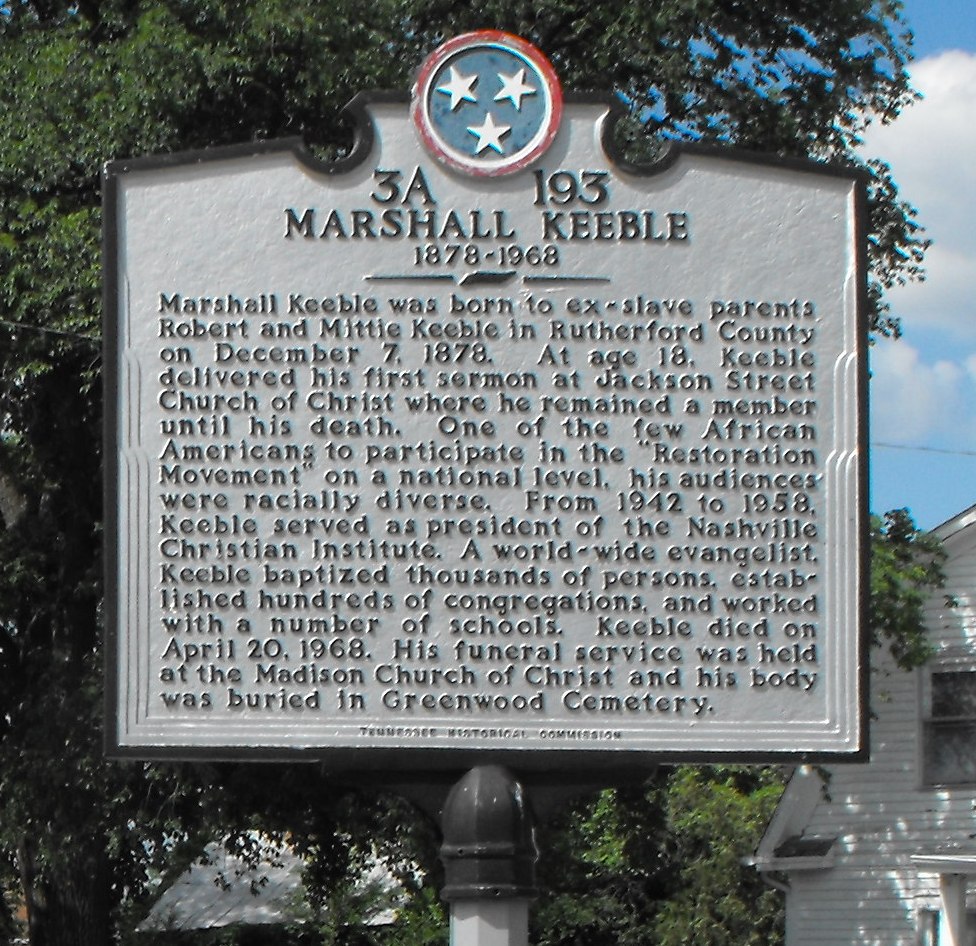
Marshall Keeble Historic Marker, Jackson Street at 14th Avenue, North, Nashville, TN

Frm McGarvey Ice’s blog – worth following!

mac's avatareScriptorium

At the northeast corner of 14th and Jackson stands this historic marker:

Jackson Street Church of Christ, Nashville, Historic Marker at Jackson and 14th Avenue North

Jackson Street Church occupied the northeast corner of the intersection until a new building was built on the west side of 14th.  An historical sketch, with photo of the earlier bulding, can be seen here, click ‘About Us’, then ‘Our History.”  Further west, beyond the current facility, is Fisk University.

I snapped the pic of the marker in June 2012 as part of a tour of Nashville Restoration Movement sites for conferees at Christian Scholars Conference.  Several tour members commented to me this was a highlight of the tour.  Indeed!

View original post

On the Edge of Disbelief?

From a Blog I follow – check it out!

A HYMN FOR TODAY – O Word of God incarnate

A HYMN FOR TODAY

O Word of God incarnate,

O Wisdom from on high,

O Truth unchanged, unchanging,

O Light of our dark sky:

We praise you for the radiance

That from the hallowed page,

A lantern to our footsteps,

Shines on from age to age.

The Scripture is a banner

Before God’s host unfurled;

It is a shining beacon

Above the darkling world.

It is a sacred vessel

Where gems of truth are stored;

It is the heav’n-drawn picture

Of Christ, the living Word.

O make Your church, dear Savior,

A lamp of purest gold,

To bear before the nations

Your true light as of old.

O teach your wand’ring pilgrims

By this their path to trace,

Till, clouds and darkness ended,

They see You face to face.

7.6.7.6.D – William W. How, 1867

Tune: MUNICH – Neuvermehrtes Gesangbuch, 1693

#279 in Psalms, Hymns, and Spiritual Songs, 2012

A Day with the Duttons (or, How Much Can Gentiles Pack Into a Sabbath?)

Great photos — reminiscing about prior visits to several of those locations. We look forward to having Trent & Rebekah back with us in Chicagoland when their sojourn there is over!

LukeChandler's avatarBible, Archaeology, and Travel with Luke Chandler

Last weekend I had the privilege to be with Trent and Rebekah Dutton. The Duttons are a great couple with an interesting story. Both are computer programmers with experience in military applications. Their interest in biblical geography and archaeology grew as they taught Bible classes at church, and piqued after a tour of Israel with Ferrell Jenkins in 2012. In short, they made a career change and are starting the two-year process to earn an M.A. in Biblical Archaeology at Wheaton College. (They were both accepted to Wheaton and are going through the program concurrently.) The first stage of their program is to excavate at Ashkelon with the Leon Levy Expedition for its full six-week season, followed by a semester of coursework in Jerusalem. They will then move to the Chicago area for the remaining 1-1/2 years of the program (with another Bible Lands dig next summer to boot.)

They and I…

View original post 398 more words

Eric Metaxas’ 7 Men And the Secret of Their Greatness – Reviewed by Alan Cornett

Eric Metaxas’ 7 Men And the Secret of Their Greatness – Reviewed by Alan Cornett

Being a Man of Conviction: Eric Metaxas’s ‘7 Men’

Reviewed by Alan Cornett in “Pinstripe Pulpit”

Posted on July 15, 2013

Review of 7 Men And the Secret of Their Greatness, by Eric Metaxas
Thomas Nelson, 2013

7 Men coverGeorge Washington could have been king. William Wilberforce was on a path to be prime minister. Eric Liddell had a guaranteed Olympic gold medal. All of them walked away. But why?

Fresh from blockbuster success of his biographies of Wilberforce and Dietrich Bonhoeffer, Eric Metaxas returns to the biographical genre that has treated him so well. This time, rather than a full length biography on a single subject, he has written a set of biographical vignettes of great men of faith and sacrifice, individuals who achieved their greatness by sacrificing for a larger cause.

Metaxas states that his goal is to address two questions with 7 Men: “what is a man?” and “what makes a man great?” Modern manhood is at a crisis, as most of us recognize. Metaxas writes, “Young men who spend their time watching violent movies and playing video games aren’t very easily going to become the men they were meant to become….[I]t is vital that we teach them who they are in God’s view, and it’s vital that we bring back a sense of the heroic.”

Hearkening back to such examples as Plutarch’s Lives and Foxe’s Book of Martyrs, Metaxas believes that to have strong exemplars of what real manhood is an age old method of training for virtue.

+++++++++++++++++++++++++

Read more at http://pinstripepulpit.com/being-a-man-of-conviction-eric-metaxass-7-men/