
Steve Wolfgang with grandchildren, Oriental Institute, University of Chicago
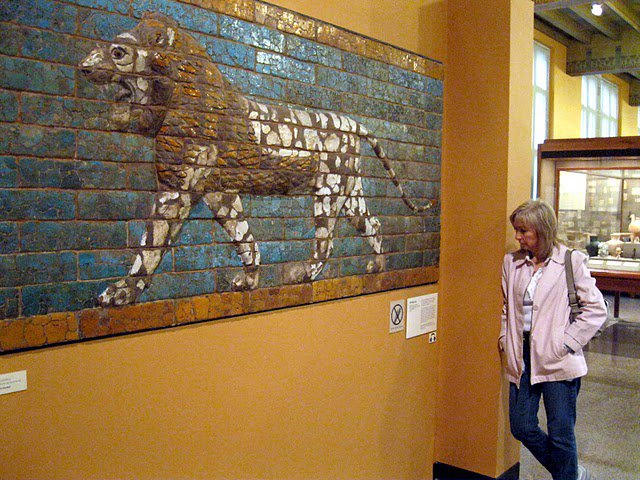
Steve Wolfgang with grandchildren, Oriental Institute, University of Chicago
Ashdod was located along an international highway known as the Way of the Sea, the Way of Philistia, or the Via Maris. This was the important route connecting Egypt and Assyria. We have already discussed, in the past few posts, that the Assyrian king Sargon II captured Ashdod in 712/11 B.C. The prophet Isaiah makes reference to this event in Isaiah 20:1.
The LORD revealed the following message during the year in which King Sargon of Assyria sent his commanding general to Ashdod, and he fought against it and captured it. (Isa 20:1 NET)
Sometime discoveries are made, but get little attention. A discovery at Tel Ashdod in 1963 falls into this category. Tel Ashdod was excavated from 1962 to 1972 under the direction of Moshe Dothan. David Noel Freedman wrote an article in Biblical Archaeologist (26:4, 1963)) about “The Second Season at Ancient Ashdod.” He describes the fragments of…
View original post 615 more words
Siege of Ft. Wagner – 150th Anniversary
Siege of Ft. Wagner – 150th Anniversary
1863: July 18 – September 7
Excerpts follow; read more at:
http://www.civilwar.org/battlefields/battery-wagner.html?tab=facts
After the successful amphibious operation against Port Royal and the stunning, long range artillery bombardment that led to the swift capture of Fort Pulaski, Brig. Gen. Quincy Gillmore was assigned to lead the 1863 campaign against the city of Charleston, South Carolina. Gillmore, who graduated first in his West Point class of 1849, was a rising star within the Union ranks.
On July 18, 1863, after the heavy land and sea bombardment subsided, Gillmore sent forward his Federal regiments. The assault was led by the 54thMassachusetts regiment; a Boston regiment filled with free African-Americans, and led by the Harvard educated Col. Robert Gould Shaw. The decision to have the 54th Massachusetts lead this dangerous attack was fraught with all sorts of political and military risk, but in the end it was Shaw’s men that led the attack up the narrow beach.
As the Federal soldiers neared the fort they were subjected to artillery and musket fire that shredded the exposed Yankee ranks. Despite their heavy losses, the remnants of the 54th Massachusetts reached and scaled the earthen walls of Fort Wagner. Descending into the fort, the 54thengaged in a bloody hand-to-hand struggle with the Confederate defenders. Col. Shaw, shouting “Onward boys! Onward boys!” was quickly shredded by a number of Confederate bullets and died on the sandy ramparts.
…..
Federal casualties reached 1,515, with the 54thMassachusetts losing 42% of its ranks in the attack. General Strong and Colonels Shaw, Putnam, and Chatfield all were killed or mortally wounded in the attack. Light by comparison, Confederate losses numbered 174 men.
After this bloody repulse, Gillmore settled into their Morris Island positions for a lengthy and costly siege that finally led to the Confederate abandonment of Fort Wagner on September 7, 1863 – far later than he had hoped.
+++++++++++++++++++++++++++++++++++++++++++++++++++
Read more at http://www.civilwar.org/battlefields/battery-wagner.html?tab=facts
A HYMN FOR TODAY
Let us, with a gladsome mind,
Praise the LORD, for He is kind.
For His mercies shall endure,
Ever faithful, ever sure.
Let us blaze His name abroad,
For of gods He is the God.
For His mercies shall endure,
Ever faithful, ever sure.
He with all commanding might
Filled the new-made world with light.
For His mercies shall endure,
Ever faithful, ever sure.
All things living He doth feed;
His full hand supplies their need.
For His mercies shall endure,
Ever faithful, ever sure.
Let us then, with gladsome mind,
Praise the LORD, for He is kind.
For His mercies shall endure,
Ever faithful, ever sure.
7.7.7.7 – John Milton, 1623
From Psalm 136:1-9, 25-26
Tune: MONKLAND – Monk’s Parish Choir, 1850 (alt. 2011)
#12 in Psalms, Hymns, and Spiritual Songs, 2012
Ancient wall in Israel matches up with Bible’s tale of Assyrian attack
Ancient wall in Israel matches up with Bible’s tale of Assyrian attack

Archaeologists say they have unearthed the remains of massive fortifications built about 2,700 years ago around an Iron Age Assyrian harbor in present-day Israel. The ruins appear to have a connection to Assyria’s takeover of the region, as mentioned in the Book of Isaiah.
“The fortifications appear to protect an artificial harbor,” Tel Aviv University’s Alexander Fantalkin, leader of the excavations at theAshdod-Yam archaeological dig, said in anews release issued Monday. “If so, this would be a discovery of international significance, the first known harbor of this kind in our corner of the Levant.”
The discovery was announced at the end of the first excavation season at Ashdod-Yam in the contemporary coastal city of Ashdod, just south of Tel Aviv. At the heart of the fortifications is a mud-brick wall measuring more than 12 feet wide (3.6 meters wide) in some places, and 15 feet (4.5 meters) high. The wall is covered in layers of mud and sand that stretch for hundreds of feet on either side.
When they were built in the 8th century B.C., the crescent-shaped fortifications would have defended an inland area covering more than 17 acres (7 hectares).

Age of Sargon II
During the late 8th century B.C., Assyrian King Sargon II ruled the entire southeastern part of the Mediterranean basin, including Egypt and the Middle East. Inscriptions tell of a Philistine king in Ashdod, named Yamani, who tried to organize a revolt against the Assyrian Empire. The Assyrians responded harshly, took control of Ashdod in 711 B.C. and eventually destroyed the city. As a result, power shifted to the nearby area of Ashdod-Yam, the site of the current excavations.
Tel Aviv University said the fortifications appear to be related to these events, although the precise relationship is not yet clear. They could have been built before or after the Ashdod rebellion was put down, either at the initiative of the local defenders or at the orders of the Assyrians.
Based on earlier excavations, the late Israeli archaeologist Jacob Kaplan concluded that the rebels built the fortifications in anticipation of the attack — but Fantalkin said the construction seems too monumental to have been done under such circumstances.
“An amazing amount of time and energy was invested in building the wall and glacis [embankments],” he said.
Staying out of the fight
Sargon II’s harsh action against Ashdod was mentioned in Isaiah 20, as a warning to those who backed the rebellion. “In that day, the people who live on this coast will say, ‘See what has happened to those we relied on, those we fled to for help and deliverance from the king of Assyria!'”
Hezekiah, king of Judah, stayed out of the fight —presumably at the urging of Isaiah.
Fantalkin and his team found more recent ruins on top of the sand of the Iron Age fortifications, dating to the Hellenistic period, between the 4th and 2nd centuries B.C.
+++++++++++++++++++++++++++++++++++++++++++++++++++++++
Read the entire article at http://www.nbcnews.com/science/ancient-wall-israel-matches-bibles-tale-assyrian-attack-6C10953508
Alan Boyle is NBCNews.com’s science editor. Connect with the Cosmic Log community by “liking” the NBC News Science Facebook page
The Gospel in Four Minutes
HT for this YouTube link to Collin Stringer, who says: “Here is a very creative presentation of the gospel. Yes, some error emerges, but it is definitely worth a listen.” My comment:
“Yes, as Collin says, very creative with errors emerging. Why do you think it is it that so many such “creative” interpretations of God’s message so often not only perpetuate human errors and additions to the message — but maybe more significantly omit fundamental portions of it which are featured prominently (in fact, are the “punch line”) when God himself revealed and recorded His own message (e.g., Matthew 28:18-20, Acts 2:38, 10:48, and elsewhere) in formats which require less time to read than this dude’s 4-minute interpretation — creative as it may be?”
Solomon, Socrates and Aristotle: Ancient Art
Solomon, Socrates and Aristotle

Pleading for her baby’s life, a woman kneels at the feet of King Solomon in 1 Kings 3:16–28. This Roman wall painting from Pompeii is the earliest known depiction of a Biblical scene. Who commissioned this painting: a Jew, a Christian or a gentile? Photo courtesy Scala/Art Resource, NY
Is it possible that the earliest existing picture of a scene from the Bible also includes the philosophers Socrates and Aristotle as onlookers? It is not only possible; I believe that is the case.
The earliest depiction of a Biblical scene comes from a site that is perhaps better known to some for its erotic art than for its religious devotions: Pompeii. The city was buried in volcanic ash in 79 A.D. following the eruption of nearby Mt. Vesuvius. It was a devastating tragedy for Pompeii’s residents but a boon to modern scholars and art historians.
In the building known as the House of the Physician, excavators found a wall painting clearly depicting King Solomon seated on a raised tribunal and flanked by two counselors. As described in the Bible, two women have come to the Israelite monarch, each claiming to be the mother of the same infant. When Solomon orders the baby to be divided in half, the real mother, shown at the foot of the dais, pleads with him to spare the child and announces her willingness to relinquish her claim. The other woman is shown standing by the butcher block on which the infant has been placed. As a soldier raises an axe to do the king’s bidding, she seizes what she believes will be her portion, saying, according to the Biblical text, “Let it be neither mine, nor thine, but divide it.” It is obvious who the real mother is. The child is given to her unharmed as soldiers and observers look on, marveling at Solomon’s wisdom (1 Kings 3:16–28).
The wall painting has now been removed and is on exhibit at the Museo Nazionale in Naples. While it is therefore well known to scholars, it has not previously been noted that this is the earliest depiction of a full-fledged Biblical scene known to us!
Our free eBook Ten Top Biblical Archaeology Discoveries brings together the exciting worlds of archaeology and the Bible! Learn the fascinating stories and insights gained from artifacts and ruins, like the Pool of Siloam in Jerusalem, where the Gospel of John says Jesus miraculously restored the sight of the blind man, and the Tel Dan inscription—the first historical evidence of King David outside the Bible.
Was the painting commissioned by a Jew, an early Christian, a so-called God-fearer (gentiles who adopted many Jewish customs and beliefs, but did not converta) or simply an educated Roman?
There is good evidence that Jews lived in Pompeii. Kosher brands of the locally popular fish sauces were packed there and appropriately labeled Kosher Garum and Kosher Muria (garum castum, muria casta).1 A two-word inscription, Sodoma Gomora, also survives from a house front in Pompeii and may have been written by a Jew or, less likely, by an early Christian, either before the eruption of Vesuvius or by a digger soon afterwards. It is perhaps more affecting to imagine its having been hastily written in the midst of the eruption by someone who analogized the town’s impending fate with that of the two doomed Biblical cities.
…………………………………………………
In any event, it is clear that the work reflects the influence of the Hebrew Bible. The Torah (the Pentateuch or Five Books of Moses) was translated into Greek beginning in about 270 B.C., and the rest of the Bible was added in the immediately following centuries. According to one account, King Ptolmey II Philadelphus of Egypt wanted a copy of the Hebrew Bible for his great library in Alexandria.b More likely, it was made by Jews for the Jews of Alexandria who did not know Hebrew. According to a traditional story, 70 scholars were isolated from each other on an island in Alexandria and instructed to prepare a Greek translation. When they were finished, all Greek copies were identical. Hence, this Greek translation of the Hebrew Bible is still known as the Septuagint.c The Greek translation became available not only to the many Greek-speaking Hellenized Jews of the Mediterranean world, but to non-Jews as well. This text served as both a literary and iconographic source-book for Jew and gentile alike. Although the owner of the House of the Physician could in theory have been either a Jew, a so-called God-fearer, an early Christian or a Roman gentile, he was most likely a gentile, based simply on demographic grounds. In short, gentiles were more numerous, more likely to attain wealth, and under no prohibition with regard to depicting the human form.
The painting contains all the essential narrative elements in the Biblical story without omissions or adumbrations. What’s more, it appears to have sprung whole from the artist’s imagination, as there is no known precedent in the history of art. As noted above, present are Solomon, the two mothers, the butcher block, the baby, the soldier waiting to divide it, and the onlookers who will attest to Solomon’s wisdom. The story has not received a more telling and cogent depiction in the 2,000 years since the painting’s creation.
…………………………………………
The owner of the House of the Physician approved the depiction of this scene and likely proposed the subject matter to the painter. In selecting an episode from the Hebrew Bible, the patron departed from the canon of classical religious subject matter and elevated one from the Scriptures of a people whose influence at the time was spreading throughout the empire and would one day, in its Christian formulation, pervade it.
|
Socrates has long been considered one of the founders of Western philosophy. Museo Pio Clementino at the Vatican. Alinari/Art Resource, NY ………………………………………………………… |
Over the years, a bald head, beard and flat nose became iconic features for depicting Socrates. The similarity to the figure in the Pompeian painting is so striking that he must be Socrates. Museo Archeologico Nazionale, NaplesScala/Art Resource, NY |
Noonan & Henthoff — What We Lose if We Give Up Privacy: A civil libertarian reflects on the dangers of the surveillance state
Excerpts from the Wall Street Journal — Updated August 16, 2013, 7:05 p.m. ET
Read more at http://online.wsj.com/article/SB10001424127887323639704579015101857760922.html
What is privacy? Why should we want to hold onto it? Why is it important, necessary, precious? Is it just some prissy relic of the pretechnological past?
We talk about this now because of Edward Snowden, the National Security Agency revelations, and new fears that we are operating, all of us, within what has become or is becoming a massive surveillance state. They log your calls here, they can listen in, they can read your emails. They keep the data in mammoth machines that contain a huge collection of information about you and yours. This of course is in pursuit of a laudable goal, security in the age of terror.
Is it excessive? It certainly appears to be. Does that matter? Yes. Among other reasons: The end of the expectation that citizens’ communications are and will remain private will probably change us as a people, and a country.
Among the pertinent definitions of privacy from the Oxford English Dictionary: “freedom from disturbance or intrusion,” “intended only for the use of a particular person or persons,” belonging to “the property of a particular person.” Also: “confidential, not to be disclosed to others.” Among others, the OED quotes the playwright Arthur Miller, describing the McCarthy era: “Conscience was no longer a private matter but one of state administration.”
Privacy is connected to personhood. It has to do with intimate things—the innards of your head and heart, the workings of your mind—and the boundary between those things and the world outside.

A loss of the expectation of privacy in communications is a loss of something personal and intimate, and it will have broader implications. That is the view of Nat Hentoff, the great journalist and civil libertarian. He is 88 now and on fire on the issue of privacy. “The media has awakened,” he told me. “Congress has awakened, to some extent.” Both are beginning to realize “that there are particular constitutional liberty rights that [Americans] have that distinguish them from all other people, and one of them is privacy.”
Mr. Hentoff sees excessive government surveillance as violative of the Fourth Amendment, which protects “the right of the people to be secure in their persons, houses, papers, and effects, against unreasonable searches and seizures” and requires that warrants be issued only “upon probable cause . . . particularly describing the place to be searched, and the persons or things to be seized.”
But Mr. Hentoff sees the surveillance state as a threat to free speech, too. About a year ago he went up to Harvard to speak to a class. He asked, he recalled: “How many of you realize the connection between what’s happening with the Fourth Amendment with the First Amendment?” He told the students that if citizens don’t have basic privacies—firm protections against the search and seizure of your private communications, for instance—they will be left feeling “threatened.” This will make citizens increasingly concerned “about what they say, and they do, and they think.” It will have the effect of constricting freedom of expression. Americans will become careful about what they say that can be misunderstood or misinterpreted, and then too careful about what they say that can be understood. The inevitable end of surveillance is self-censorship.
All of a sudden, the room became quiet. “These were bright kids, interested, concerned, but they hadn’t made an obvious connection about who we are as a people.” We are “free citizens in a self-governing republic.”
Mr. Hentoff once asked Justice William Brennan “a schoolboy’s question”: What is the most important amendment to the Constitution? “Brennan said the First Amendment, because all the other ones come from that. If you don’t have free speech you have to be afraid, you lack a vital part of what it is to be a human being who is free to be who you want to be.” Your own growth as a person will in time be constricted, because we come to know ourselves by our thoughts.
He wonders if Americans know who they are compared to what the Constitution says they are.
Mr. Hentoff’s second point: An entrenched surveillance state will change and distort the balance that allows free government to function successfully. Broad and intrusive surveillance will, definitively, put government in charge. But a republic only works, Mr. Hentoff notes, if public officials know that they—and the government itself—answer to the citizens. It doesn’t work, and is distorted, if the citizens must answer to the government. And that will happen more and more if the government knows—and you know—that the government has something, or some things, on you. “The bad thing is you no longer have the one thing we’re supposed to have as Americans living in a self-governing republic,” Mr. Hentoff said. “The people we elect are not your bosses, they are responsible to us.” They must answer to us. But if they increasingly control our privacy, “suddenly they’re in charge if they know what you’re thinking.”
This is a shift in the democratic dynamic. “If we don’t have free speech then what can we do if the people who govern us have no respect for us, may indeed make life difficult for us, and in fact belittle us?” If massive surveillance continues and grows, could it change the national character? “Yes, because it will change free speech.”
++++++++++++++++++++++++++++++++++++++++++++++++++++++++
A version of this article appeared August 16, 2013, on page A13 in the U.S. edition of The Wall Street Journal, with the headline: What We Lose if We Give Up Privacy.
Read more at: http://online.wsj.com/article/SB10001424127887323639704579015101857760922.html
TIME: Singing Changes Your Brain
Singing Changes Your Brain – Excerpts
Group singing has been scientifically proven to lower stress, relieve anxiety, and elevate endorphins
As the popularity of group singing grows, science has been hard at work trying to explain why it has such a calming yet energizing effect on people. What researchers are beginning to discover is that singing is like an infusion of the perfect tranquilizer, the kind that both soothes your nerves and elevates your spirits.
The elation may come from endorphins, a hormone released by singing, which is associated with feelings of pleasure. Or it might be from oxytocin, another hormone released during singing, which has been found to alleviate anxiety and stress. Oxytocin also enhances feelings of trust and bonding, which may explain why still more studies have found that singing lessens feelings of depression and loneliness….
The benefits of singing regularly seem to be cumulative. In one study, singers were found to have lower levels of cortisol, indicating lower stress. A very preliminary investigation suggesting that our heart rates may sync up during group singing could also explain why singing together sometimes feels like a guided group meditation. Study after study has found that singing relieves anxiety and contributes to quality of life. Dr. Julene K. Johnson, a researcher who has focused on older singers, recently began a five year study to examine group singing as an affordable method to improve the health and well-being of older adults.
It turns out you don’t even have to be a good singer to reap the rewards. According to one 2005 study, group singing “can produce satisfying and therapeutic sensations even when the sound produced by the vocal instrument is of mediocre quality.”
+++++++++++++++++++++++++++++++++++++++++++++++
Read more: http://ideas.time.com/2013/08/16/singing-changes-your-brain/#ixzz2cC9WrqxS
A HYMN FOR TODAY
Praise to the LORD, the Almighty, the King of creation!
O my soul, praise Him, for He is thy health and salvation!
All ye who hear, now to His temple draw near;
Praise Him in glad adoration.
Praise to the LORD, who o’er all things so wondrously reigneth,
Shelters thee under His wings, yea, so gently sustaineth!
Hast thou not seen how all thy longings have been
Granted in what He ordaineth?
Praise to the LORD, who doth prosper thy work and defend thee;
Surely His goodness and mercy here daily attend thee.
Ponder anew what the Almighty can do
If with His love He befriend thee.
Praise to the LORD; O let all that is in me adore Him!
All that hath life and breath, come now with praises before Him.
Let the amen sound from His people again;
Gladly forever adore Him.
14.14.4.7.8 – Joachim Neander, 1680
tr. Catherine Winkworth, 1863
Tune: LOBE DEN HERREN – Stralsund Gesangbuch, 1665
arr. William Sterndale Bennett, 1864)
#104 in Psalms, Hymns, and Spiritual Songs, 2012
Resources for congregational worship in song
Just another WordPress.com site
It's EVERYBODY'S "Holy Land"
Around the World, or Just in my Thoughts.
Discussing Sites, Peoples, and Events Related to the Bible, Ancient Near East, and Classical Studies
Steve Wolfgang's view of the world from suburban Chicago -- or wherever he may be on any given day
It's about calling.
Steve Wolfgang's view of the world from suburban Chicago -- or wherever he may be on any given day
Executive Director of CSNTM & Senior Research Professor of NT Studies at Dallas Theological Seminary
Steve Wolfgang's view of the world from suburban Chicago -- or wherever he may be on any given day
They hymned their King in strains divine; I heard the song and strove to join.
"I think I can. I think I can. I think I can." -The Little Engine That Could
Steve Wolfgang's view of the world from suburban Chicago -- or wherever he may be on any given day
Comments on the New Testament and Early Christianity (and related matters)


 ἐκλεκτικός