Finding Vivian Maier: Chicago Photographer Noticed Even in New York

New York Times — March 27, 2014 — by Manohla Dargis

Finding Vivian Maier

Excerpts below — Read more at http://www.nytimes.com/2014/03/28/movies/finding-vivian-maier-explores-a-mysterious-photographer.html?rref=movies&_r=0

An exciting electric current of discovery runs through “Finding Vivian Maier,” a documentary about a street photographer who never exhibited her work. She scarcely shared it even with those who knew her. Then again, many of her acquaintances when she was taking some of her remarkable images, particularly in and around Chicago in the 1950s and ’60s, were the children she cared for while working as a nanny. Later in her life, some of those children took care of her in turn, first by moving her into an apartment and then the nursing home where she died in 2009. What rotten timing: She was on the verge of being discovered, first as a curiosity and then as a social-media sensation and a mystery.


Read more at http://www.nytimes.com/2014/03/28/movies/finding-vivian-maier-explores-a-mysterious-photographer.html?rref=movies&_r=0


There’s a cost?

Recent post by a new blogger, Derrick Victor. Well said — and on a crucial topic. I preached on this subject last week, including these “famous” comments from Bonhoeffer’s Cost of Discipleship: ” Cheap grace is the preaching of forgiveness without requiring repentance, baptism without church discipline, communion without confession…. Cheap grace is grace without discipleship, grace without the cross, grace without Jesus Christ, living and incarnate.” p.47 His comments on “Costly Grace” in following passages are also worth reading.

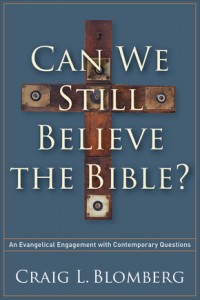
Can We Still Believe the Bible?

Daniel B. Wallace's avatarDaniel B. Wallace

Can-We-Still-Believe-the-Bible-200x300

Craig Blomberg, Distinguished Professor of New Testament at Denver Seminary, has written another outstanding volume. Blomberg is a committed evangelical, but not one with a closed mind. As he says in his preface about the environment of Denver Seminary (quoting Vernon Grounds, former president of the school), “Here is no unanchored liberalism—freedom to think without commitment. Here is no encrusted dogmatism—commitment without freedom to think. Here is a vibrant evangelicalism—commitment with freedom to think within the limits laid down by Scripture.” Blomberg’s writings have always emulated this philosophy. His research in the secondary literature is consistently of superb quality, and his discussions of problem passages and issues, especially in the Gospels, is always well informed. Rather than clutter the narrative with documentation, Blomberg has wisely used endnotes instead of footnotes (though I personally prefer footnotes, I understand that most readers see them as a distraction). This book has nearly…

View original post 3,073 more words

Your Hands: A 13th-Century Hymn Refreshed — and Refreshing

Your Hands: A 13th-Century Hymn Refreshed — and Refreshing

From Matt Bassford’s Excellent Blog:

http://hisexcellentword.blogspot.com/2014/03/your-hands.html

Your Hands

For dogs have surrounded me; 
A band of evildoers has encompassed me; 
They pierced my hands and my feet.
— Psalm 22:16 (NASB)O Christ the Shepherd, great and good,
Upon the tree suspended,
Your body pinned against the wood
And by Your hands extended.
O holy hands that all should hail!
New roses there are growing;
They bloom with red around each nail
Where many drops are flowing.Your cross arrests my inward sight,
Its plea, intense and fervent;
My understanding, will, and might–
Let each become Your servant!
Then draw me in Your love so wide
Before the cross I cherish,
For where Your hands were crucified,
There all my sin must perish.

Your holy hands I now embrace
With joy and lamentation;
I kiss the wounds that flow with grace
And weep at my salvation.
Now by Your sprinkled blood, I plead
For You alone to tend me,
And in my final hour of need,
Then may Your hands defend me!

Arnulf of Leuven, 13th cent.
tr. M. W. Bassford

An Offering That Costs Us Something

An Offering That Costs Us Something.

Places to look out over Jerusalem

Ferrell Jenkins's avatarFerrell's Travel Blog

The Times of Israel has a nice illustrated article today entitled “Five Glorious places from which to look out over Jerusalem.” Aviva and Shmuel Bar-Am show photographs from the following five places. Click here for the complete article.
  1. Haas-Sherover Promenade
  2. Confederation House Overlook
  3. Mount Zion Promenade and Overlooks
  4. Mount Scopus Observation Decks
  5. Gandhi Overlook (many will recall this as the lookout from the Mount of Olives)

Our photo below slows the modern view of Jerusalem from the Mount Scopus overlook.

View of Jerusalem from the Mount Scopus Overlook. Photo by Ferrell Jenkins. View of Jerusalem from the Mount Scopus Overlook. Photo by Ferrell Jenkins.

View original post

Not What You Think: Most Popular Bible Translation?

Not What You Think: Most Popular Bible Translation?

NIV vs. KJV: Surveys and searches suggest the translation that most Americans are reading is actually not the bookstore bestseller.

Excerpts from Christiaity Today — read more at http://www.christianitytoday.com/gleanings/2014/march/most-popular-and-fastest-growing-bible-translation-niv-kjv.html?utm_source=ctweekly-html&utm_medium=Newsletter&utm_term=13563403&utm_content=255150180&utm_campaign=2013

Sarah Eekhoff Zylstra        [ posted 3/13/2014 11:17AM ]The Most Popular and Fastest Growing Bible Translation Isn't What You Think It Is

When Americans reach for their Bibles, more than half of them pick up a King James Version (KJV), according to a new study advised by respected historian Mark Noll. The 55 percent who read the KJV easily outnumber the 19 percent who read the New International Version (NIV). And the percentages drop into the single digits for competitors such as the New Revised Standard Version, New America Bible, and the Living Bible.

So concludes “The Bible in American Life,” a lengthy report by the Center for the Study of Religion and American Culture at Indiana University–Purdue University Indianapolis (IUPUI). Funded by the Lilly Foundation, researchers asked questions on what David Briggs of the ARDA, which first reported the results, calls “two of the most highly respected data sources for American religion”—the General Social Survey and the National Congregations Study.

The numbers are surprising, given the strong sales of NIV translations in bookstores. The NIV has topped the CBA’s bestselling Bible translation list for decades, and continued to sell robustly in 2013. The high numbers of KJV readers confirm the findings of last year’s American Bible Society (ABS) State of the Bible report. On behalf of ABS, Barna Group found that 52 percent of Americans read the King James or the New King James Version, compared with 11 percent who read the NIV.

The KJV also received almost 45 percent of the Bible translation-related searches on Google, compared with almost 24 percent for the NIV, according to Bible Gateway’s Stephen Smith.  In fact, searches for the KJV seem to be rising distinctly since 2005, while most other English translations are staying flat or are declining, according to Smith’s Google research.

Smith, whose research on how technology is shaping Bible use is profiled in this month’s CT cover story, blended data from Google Trends and the Google Keyword Tool to see how English Bible translations compare in search terms. Bible translation searches may not necessarily be an indicator of Bible translation usage—a Bible Gateway study earlier this year found dramatic differences between the cities most likely to search for Bible verses and the American Bible Society’s list of top “Bible-minded” cities.

Nevertheless, other studies also indicate that the KJV remains the translation powerhouse. A 2011 Lifeway study, for example, found that 62 percent of Americans—and 82 percent of Americans who regularly read the Bible—own a copy of the KJV.

“Although the bookstores are now crowded with alternative versions, and although several different translations are now widely used in church services and for preaching, the large presence of the KJV testifies to the extraordinary power of this one classic English text,” Noll commented in the IUPUI report. “It also raises most interesting questions about the role of religious and linguistic tradition in the makeup of contemporary American culture.”

READ MORE AT http://www.christianitytoday.com/gleanings/2014/march/most-popular-and-fastest-growing-bible-translation-niv-kjv.html?utm_source=ctweekly-html&utm_medium=Newsletter&utm_term=13563403&utm_content=255150180&utm_campaign=2013

CT has reported on ABS’s State of the Bible reports, including how the Bible gained 6 million new antagonists in 2013.

Philadelphia Inquirer: The Pain of Campus Suicide

Philadelphia Inquirer: The Pain of Campus Suicide

Question: If you have (or are) a college student, what is your college doing to address this issue? This sobering article, with alarming statistics and tragic examples, appeared originally in the Philadelphia Inqurier, and has been reprinted in the Chicago Tribune and other venues.  Excerpts follow; read more at:

http://articles.philly.com/2014-02-10/news/47171516_1_college-campuses-college-students-parking-garage

Addressing suicide among seemingly successful college students

Two recent suicides at Penn and a smattering of others at college campuses over the last year – including a student who jumped off a parking garage at Pennsylvania State University in December – has brought renewed attention from administrators and talk on how to ramp up prevention and awareness. … when popular, high-achieving students, who seemingly have everything to live for, take their lives, it sends nothing short of a shock wave through their campuses and leaves families and friends grappling – even years later – for answers.

“You won’t really know what triggered this in anybody,” said Donna Ambrogi, whose son Kyle, a Penn football player, killed himself in 2005. “That’s the hardest part for families.”

…………………..

When a student commits suicide, it’s often the result of multiple factors, said Victor Schwartz, a psychiatrist and medical director for the Jed Foundation, a New York-based suicide-prevention group aimed at college students. “It’s more often personal- and family-relationship disruption,” he said. “In many cases, alcohol or other substances are involved.”

College age, he said, is also the time when many mental illnesses, including depression and schizophrenia, surface. Up to 90 percent of suicide victims have a diagnosable psychiatric condition, he said. In addition, students are learning independence, testing boundaries, and discovering sexual identity.

“For most people who die by suicide, there is some underlying vulnerability, then some triggering, stressful situation,” said Mary E. Kelly, lead psychologist and suicide-prevention specialist at Rutgers University, which was rocked by the 2010 suicide of freshman Tyler Clementi.

……………………………………………….

The statistics

Colleges aren’t required to report suicides, so the problem is hard to track.  Penn officials said they don’t know how many students died of suicide over the last five years.  “The university doesn’t keep records like that,” said spokesman Ron Ozio.

About 7 percent of students nationally report having experienced suicidal thoughts in the last 12 months, statistics show. About 1 percent attempt suicide.

Suicide is the second-leading cause of death for college students.

National statistics show that 6.5 college students per 100,000 commit suicide annually, a rate that has declined slightly since 1990. The rate for college students is only about half that of noncollege students that age.

 Warning Signs for Suicide

 Talking about wanting to die.

Talking about feeling hopeless or having no reason to live.

Talking about feeling trapped or in unbearable pain.

Talking about being a burden to others.

Increasing the use of alcohol or drugs.

Acting anxious or agitated.

Sleeping too little or too much.

Withdrawing or isolating.

Showing rage or talking about seeking revenge.

Displaying extreme mood swings.

What to do if someone exhibits warning signs

Do not leave the person alone.

Remove any firearms, alcohol, drugs, or sharp objects that could be used in a suicide attempt.

Call the National Suicide Prevention Lifeline at 1-800-273-TALK (8255).

Take the person to an emergency room or seek help from a medical or mental health professional.

SOURCE: National Suicide Prevention Lifeline


ssnyder@phillynews.com

215-854-4693 @ssnyderinq

www.inquirer.com/campusinq

Read more at http://articles.philly.com/2014-02-10/news/47171516_1_college-campuses-college-students-parking-garage


A Film Any Person of Conscience Should Probably See

A Film Any Person of Conscience Should Probably See

Bette and I saw “12 Years A Slave” this weekend (we often wait to see it in one of the inexpensive late-run theaters). 

It was brutal, raw, and offensive on many levels — and ought to be seen by persons of conscience. Here are a few excertps from Crosswalk.com, detailing the particulars. Read more at http://www.crosswalk.com/culture/movies/12-years-a-slave-movie-review.html?ps=0

We’ve seenslavery depicted on film before, but not like this.

12 Years a Slave is the adaptation of a little known memoir by 19th-century African-American Solomon Northup, a free man by birth living in New York who was kidnapped into slavery. It’s a visceral, relentless look, one so unflinching that I became genuinely concerned for the welfare of the actors.

It also examines the business of slavery in detail. Seeing the system at work compounds the oppression. This shame didn’t happen just by force but by calculation, one of perverse sociopathic indifference. Human bondage was not just circumstantial; it was societal. The scope communicates the hopelessness.

Indeed, slavery was the very foundation of an entire economic culture, one on which a civilization was built and sustained. It required people to be kept, moved, and treated worse than animals because there is a spirit and soul in humans that must be dehumanized. We see how the intricacies of a Slavery Society do that, and why slave uprisings – which may make for provocative historical fiction – rarely, if ever, occurred. Violence breaks the body, but it’s the system that breaks the soul.

Read more at http://www.crosswalk.com/culture/movies/12-years-a-slave-movie-review.html?ps=0

A View From “Behind” – Painted on Jeans in Worship.