Homeschooling History and Statistics
VERY interesting infographic — via Lindsay Wolfgang Mast and
|

Homeschooling History and Statistics
VERY interesting infographic — via Lindsay Wolfgang Mast and
|
On the way from Luxor to the Valley of the Kings on the West Bank of the Nile one passes two huge statues known as the Colossi of Memnon. The statues are nearly 60 feet tall, and once stood at the entrance to the funerary temple of Amenhotep III (also known as Amenophis III). With their crowns, each statue would have been about 66 feet tall. Amenhotep III ruled Egypt during the 18th Dynasty (14th century B.C.).
During the time of the Roman Empire the statues were mistakenly associated with “Memnon, son of Eos and Tithonus, who was killed by Achilles during the Trojan War” (Baedeker’s Egypt).
The last time I was in the Valley of the Kings I noticed the head and chest of the statue had become a resting place for birds. Just an interesting picture, I thought.
Whether covered by sand or birds, this…
View original post 61 more words
Where Have all the Wretches Gone? by Timothy C. Tennent
Re-blogged from http://timothytennent.com/2011/06/08/where-have-all-the-wretches-gone/

This past Sunday our congregation sang the wonderful hymn by Stuart Townend, How Deep the Father’s Love for Us. Townend is one of my favorite contemporary British hymn writers. If you haven’t discovered the hymns of Stuart Townend, Keith Getty, Christopher Idle or Timothy Dudley-Smith, then you have missed some real treasures! These contemporary hymn writers have put out a body of work which is, for the most part, theologically solid, musically strong, sensitive to the rhythms of the church year, Trinitarian, and worshipful.
There is a line in Townend’s How Deep the Father’s Love for Us hymn which says, “How deep the Father’s love for us, how vast beyond all measure; that he should give his only Son to make a wretch his treasure.” Did you notice the modern use of the word “wretch?” by Townend? If you have followed the adaptation of older hymns into current usage you will be aware of the quiet removal of the word “wretch.” The most well known examples are in the well known hymns, Amazing Grace and Victory in Jesus. The phrase, “that saved a wretch like me” in Amazing Grace or “to save a wretch like me” in Victory in Jesus has been rendered in some modern hymnbooks, “to save one just like me.” It seems that we just don’t like the word “wretch.” It is entirely too negative for modern sensibilities. So, there I was singing How Deep the Father’s Love for us when I noticed that someone had changed the last phrase from, “to make a wretch his treasure” to “to make us all His treasure.” It took over 200 years for people to start meddling with John Newton’s classic Amazing Grace. Stuart Townend is being de-constructed and re-cast in about ten years. The problem is, until we really come face to face with our own sinfulness – our naked wretchedness before God, then we can never begin to comprehend the holiness of God. There is a direct relationship between the comprehension of our sinfulness and our vision of God’s holiness.
So, I encourage you to think about the theological implications which quietly lay behind changing the words to hymns. Here’s another example to ponder and weigh in on this blog what you think. The hymn The Church’s One Foundation was written in 1866 by Samuel Stone. One of the lines goes,
“From heaven he came and sought her to be his holy bride;
With his own blood he bought her and for her life he died.”
In 1983 Laurence Stookey updated it (see current UMC hymnal). The result is the following:
“From heaven he came and sought us that we may ever be
His loving servant people, by his own death set free”
Think about this change theologically. What can we learn from this? … The best hymns are always written by those who have come face to face with their own wretchedness and then captured a glimpse of the depth of God’s grace.
A HYMN FOR TODAY – The Shining Shore
http://www.melodycenta.com/Anonymous-4/Gloryland-mp3/download-4297152
A HYMN FOR TODAY – The Shining Shore
(with link to Anonymous 4 “Gloryland” track)
My days are gliding swiftly by,
And I, a pilgrim stranger,
Would not detain them as they fly –
Those hours of toil and danger.
[Chorus]
For now we stand on Jordan’s strand;
Our friends are passing over;
And, just before, the shining shore
We may almost discover.
Our absent king the watchword gave,
“Let every lamp be burning.”
We look afar, across the wave,
Our distant home discerning.
Should coming days be dark and cold,
We will not yield to sorrow,
For hope will sing with courage bold,
“There’s glory on the morrow.”
Let storms of woe in whirlwinds rise,
Each cord on earth to sever.
There, bright and joyous in the skies,
There is our home forever.
[Chorus]
For now we stand on Jordan’s strand;
Our friends are passing over;
And, just before, the shining shore
We may almost discover.
8.7.8.7 – David Nelson, 1843 (?) Tune: Shining City – George F. Root, 1868 #701 in Psalms, Hymns, and Spiritual Songs, 2012
This is a fascinating hymn, one of the most popular in the 19th century – found in soldiers’ paperback hymnals from the Civil War camp revivals of both the Union and Confederate armies. David Nelson, the author of the lyrics, was a minister who lived in Danville, KY, during the 1830’s before “removing” to Missouri. His hymn was later set to the tune “Shining City” by George F. Root, a Chicago musician known for both hymn tunes and secular music – most famously, “The Battle Cry of Freedom,” one of the chief marching tunes of the Union armies.
The hymn seems to have fallen into disfavor following the Civil war, probably for obvious reasons of overuse and connection to memories best forgotten. (Imagine singing lines like, “Our friends are passing over,” after returning from the slaughter). This hymn sank like a stone to the bottom of “The Great Lakes of Forgotten Hymns.” The last word of the hymn, “discover,” is also used in a sense different from “modern” usage, where it often means “to find by accident” (as in, “scientists have made a surprising new discovery”). Here, it means almost “un-cover” or “dis-cover,” as we can almost dimly see, across on the far shore, our home, shrouded in the distant msits.
The hymn thus compares our passing from earth into heaven to Israel’s crossing the Jordan into the Promised Land, the imagery being that we are on the shore across from our “Promised Land,” heaven. As we stand before, but across from, heaven’s “shining shore,” we can glimpse it because of our lamps. We can envision heaven now, especially since friends have already gone there. Our time on earth seems to pass quickly, and we do not wish to delay our “crossing.” Furthermore, we recognize the value of sorrow here, since it prevents us from finding this life too attractive tomake us eager for eternal rest with God. (Psalm 39:4-5; 103:1-16; Isaiah 40:6-8; Luke 12:35-40; Hebrews 4:9-11; 11:13; James 4:14).
http://www.melodycenta.com/Anonymous-4/Gloryland-mp3/download-4297152
The Genius of J.S. Bach’s “Crab Canon” Visualized
The Genius of J.S. Bach’s “Crab Canon” Visualized on a Möbius Strip
From Colin Marshall’s Open Culture — read more at:
The Genius of J.S. Bach’s “Crab Canon” Visualized on a Möbius Strip
The most impressive of Johann Sebastian Bach’s pieces, musicophiles may have told you, will knock you over with their ingeniousness, or at least their sheer complexity. Indeed, the music of Bach has, over the past two and a half centuries, provided meat and drink to both professional and amateur students of the relationship between ingeniousness and complexity. It’s no mistake, for instance, that the composer has offered such a rich source of intellectual inspiration to Gödel, Escher, Bach author Douglas R. Hofstadter, well beyond having given him a word to fill out the book’s title. Listen to the first canon from Bach’s Musical Offering, and you’ll hear what sounds like a simple beginning develop into what sounds like quite a complex middle. You may hear it and instinctively understand what’s going on; you may hear it and have no idea what’s going on beyond your suspicion that something is happening.
If you process things more visually than you do aurally, pay attention to the video above, a visualization of the piece by mathematical image-maker Jos Leys. You can follow the score, note for note, and then watch as the piece reverses itself, running back across the staff in the other direction. So far, so easy, but another layer appears: Bach wrote the piece to then be played simultaneously backwards as well as forwards. But prepare yourself for the mind-blowing coup de grâce when Leys shows us at a stroke just what the impossible shape of the Möbius strip has to do with the form of this “crab canon,” meaning a canon made of two complementary, reversed musical lines. Hofstadter had a great deal of fun with that term in Gödel, Escher, Bach, but then, he has one of those brains — you’ll notice many Bach enthusiasts do — that explodes with connections, transpositions, and permutations, even in its unaltered state. Alternatively, if you consider yourself a consciousness-bending psychonaut, feel free get into your preferred frame of mind, watch Bach’s crab canon visualized, and call me in the morning.
Related content:
A Big Bach Download: All of Bach’s Organ Works for Free
The Open Goldberg Variations: J.S. Bach’s Masterpiece Free to Download
Glenn Gould Explains the Genius of Johann Sebastian Bach (1962)
Colin Marshall hosts and produces Notebook on Cities and Culture and writes essays on literature, film, cities, Asia, and aesthetics. He’s at work on a book about Los Angeles, A Los Angeles Primer. Follow him on Twitter at @colinmarshall.
Read more at:
The Genius of J.S. Bach’s “Crab Canon” Visualized on a Möbius Strip
A HYMN FOR TODAY
All nations, clap your hands;
Let shouts of triumph ring;
For mighty over all the lands
The LORD Most High is King.
Above our mighty foes
He gave us power to stand,
And as our heritage He chose
The goodly promised land.
With shouts ascends our King,
With trumpet’s stirring call;
Praise God, praise God; His praises sing,
For God is Lord of all.
O sing in joyful strains,
And make His glory known;
God over all the nations reigns,
And holy is His throne.
Our fathers’ God to own
The kings of earth draw nigh,
For none can save but God alone,
He is the LORD Most High.
SM (6.6.8.6) – arr. McNaugher’s Psalter (1912)
Psalm 47
Tune: SILVER STREET – Isaac Smith, 1770
#59 in Psalms, Hymns, and Spiritual Songs, 2012
How To Treat the Freshmen — 1495
From the Blog “Ask the Past: Advice From Old Books”
See the complete post, and much more, at:
http://askthepast.blogspot.com/2013/08/how-to-treat-freshmen-1495.html
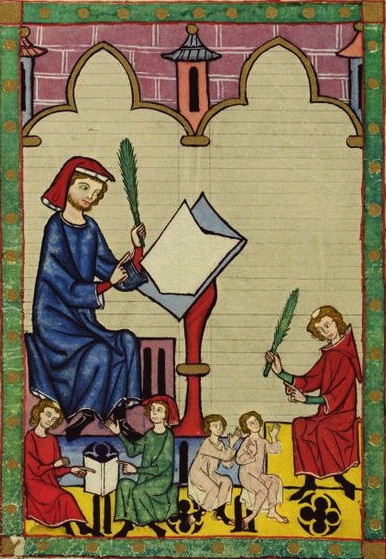 |
| They get smaller every year. Codex Manesse (c. 1304) |
“Statute Forbidding Any One to Annoy or Unduly Injure the Freshmen. Each and every one attached to this university is forbidden to offend with insult, torment, harass, drench with water or urine, throw on or defile with dust or any filth, mock by whistling, cry at them with a terrifying voice, or dare to molest in any way whatsoever physically or severely, any, who are called freshmen, in the market, streets, courts, colleges and living houses, or any place whatsoever, and particularly in the present college, when they have entered in order to matriculate or are leaving after matriculation.”
Leipzig University Statute (1495)
+++++++++++++++++++++++++++++++++++++++++++++++++
Edited by Elizabeth Archibald, who has a Ph.D. in History with a focus on early medieval education. She teaches at the Peabody Institute of the Johns Hopkins University. Read more at: http://askthepast.blogspot.com/p/blog-page.html
In case you’ve been wondering, “Where’s Lindsay?”
It’s Monday morning, and I am far from Oregon and Hood to Coast, but they are in my heart, along with an overflowing serving of gratitude.
First, to Nuun:
Thank you. Thank you for the most amazing four days of fun. Thank you for showing me and the other Hood to Coast team members the time of our lives. Thank you for getting it–for understanding that endurance athletes want a great experience, and delivering it. First, in making a product that makes achieving our goals easier and more enjoyable by giving us a tasty way to hydrate. And more importantly, for getting that the greatest gift you could give the biggest fans of your product is an unforgettable, amazing experience with other people who feel likewise. We don’t need to see your product in a magazine or billboard.. But we love tasting it at the end of a…
View original post 830 more words
How the World Sees US: Matters Not Widely Reported in Mainstream American News Media
Daily Mail — Is it any wonder the world sees the US as it does?
By JEFF MAYSH IN DUNCAN, OKLAHOMA and MEGHAN KENEALLY
PUBLISHED: 08:52 EST, 22 August 2013 | UPDATED: 13:34 EST, 22 August 2013
Follow us: @MailOnline on Twitter | DailyMail on Facebook
Female Soldiers in the Civil War
Female Soldiers in the Civil War
BY SAM SMITH
The outbreak of the Civil War challenged traditional American notions of feminine submissiveness and domesticity with hundreds of examples of courage, diligence, and self-sacrifice in battle. The war was a formative moment in the early feminist movement.

In July of 1863, a Union burial detail at Gettysburg, Pennsylvania made a startling discovery near Cemetery Ridge. Among the bodies covering the ground–the wreckage of the Confederate attacks during the battle–the Union men found a dead woman wearing the uniform of a Confederate private.
The burial detail had stumbled upon one of the most intriguing stories of the Civil War: the multitudes of women who fought in the front line.
Although the inherently clandestine nature of the activity makes an accurate count impossible, conservative estimates of female soldiers in the Civil War puts the number somewhere between 400 and 750. Long viewed by historians as anomalies, recent scholarship argues that the women who fought in the Civil War shared the same motivations as their male companions.
Some women went to war in order to share in the trials of their loved ones. Others were stirred by a thirst for adventure, the promise of reliable wages, or ardent patriotism. In the words of Sarah Edmonds Seelye, also known as Franklin Flint Thompson of the 2nd Michigan Infantry: “I could only thank God that I was free and could go forward and work, and I was not obliged to stay at home and weep.” Seelye holds the honor of being the only woman to receive a veteran’s pension after the war.
++++++++++++++++++++++++++++++++++++++
Read more at http://www.civilwar.org/education/history/untold-stories/female-soldiers-in-the-civil.html
Resources for congregational worship in song
Just another WordPress.com site
It's EVERYBODY'S "Holy Land"
Around the World, or Just in my Thoughts.
Discussing Sites, Peoples, and Events Related to the Bible, Ancient Near East, and Classical Studies
Steve Wolfgang's view of the world from suburban Chicago -- or wherever he may be on any given day
It's about calling.
Steve Wolfgang's view of the world from suburban Chicago -- or wherever he may be on any given day
Executive Director of CSNTM & Senior Research Professor of NT Studies at Dallas Theological Seminary
Steve Wolfgang's view of the world from suburban Chicago -- or wherever he may be on any given day
They hymned their King in strains divine; I heard the song and strove to join.
"I think I can. I think I can. I think I can." -The Little Engine That Could
Steve Wolfgang's view of the world from suburban Chicago -- or wherever he may be on any given day
Comments on the New Testament and Early Christianity (and related matters)


 ἐκλεκτικός