Pay your taxes and do not fear the authorities

Ferrell Jenkins's avatarFerrell's Travel Blog

While reading Romans 13 I came to Paul’s admonition to the saints at Rome, “Would you have no fear of the one who is in authority? Then do what is good.” My mind immediately turned to the mosaic which was discovered during the excavation of the Byzantine public area at Caesarea Maritima.

The context in Paul’s Epistle to the Romans reads this way.

For rulers are not a terror to good conduct, but to bad. Would you have no fear of the one who is in authority? Then do what is good, and you will receive his approval, for he is God’s servant for your good. But if you do wrong, be afraid, for he does not bear the sword in vain. For he is the servant of God, an avenger who carries out God’s wrath on the wrongdoer. (Romans 13:3-4 ESV)

The sign at the site describes the building…

View original post 48 more words

James Harold Wolfgang (1922-2015) – A Remembrance

James Harold Wolfgang (1922-2015) – A Remembrance by James Stephen Wolfgang

Remarks read at my father’s funeral, which included hymns, selected by the family from a list of those Dad often led, sung by the audience: Soldiers of Christ, Arise! — There Is a Habitation — In the Morning of Joy

Many thanks to my friend David Malcomson, a deacon at the church of Christ in Downers Grove, who has come down from the western suburbs of Chicago to lead us in song today; and to Josh Coles for his remarks. My brother John also has some comments to follow after I finish. Josh’s remarks reminded me in part of the inscription on the grave marker of the original Wolfgang ancestor, Johann Nicolaus Wolfgang (1711-1790), nine generations before me, who came through the port of Philadelphia in 1732 and settled in the Pennsylvania “Dutch” (Deutsch) area near Lancaster and York, PA – where he lived and farmed when the Continental Congress fled when chased out of Philadelphia by the British Army during the American Revolution. If you were to go to the old Stone Church in southern Pennsylvania, near the Mason-Dixon line, you would read on his marker the sobering admonition, in German, roughly translated as: “Take heed, all who pass by – this too shall be your end.”

And thank you all for coming so that we might pay proper respect to my father, and remember his life’s work. I want to share, briefly, some memories of my Dad, distilled to two pages. While it is my intent to praise him with recollections of fond memories, I know well that my father was not perfect, and he would have no wish to make him so. To repeat a phrase, I would not enlarge him in death beyond what he was in life, but rather remember him simply as a good and decent man. In many ways, he was an ordinary guy who, with the help of the Lord and my mother, accomplished some extra-ordinary things – chiefly through his diligent devotion to Christ, and to Christ’s church.

Upon reading my father’s obituary, my good friend Matt Bassford wrote, “May the Lord feature as prominently in all our obituaries!” Another old friend, Mike Willis, remarked, “This world no longer held anything for him.” Due respect to Mike, that is true – with one major exception: my mother, Jean, the apple of his eye, the love of his life, his bride of 68 years, whom I heard him praise frequently to us, his children, and others, as the source of much of whatever good our family experienced and accomplished. When Dad was leaving Community Hospital 6 months ago, recovering from the pneumonia which dictated his move to Westminster Village, one of the nurses who had cared for him for a week murmured to my mother, “Not many people can say they have been married to the same person for 68 years!” Indeed.

He was a good Daddy to me – and to my siblings. Despite what my sister Janet may claim about me being the “favorite child,” the truth is that, while as the firstborn “rank doth have its privileges,” they too were treated well (and I note for the record that I WAS outnumbered 2-1)! Dad worked hard to provide his kids with numerous advantages – working overtime to pay for field trips, summer camps and study abroad as far away as Israel; paying private college tuitions because he wished his children to have a spiritual dimension to our education which was not available in less expensive state universities; and providing musical instruments including piano, organ, and various stringed instruments so that our lives could be enriched through the magic of music. In the file of digital photos you will find a picture of John and me standing in front of the shop of William Moening & Sons in Philadelphia – makers and importers of fine, classical musical instruments, which Dad bought for us. I played one of those expensive instruments for several years, and John then took over and performed on it in international competitions as a member of Bruce B. Fowler’s outstanding orchestras in Chicago and elsewhere.

Dad was not naturally musically gifted, but when the opportunity arose to learn how to serve the Lord’s people by leading a congregation in hymn worship, he devoted countless hours to learning and mastering the skill sets necessary to properly sound the pitch of a hymn and then direct it – LEAD! – with the correct beat pattern, thus uniting a congregation in melodious harmony. Under the instruction of several Christians who were also graduates of the renowned Indiana University School of Music, Dad became, in the words of one Christian who sang under his direction, “a great song leader.” While I too have learned about music from similarly-gifted music teachers, much of what I know about leading a congregation in song I learned first from James H. Wolfgang.

Dad inherited from his father, James O. Wolfgang, a love of intricate and interrelated machinery of many kinds, from the small-but-complex single-lens reflex camera he used often and cared for lovingly, to the huge multi-color web presses at the Indianapolis Star – huge machines which drank ink by the barrel and were fed forests of pulp so that Hoosiers could “read all about it” –which Dad took his son to observe and instruct in the chemistry of proper ink-and-water balance and other matters. In childhood I became fascinated with the marriage of man and machine, watching James H. Wolfgang, master of his craft, operate the one-man letter-press which resided in the basement of our house on Eustis Drive – each page carefully (and dangerously) hand-fed between speedy revolutions of cast-iron heavy metal. A careless person could easily mangle a hand – but Dad was not careless. While I never came close to mastering type-setting from a California job case, it was fascinating and challenging to try to learn it under his expert tutelage.

When the time came – dictated by changes which produced the transition of the printing craft from mechanical to digital, mandating the passing of a technological era – and led to his press being broken in pieces (an event I think I may have experienced more as a tragedy than did he), he said, simply, “I have no need of it any longer.” My Dad’s press was “rescued” and, in a sense immortalized, by a photo taken by Don Distel, my cousin Janet Jane’s husband – a photo which evermore graces the cover of a Howard Sams textbook, ironically, about HTML.

Dad’s love of fine machinery extended to his automobiles (lately, red Cadillacs), which he treated with lovingkindness. I can recall many a time when, as the oldest child, I was “privileged” to help him wash and wax our cars, with the help of his beloved chamois (a “Shammy” to us Hoosiers!) and a “whisk broom” – terms and items likely unknown to younger generations. He taught me the basics of how an automobile works, what is the use of a timing gun, or the importance of little things like installing a running light in 1961 to make the family car more visible and thus safer. One of my favorite memories was the winter we spent significant time together while constructing and assembling a 1/8-size, moving-parts model of an internal combustion engine.

Dad was a teacher of other things as well. Together, he and another Little League coach stayed late to help me overcome my petrification of being hit by a pitch hurled with all the precision of a 9-year-old’s arm. Imagine my joy to discover that I could actually hit the ball before it hit me – and could become a pretty fair hitter. Much more significantly, my first glimmer of the profundity of the concept of “justification by faith” came in a teenage class he taught on the book of Romans. Try doing that with a class of rowdy teens and you will not only discover the difficulty, but test patience and endurance as well!

In class teaching, functioning first as a deacon and then as an elder in two congregations, and serving as trusted treasurer of two churches, Dad did, as someone put it recently, “much of the unseen ‘grunt work’” which is necessary for any organization to function properly. He thus provided services and opportunities for others to worship God – including those who too often show up only to observe and criticize. Dad did this not because he craved the limelight, but because he knew that “a servant is not greater than his Master.” In the digital video, John included a photo of him working at his “desk” – the dining room table – where he sat to write out the monthly checks for evangelists supported by the church. Anyone who has preached, or was raised in a minister’s household, well understands the importance of maintaining that lifeline as Dad did – timely and regularly. I can recall him sitting us down, map of the world in hand, to show us where those checks went: “this one goes to Leslie Diestelkamp in Nigeria” or one “to Gordon Pennock in North Dakota,” or “that one to Piet Joubert in South Africa” or men in Japan or the Philippines or “parts unknown.” Talk about a powerful lesson in enabling others to evangelize overseas!

That dining room table was also an instrument of hospitality, another important lesson taught us by both my Dad and Mom. To be able to sit at table and share conversation – and the delicious food that Mom prepared! – with the likes of a James R. Cope, or Franklin T. Puckett, or a Robert F. Turner – preachers of renown in bygone days who are now largely forgotten by successive generations; men of wit and verbal skill and Godly devotion – made a lasting impression on me. And my parents’ “hospitality” extended outside the home: a recent visitor to Eastside described for me how meaningful it was to see both of my aged parents “wobble,” as she put it, “on their walkers, all the way across the building to greet me.” Small acts of kindnesses do live on in the memory of others. Thank you, Daddy!

“Let us now praise famous men, and our fathers that begat us” (Sirach 44:1).
A Hymn For Today – Forever With the Lord

FOREVER WITH THE LORD

“Forever with the Lord!”
Amen, so let it be!
Life from His death is in that word –
‘Tis immortality.
Here in the body pent,
Absent from Him I roam,
Yet nightly pitch my moving tent
A day’s march nearer home

My Father’s house on high,
Home of my soul, how near
At times, to faith’s foreseeing eye,
Your golden gates appear!
Ah! then my spirit faints
To reach the land I love,
The bright inheritance of saints,
Jerusalem above.

“Forever with the Lord!”
Forever in His will,
The promise of that faithful word,
Lord, here in me fulfill.
With You at my right hand,
Then I shall never fail.
Uphold me, Lord, and I shall stand;
Through grace I will prevail.

So when my latest breath
Breaks through the veil of pain,
By death I shall escape from death,
And life eternal gain.
That resurrection word,
That shout of victory:
Once more, “Forever with the Lord!”
Amen, so let it be!

SMD (6.6.8.6.D) – James Montgomery, 1835                                                                                                                    Tune: TERRA BEATA – Franklin L. Sheppard, 1915                                                                                                                # 695 in Psalms, Hymns, and Spiritual Songs, 2012

A HYMN FOR TODAY – God of the Living, In Whose Eyes

I posted this on March 27, 2013 — almost 2 years ago — and it seems appropriate to reblog it now.

stevewolfgang's avatarἐκλεκτικός

A HYMN FOR TODAY

God of the living, in whose eyes

Unveiled, Thy whole creation lies;

All souls are Thine; we must not say

That those are dead who pass away.

From this our world of flesh set free,

We know them living unto Thee.

Released from earthly toil and strife,

With Thee is hidden still their life;

Thine are their tho’ts, their works, their pow’rs,

All Thine, and yet most truly ours;

For well we know, where’er they be,

Our dead are living unto Thee.

Not spilled like water on the ground,

Not wrapped in dreamless sleep profound,

Not wandering in unknown despair,

Beyond Thy voice, Thine arm, Thy care;

Not left to lie like fallen tree –

Not dead, but living, unto Thee.

Thy Word is true, Thy will is just;

To Thee we leave them, Lord, in trust;

And bless Thee for the love which gave

Thy…

View original post 75 more words

Parable of Immortality

Parable of Immortality

I am standing upon the seashore.

A ship at my side spreads her white sails to the morning breeze and starts for the blue ocean. She is an object of beauty and strength, and I stand and watch until at last she hangs like a speck of white cloud just where the sea and sky come down to mingle with each other.

Then someone at my side says, “There she goes!”

Gone where? Gone from my sight . . . that is all.

She is just as large in mast and hull and spar as she was when she left my side and just as able to bear her load of living freight to the place of destination. Her diminished size is in me, not in her.

And just at the moment when someone at my side says, “There she goes!” there are other eyes watching her coming . . . and other voices ready to take up the glad shout . . . “Here she comes!”

This poem, variously attributed to Henry Van Dyke and Luther Beecher (cousin of Henry Ward Beecher), has been oft-quoted and by some considered overused. But it has been meaningful to me, even before my days as board chair of our local Hospice – with which it is sometimes associated – in  Kentucky, before we moved to Chicago. It is even more so now, on the occasion of my father’s passing. Whoever wrote it, it seems an apt, though imperfect analogy of how we experience the departure of a loved one.

There are, course, many other hymns and other poetic expressions, describing the experience – to say nothing of Scripture. In the words of hymnist Tillit S. Teddlie: “Loved ones are waiting and watching my coming” (Heaven Holds All To Me, 1932).

For more on the poem – sometimes titled “What Is Dying?” – see http://dallaslibrary2.org/blogs/bookedSolid/2014/04/i-recently-heard-the-poem-the-parable-of-immortality-in-searching-the-internet-i-found-it-attributed-to-henry-van-dyke-bishop-charles-henry-brent-and-even-victor-hugo-i/

Books As Friends


Here’s the fairly well-known account of J.W. McGarvey’s farewell to his “friends” (his books) from the Facebook page, “Friends of the Restoration.” As someone on the page observed, “One who does not have them cannot understand the sentiment involved.”

https://books.google.com/books?id=zITVAAAAMAAJ&printsec=frontcover&dq=%22lands+of+th One who does not have them cannot understand the sentiment involved e+bible%22+mcgarvey&hl=en&sa=X&ei=GAAGVbLpFe_dsAS44IKgAQ&ved=0CB4Q6AEwAA#v=onepage&q=%22lands%20of%20the%20bible%22%20mcgarvey&f=false

“I had already been upstairs in my library to take a last look there, and as I gazed upon the rows of familiar books I said within myself, ‘goodbye, my dear old friends; and if I never see you again, God bless you for the good you have done me and the happy hours we have spent together.” (Lands of the Bible, p. 387).

Solomon’s Quarries discovered by American Medical Doctor J. T. Barclay

Ferrell Jenkins's avatarFerrell's Travel Blog

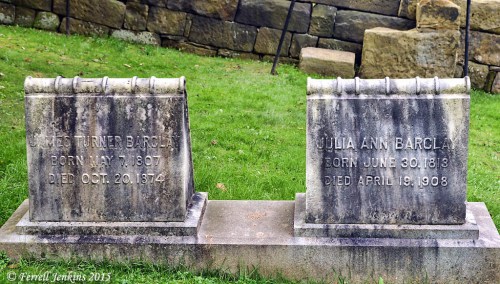
Dr. James Turner Barclay was sent to Jerusalem by the American Christian Missionary Society in 1851 as a medical and evangelistic missionary. During his first trip he stayed until 1854 and  returned for a second stint from 1858 to 1861. Barclay was active in medical work, treating more than 2,000 cases of malaria during his first year in the city.

Grave stone of James T. Barclay, and his wife Julia, in the Campbell Cemetery at Bethany, WVA. Photo by Ferrell Jenkins. Grave stone of Dr. James T. Barclay, and his wife Julia, in the Campbell Cemetery at Bethany, West Virginia. Photo by Ferrell Jenkins.

Barclay wrote a book in 1858 about the city of Jerusalem under the title The City of the Great King; or, Jerusalem As It Was, As It Is, and As It Is To Be. In it he tells about some of his explorations in and around the Old City. In a section dealing with nether Jerusalem he discusses the discovery of what is commonly called Solomon’s Quarry…

View original post 495 more words

Traveling Music (ReMix)

Here is yet another iteration of a “re-run” post from a different venue several years ago, engendered this time by scanning old iPod tracks on the ever-more-repetitious journey down I-65 from Chicago to Indianapolis.  It is likely just babel/babble to anyone but me.  FWIW.

Mumford and Sons – Babel – ROCKS!

But it also engenders reservations, similar to their first album, about which I posted the following on 21 January 2011.

In an earlier post I mentioned listening to the musical group, Mumford & Sons while driving near the end of long trip.  Due to some questions, I took it down, lest anyone think I condone the use of profanity on that CD (Sigh No More).  I do not.  Here’s a response of sorts to some of the questions:

Presumably most people understand that mentioning a group, person, or work of art does not imply endorsement of everything in, on, or about it.  The track Timshel, referencing Genesis 4 and resonating Steinbeck’s East of Eden, does not imply endorsement of Steinbeck or all that is in the book.  Quoting a commentary on Genesis 4 does not mean accepting or recommending everything in it.  This is, one hopes, elementary for anyone willing to think about it.

I’m a sucker for clever lyrics, especially those with religious implications – even cryptic ones (especially when married to great harmonious melodies).  Who could not like the opening lines of the first track: “Serve God, love me, and mend – this is not the end…Sigh no more, no more.  One foot in sea and  one on shore.  My heart was never pure – You know me.”   Or, “If only I had an enemy bigger than my apathy I could have won” (from “I Gave You All”).

Or this:  “You told me that I would find a hole Within the fragile substance of my soul, And I have filled this void with things unreal And all the while my character it steals”  — followed by, “It seems all my bridges have been burned, But you say that’s exactly how this grace thing works – It’s not the long walk home that will change this heart, But the welcome I receive with the restart” (Roll Away Your Stone).

However, admixed with admirable thoughts expressed with dexterity are others of a baser sort…of infidelity and betrayal, doubt and denial.  Of course, many people, even those of strong faith, have experienced such thoughts and possibly even behaviors, as we succumb to various temptations to one degree or another.

Most vexing and disturbing is the gratuitous use (in Little Lion Man, CD track 7) of a common vulgarism meant to describe one of the most divinely pleasurable of human experiences – made into a cheap swear-word.  That is, of course the nature of profanity – taking something which is a should be special or limited to particular circumstances and profaning it by making it common or ordinary.  As several before me have noticed, if one wished to express extreme displeasure, one could at least use something REALLY unpleasant, like “Audit you, buddy!”

I realize one can hear such vulgarities at the mall or at a high school sporting event (to say nothing or college or pro games).  But it pains me to spend money to download or rip such junk.  One man’s opinion.

Other issues raised by such questions include how those who find such things objectionable should react.  Bury head in sand and ignore?  Boycott?  Draw up the bridge and retreat behind the moat?  Or recognize and engage when possible?  Do we read only that which has no objectionable material?  Hard to come by.  Can we be “fans” only of athletes, teams, or artists without flaw?  Good luck.

Late night thoughts from a fried brain at the end of a long day. Anybody want to sound off on this?  No obligation.

(A closing thought:  It is sobering, when contemplating passing an 18-wheeler in snow, to hear lyrics like, “In these bodies we will live, in these bodies we will die…for you were made to meet your maker.”  Hmmmmm)


Assyrian Nimrud (Calah) destroyed

Tragic.

Ferrell Jenkins's avatarFerrell's Travel Blog

The phrase “Assyrian Triangle” came to be used of three famous Assyrian cities of northern Mesopotamia: Nimrud, Khorsabad, and Nineveh. I think an understanding of this helps when we study Jonah 3:3.

Then the word of the LORD came to Jonah the second time, saying, 2 “Arise, go to Nineveh, that great city, and call out against it the message that I tell you.” 3 So Jonah arose and went to Nineveh, according to the word of the LORD. Now Nineveh was an exceedingly great city, three days’ journey in breadth. (Jonah 3:1-3 ESV)

Parrot says that the word Nineveh might have been understood by those living far away from Assyria by what we now call “‘the Assyrian triangle’ which stretches from Khorsabad in the north to Nimrud in the south, and with an almost unbroken string of settlements, covers a distance of some twenty six miles” (Nineveh and the Old…

View original post 291 more words

“You shall not steal…You shall not covet”

Ferrell Jenkins's avatarFerrell's Travel Blog

“You shall not steal. “You shall not bear false witness against your neighbor. “You shall not covet your neighbor’s house; you shall not covet your neighbor’s wife, or his male servant, or his female servant, or his ox, or his donkey, or anything that is your neighbor’s.” (Exodus 20:15-17 ESV; cf. Romans 13:9)

The Ten Commandments, given to the nation of Israel, were clear about the attitude one should take toward the property belonging to others. Coveting causes one to desire the wife, or the property, of another man.

The reason the donkey and ox of another was not to be coveted or stolen was because these were the man’s means of income. How could he work without his donkey or ox?

A loaded donkey at Seleucia. Photo by Ferrell Jenkins. A loaded donkey at Seleucia. Photo by Ferrell Jenkins.

It may be that none of my readers own a donkey or an ox, but the principle is clear. You shall not…

View original post 533 more words