Todd Bolen tells the backstory of BiblePlaces Photos

From Ferrell Jenkins’ blog

Ferrell Jenkins's avatarFerrell's Travel Blog

This morning I was pleased to receive the BiblePlaces Newsletter (Vol 19, #1). In it Todd Bolen reminds us that “twenty years ago this month, BiblePlaces.com was born.” He provides us with a brief history of the development of his Photo Collections.

The Pictorial Library of Bible Lands. The Pictorial Library of Bible Lands – 18 volumes.

If you have ever used the images in The Pictorial Library of Bible Lands (now 18 volumes), The Photo Companion to the Bible, or one of the other resources developed under Bolen’s leadership, you know how valuable the material can be in teaching the Bible.

Bolen observes that he bought one of the set of 100 slides that used to be hawked by the guides on tours of Israel. My experience was much the same. Indeed, even if the photos were good but the quality of the duplication was not good.

I trust I have said enough…

View original post 104 more words
Ferrell’s Favorite Foto # 33 – Cave of Adullam

Ferrell Jenkins's avatarFerrell's Travel Blog

In 2011 Leon Mauldin and I make arrangements to visit Tel Adullam and the Cave of Adullam. I had gathered some information from Prof. Carl Rasmussen and Gordan Franz about locating the site. We secured the services of a guide from the small town of Aderet, a moshav on the north side of Adullam. She took us to the site in a four-wheel drive vehicle and explained what we were seeing.

Tel Adullam is near the Valley of Elah where David had met and defeated Goliath (1 Samuel 17).

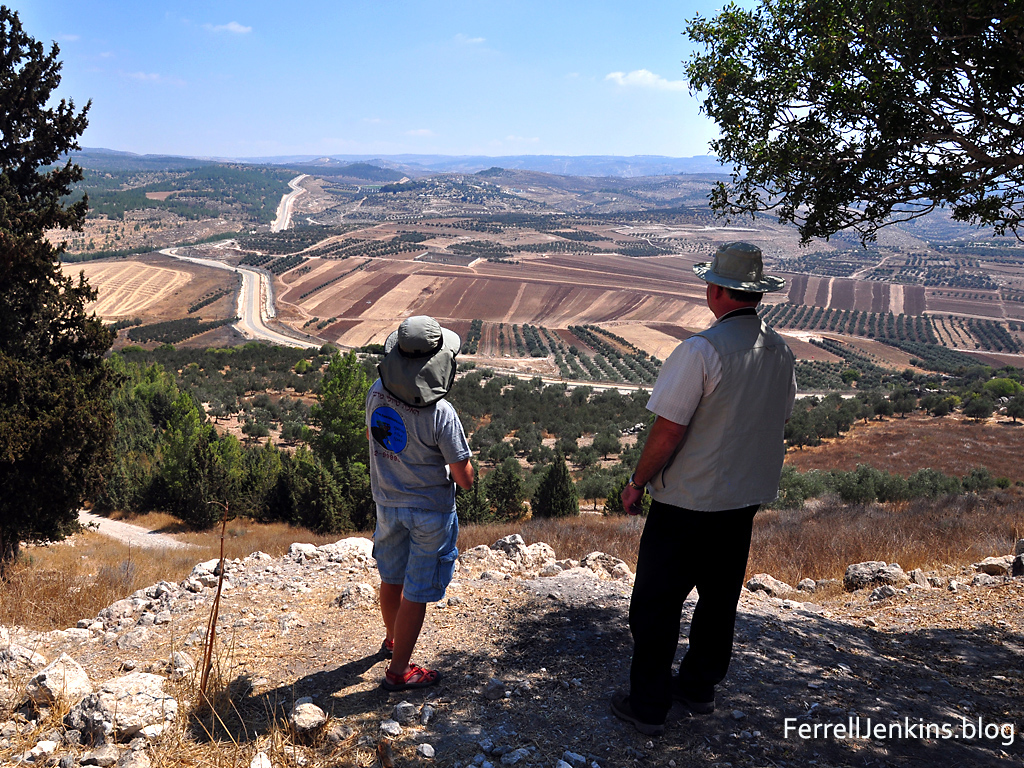
View from Tel Adullam. Photo: ferrelljenkins.blog. Daphna, our guide, and Leon look east from Tel Adullam. Notice the central mountain range in the distance. Photo by Ferrell Jenkins.

Once we reached the forested mound we enjoyed a wonderful view to the east, and south. Our guide, Daphna, inquired first about our interest in the site. How did we even know about the site, she wondered. She is…

View original post 371 more words

New BiblePlaces photo collection of Persia

LukeChandler's avatarBible, Archaeology, and Travel with Luke Chandler

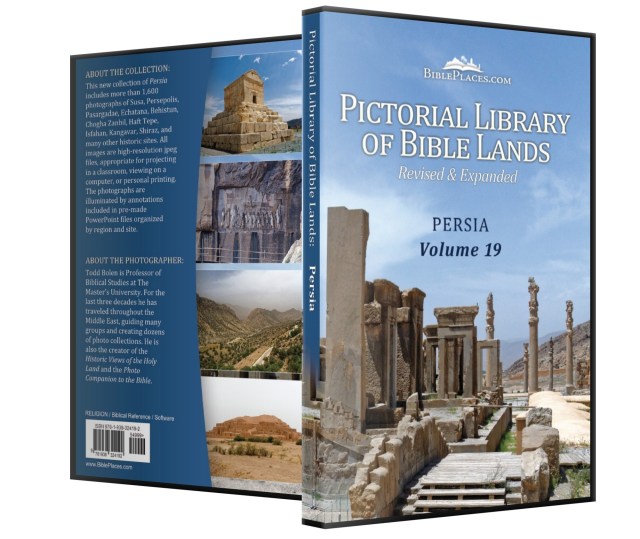
The fabulous BiblePlaces photo collection has a new addition most of us would not have expected to see. A 1,600 high-res photo volume on Persia is now available for purchase at the introductory price of just $25.

PersiaPLBLCoverCropped The new Persia volume of the BiblePlaces photo collection

Ancient Persia is of course modern Iran, which brings political barriers for many Western travelers, particularly from the United States. Todd Bolen was able to visit earlier this year and describes his experience in the new BiblePlaces newsletter.

… The trip was everything I could have hoped for and more. I was able to visit every site on my itinerary, following in the footsteps of such figures as Cyrus, Darius, Xerxes, and Artaxerxes. I saw the famous Behistun Inscription, walked around one of the best preserved ziggurats, explored numerous museums, and marveled at the well-preserved tomb of King Cyrus. You can still see the…

View original post 263 more words

Trephination was not that uncommon

Ferrell Jenkins's avatarFerrell's Travel Blog

Archaeologists working at Tel Megiddo excavated skeletons of two brothers from the Canaanite (Late Bronze) period dating to about 3,500 years ago,  who had a “complex medical procedure” known as trephination (or trephanation). An article in Haaretz includes several nice photos in the Premium Magazine here.

A few years ago Leon Mauldin and I traveled to some of the cities along the Turkish Black Sea Coast that may have been associated with the delivery of Peter’s epistles. See the  index of my articles here. In Samsun we visited the small archaeological museum and noted some skulls from Ikiztepe that had undergone the medical practice of trephination.

Ancient brain surgery that cut a hole in the skull to relieve pressure is referred to as trepination. A few of the skulls found at Ikiztepe are displayed in the museum. They are said to belong to Bronze Age III…

View original post 183 more words

“I will make your enemies your footstool”

“A common motif found in Ancient Near East reliefs shows a monarch placing his foot on his enemy. One illustration of this is the large relief showing the Assyrian King Tiglath-Pileser III (reigned 745-727 B.C.) with his foot on the neck of an enemy. Tiglath-Pileser III is known as Pul in the Bible.”

Ferrell Jenkins's avatarFerrell's Travel Blog

A common motif found in Ancient Near East reliefs shows a monarch placing his foot on his enemy. One illustration of this is the large relief showing the Assyrian King Tiglath-Pileser III (reigned 745-727 B.C.) with his foot on the neck of an enemy. Tiglath-Pileser III is known as Pul in the Bible.

Pul the king of Assyria came against the land, and Menahem gave Pul a thousand talents of silver, that he might help him to confirm his hold on the royal power. (2 Kings 15:19 ESV)

So the God of Israel stirred up the spirit of Pul king of Assyria, the spirit of Tiglath-pileser king of Assyria, and he took them into exile, namely, the Reubenites, the Gadites, and the half-tribe of Manasseh, and brought them to Halah, Habor, Hara, and the river Gozan, to this day. (1 Chronicles 5:26 ESV)

The Assyrian relief below is displayed in…

View original post 227 more words

Mount Arbel and the Sea of Galilee

Ferrell Jenkins's avatarFerrell's Travel Blog

Our photo today was made from NW of the Sea of Galilee. The formation on the right is known as Mount Arbel. The agricultural area you see slopes down to the Plain of Gennesaret which stretches about 2½ miles to the Sea (Matthew 14:34).

View of Mount Arbel and the Sea of Galilee from the NW. Photo by Ferrell Jenkins. View of Mount Arbel and the Sea of Galilee from the NW. Photo by Ferrell Jenkins.

Across the Sea of Galilee is a portion of the Golan Heights, known in Old Testament times as Bashan. This territory was taken by Israel from Og the king of Bashan and eventually became territory belonging to the tribe of Manasseh.

Then they turned and went up by the way to Bashan. And Og the king of Bashan came out against them, he and all his people, to battle at Edrei. But the LORD said to Moses, “Do not fear him, for I have given him into your hand…

View original post 90 more words

Have you seen “Following the Messiah”?

Ferrell Jenkins's avatarFerrell's Travel Blog

Many of our readers have likely seen some of the new videos produced by Appian Media. Following a fundraising campaign a small group, including two professional producers and a cinematographer, visited Israel to film places associated with the ministry of Jesus.

Jeremy Dehut, a minister in Alabama, was so impressed with his visit to Israel a few months earlier with Barry Britnell he convinced his brother Craig, Stuart Peck, and Jet Kaiser, to join him and Britnell in this undertaking. These guys are not filming with their iPhone. Take a look as they get organized for one of their international flights. When you view some of the videos you will see the quality.

The Appian Media film crew gets ready for an international flight. The Appian Media film crew gets ready for an international flight.

After a fundraiser this team made their trip to Israel and then spent months editing the large amount of video into this series of videos…

View original post 144 more words

Where the Romans breached Jerusalem wall

Ferrell Jenkins's avatarFerrell's Travel Blog

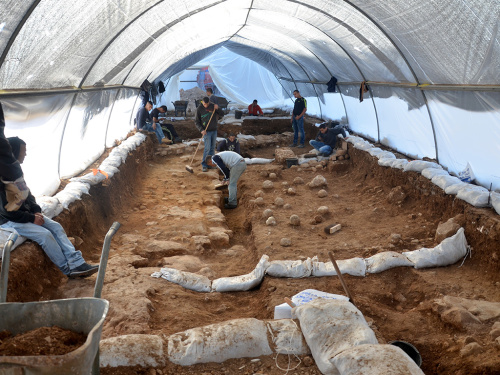
There is abundant evidence of the presence of the Romans in Jerusalem and the land they would later call Palestine. Now comes specific evidence of the place where Titus’ army breached the Third Wall of the city.

The excavation site in the Russian Compound. One can see the sling stones on the floor, which are tangible evidence of the battle that was waged here 2,000 years ago. Photographic credit: Yoli Shwartz, courtesy of the Israel Antiquities Authority. The excavation site in the Russian Compound. One can see the wall and sling stones on the floor, which are tangible evidence of the battle that was waged here 2,000 years ago. Photographic credit: Yoli Shwartz, courtesy of the Israel Antiquities Authority.

The Israel Antiquities Authority released this information earlier today.

— “ —

Impressive and fascinating evidence of the battlefield and the breaching of the Third Wall that surrounded Jerusalem at the end of the Second Temple period was uncovered last winter in the Russian Compound in the city center. The finds were discovered in an archaeological excavation the Israel Antiquities Authority conducted in the location where the new campus of the…

View original post 553 more words

Leichty: “We have forty thousand of these things here”

Ferrell Jenkins's avatarFerrell's Travel Blog

The Agade list reports the passing Monday night of Dr. Erle Verdun Leichty (1933-2016), Emeritus Professor of Asian and Middle Eastern Studies (Assyriology) at the University of Pennsylvania.

The announcement says,

In 2006, a number of colleagues and students banded together to produce “If a Man Builds a Joyful House. Assyriological Studies in Honor of Erle Verdun Leichty” (Brill). This volume is available for download at < http://tinyurl.com/zgdf9pb>. In it, his Penn colleague Barry Eichler tells about “Cuneiform Studies at Penn: From Hilprecht to Leichty,” where can also be found details on Leichty’s fine career and contributions.

I did not know Dr. Leichty, but did have a chance meeting with him at the University of Pennsylvania Museum of Archaeology and Anthropology in 2004. I was looking for a particular ancient document and inquired of the staff. They could not provide the answer but said that Dr. Leichty might be…

View original post 154 more words

Statue of an Egyptian official found at Hazor

Hazor excavations – from Ferrell Jenkins’ blog

Ferrell Jenkins's avatarFerrell's Travel Blog

Hebrew University announces this morning the discovery of a statue of an Egyptian official at Tel Hazor.

— “ —

Jerusalem, July 25, 2016 — In a historic find, a large fragment of an Egyptian statue measuring 45 X 40 centimeters [about 18 x 16 inches], made of lime-stone, was discovered in the course of the current season of excavations at Tel-Hazor, north of the Sea of Galilee in Israel. Only the lower part of the statue survived, depicting the crouching feet of a male figure, seated on a square base on which a few lines in the Egyptian hieroglyphic script are inscribed.

The archaeologists estimate that the complete statue would equal the size of a fully-grown man. At present only a preliminary reading of the inscriptions has been attempted, and the title and name of the Egyptian official who originally owned the statue, are not yet entirely clear.

The…

View original post 912 more words