Rare hoard of coins from pre-AD 70 discovered near Jerusalem-Tel Aviv highway

Ferrell Jenkins's avatarFerrell's Travel Blog

The Israel Antiquities Authority announces today the discovery of a box containing 114 bronze coins dating to Year Four of the Great Revolt (Jewish Revolt against the Romans). The discovery was made several months ago during work on the new Highway 1 project (between Jerusalem and Tel Aviv).

Coin hoard as it was found in the excavation. Photo Vladimir Nuhin, IAA. Coin hoard as it was found in the excavation. Photo Vladimir Nühin, IAA.

According to Pablo Betzer and Eyal Marco, excavation directors on behalf of the Israel Antiquities Authority, “The hoard, which appears to have been buried several months prior to the fall of Jerusalem, provides us with a glimpse into the lives of Jews living on the outskirts of Jerusalem at the end of the rebellion. Evidently someone here feared the end was approaching and hid his property, perhaps in the hope of collecting it later when calm was restored to the region”. All of the coins are stamped on one…

View original post 324 more words

Grid 20 – The “Snake Tower”

Digging with Trent and Rebekah

New excavations at Tel Achziv (Achzib)

Ferrell Jenkins's avatarFerrell's Travel Blog

The Nelson Glueck School of Archaeology, Hebrew Union College, and the French Research Center at Jerusalem has announced the first season of an Israeli-French mission at Tel Achziv from June 29 to July 9. This announcement is from Yifat Thareani, one of the directors of the dig. (HT: Jack Sasson).

The town of Achziv (English Bibles use Achzib) is located on the Mediterranean coast of Western Galilee about 9 miles north of Acco (Akko, Acre = Ptolemais). This is in the northern portion of the Plain of Acco.

Achziv was assigned to the tribe of Asher (Joshua 19:29; Judges 1:31), but Asher was not able to drive out the Canaanite inhabitants of the land.

Asher did not drive out the inhabitants of Acco, or the inhabitants of Sidon or of Ahlab or of Achzib or of Helbah or of Aphik or of Rehob, (Judges 1:31 ESV)

Achziv remained primarily…

View original post 283 more words

July 4th at Lachish

July 4th is celebrated by Americans all over the world ….

Ferrell Jenkins's avatarFerrell's Travel Blog

In the previous post I mentioned that several former students and friends are participating in the dig at Tel Lachish this year.

Six years ago on this day I wrote about Lachish on July 4th, 1980. Since we have many more readers now I think it appropriate to re-post that entry here.

— • —

On July 4, 1980, I was participating in the excavation at Tel Lachish in Israel along with three of my colleagues from Florida College (James Hodges, Phil Roberts, and Harold Tabor). There were sizable numbers of participants from Israel, United States, Australia, South Africa, and Germany. In addition to the hard work out in the sun, we had some fun. On the morning of July 4th a few of the guys got an American flag and put together a drum and bugle corp and marched across the tel. Note especially the plastic bucket being used…

View original post 413 more words

Visualizing Isaiah 36: Hezekiah and Sennacherib

This installment regarding Isaiah’s prophecies features the “Sennacherib Prism” — one of which is in the University of Chicago’s Oriental Institute, and featured in my tours there as a Docent at the OI. Check out other installments on “Ferrell’s Travel Blog.”

Ferrell Jenkins's avatarFerrell's Travel Blog

Two significant historical characters are mentioned together in Isaiah 36. Sennacherib, the king of Assyria from 704–681 B.C., claims to have taken 46 cities of Judah in the days of Hezekiah. The biblical account says,

In the fourteenth year of King Hezekiah, Sennacherib king of Assyria came up against all the fortified cities of Judah and took them. (2 Kings 18:13 ESV)

There are three known clay prisms in which Sennacherib mentions Hezekiah, king of Judah.

  1. The Taylor Prism, in the British Museum
  2. The Oriental Institute Prism in Chicago
  3. The Jerusalem Prism, in the Israel Museum

Sennacherib admits in the prism-account that Hezekiah did not submit to his yoke, but was “shut up in Jerusalem” like a caged bird.

The Jerusalem Prism, now displayed in the Israel Museum, is perhaps the least well-known of the three documents. Our photo shows that document displayed under the replica of the relief of…

View original post 22 more words

“Jesus’ Wife Fragment”: Further Observations

“Jesus’ Wife Allegations Are ‘Misleading Tripe:” Hurtado

larryhurtado's avatarLarry Hurtado's Blog

As a follow-up to my initial observations yesterday, I’ll offer a few more to underscore where I think things are at this point.

  • First, let me reiterate that all references to “The Gospel of Jesus’ Wife” are completely misleading tripe.  What we have is a purported small fragment with several incomplete lines on each side, in which one line contains the words “my wife” ascribed to Jesus there.  If the fragment is authentic (i.e., from some Christian hand ca. 7th-10th century CE, as per the Harvard radio-carbon test), only God knows what it was.  But it’s totally mischievous to claim that it comes from some “Gospel of Jesus’ Wife”.  We have a “Jesus’ Wife fragment.”  That’s it.
  • The most recent palaeographical, chemical and radio-carbon tests reported in the latest issue of Harvard Theological Review support the conclusion that the writing material is old, that the ink seems composed per…

View original post 405 more words

Reading the Blogs # 3

Reading the Blogs # 3

While you’re at it, check out Ferrell’s “Visualizing Isaiah” series on his blog!

Ferrell Jenkins's avatarFerrell's Travel Blog

Michael J. Kruger (canon fodder) has written a review of each episode of the History Channel’s Bible Secrets Revealed. He says the series has reminded him of two critical truths:

1. Our popular culture is prone to distort and misrepresent the teachings of the Bible. I was struck again by how sensationalistic and misleading popular-level programming can actually be when it comes to the Bible.  Although this series had some good moments, as a whole I was disappointed to see the History Channel offer the standard Da Vinci Code-style approach to the Bible.

2. The church must be equipped to respond to these sorts of critiques.  Given the high-profile nature of the History Channel (and similar style programming), the average person we are trying to reach is going to be exposed to this type of material.  And we need to be ready to offer some…

View original post 521 more words

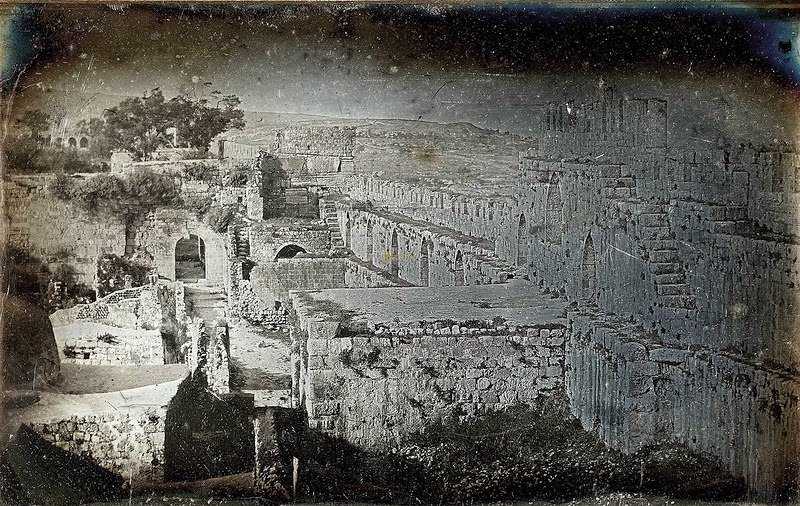
See the First Photographs Ever Taken of Jerusalem | Smart News | Smithsonian

J'lem-Smithsonian-34.jpg.800x0_q85_cropSee the First Photographs Ever Taken of Jerusalem | Smart News | Smithsonian.  http://www.smithsonianmag.com/smart-news/see-first-photographs-ever-taken-jerusalem-180949473/


Southern Gateways of the Levant, Part 2 — Historical Philistia

Southern Gateways of the Levant, Part 1 — Geography of Philistia

Looking forward to having Trent & Rebekah in Chicagoland!