Zondervan Essential Atlas of the Bible

Ferrell Jenkins's avatarFerrell's Travel Blog

Frequently we have mentioned and recommended the Zondervan Atlas of the Bible by Carl G. Rasmussen. Every Bible student needs at least one or two good atlases to assist them in their study of the Scriptures.

Last month I attended some annual professional meetings in Baltimore and was pleased to see that Zondervan already had copies of the new Zondervan Essential Atlas of the Bible. One of the sales reps gave me a copy for review here.

At first appearance, the ZEAB has a beautiful cover of stiff, durable paper. It is a convenient 9 1/8″ x 7 3/8″ in size. The content is basically the same as the larger hard back edition. There has been some editing of the text to condense the book from 303 pages to 159 pages.

There are two major sections to the book: Geographical Section and Historical Section. The Geographical Section includes an Introduction to the…

View original post 256 more words

Footnote 27 – C.S. Lewis: The Discarded Image

Footnote 27 – C.S. Lewis, The Discarded Image: An Introduction to Medieval and Renaissance Literature (Cambridge University Press, 1964), p. 89.

Earlier I posted information about CS Lewis’ death on November 22, 1963. Normally this would have received significant press and public attention – the death of a respected scholar at both Oxford and Cambridge who became a wartime fixture in Britain for his radio discussions during the dark days of World War 2; the former atheist who became of the most significant and widely-read apologists for the truth of Christianity – was “overtaken by events” of the same day.

The significance of CS Lewis as an academician and scholar is sometimes overlooked or dismissed by those who know him only through his more popular apologetics books, or who cavalierly dismiss his views.  But his work as a scholar of medieval literature and the trans-generational and cross-cultural transmission of knowledge is significant.  His posthumously-published work,The Discarded Image (Cambridge University Press, 1964) is one of my “favorites” – describing how medieval texts assimilated the Greco-Roman corpus of “natural history” (what would, in the 19th century, be dubbed “science”) – useful to a green graduate student in the History of Science at Emory University in Atlanta, grappling with bestiaries and other strange accumulations of knowledge. .

As a young man, I once had a flash of insight that youthful hubris allowed me to imagine at the time to be one of the few truly “original” ideas I ever had (everyone should have one or two such ideas in a lifetime, no?) It was the notion that God does not really “foreknow” what happens in the future (as though He were limited to looking at the future through a keyhole, or the “wrong” end of a telescope – actually an apt description of the limited view of prophets and angels described in 1 Peter 1:10-12). Rather, since He is not time-bound, and therefore is already “at” tomorrow, or next year, He knows what decisions I make in my future since he is already “there.” In the same way that I know what choices I made for breakfast this morning (bacon and eggs, cereal, bagel? – ALWAYS go for the bacon, if available), similarly, He knows my “future-to-me” choices, without limiting them in any way. The insight seemed so profound and original at the time…..

Then I encountered Lewis’ comments below, published while I was still a high school kid only beginning to contemplate such matters.  Ah, well….there is no shame in being superseded, or pre-dated, by C.S. Lewis!

Here’s the text:

“God is eternal, not perpetual.  Strictly speaking, He never foresees; He simply sees.  Our ‘future’ is only an area, and only for us a special area, of His infinite Now.  He sees (not remembers) your yesterday’s acts because yesterday is still ‘there’ for him; He sees (not foresees) your tomorrow’s acts because He is already in tomorrow.  Just as a human spectator, by watching my present act, does not at all infringe its freedom, so I am free to act as I choose in the future because God, in that future (His present) watches me acting.”

        C.S. Lewis, The Discarded Image: An Introduction to Medieval and Renaissance Literature (Cambridge University Press, 1964), p. 89.

‘November Twenty Six Nineteen Hundred Sixty Three’ by Wendell Berry & Ben Shahn

‘November Twenty Six Nineteen Hundred Sixty Three’ by Wendell Berry & Ben Shahn

‘November Twenty Six Nineteen Hundred Sixty Three’ by Wendell Berry & Ben Shahn

From Alan Cornett’s blog, Pinstripe Pulpit — read more at:http://pinstripepulpit.com/off-the-shelf-november-twenty-six-nineteen-hundred-sixty-three-by-wendell-berry-ben-shahn/

Wendell Berry’s poem can be read here: http://thenation.s3.amazonaws.com/pdf/jfkpoem1963.pdf

Berry Nov 26 text 1

So much symbolism is bound up in John F. Kennedy it is difficult to separate the myth from the reality. For those my age, and even a decade older, JFK is someone we know only from photographs and old video clips. It is that last video clip from Dallas that transformed the man into the legend.

Wendell Berry, a novelist and poet still in his twenties at the time, was understandably moved. In response to Kennedy’s assassination on November 22, and his state funeral on November 25, Berry wrote his reflections in verse as “November 26, 1963,” a consideration the day after.

Berry Nov 26 text 2

Berry published the poem in The Nation magazine (December 21) where it was read by artist Ben Shahn (1898-1969). Lithuianian born, Shahn’s father had been exiled to Siberia by the czars as a political dissident. Eventually the family emigrated from their homeland to the United States.

Shahn embraced leftist ideology in his politics and social realism in his art. Among Shahn’s famous subjects were Sacco and Vanzetti and, later, Martin Luther King, Jr. for TIME magazine. He was also well-known as a Depression-era photographer for the Farm Security Administration.

Shahn Nov 26 illust horse

Kennedy’s assassination was, then, a perfect subject for Shahn, and Berry’s poem was the perfect vehicle. Shahn writes,

It was shortly after those shattering few days that the following poem appeared in The Nation. I found it extraordinarily moving. It was right in every way; it was modest and unrhetorical. It examined soberly and sensitively just this event in its every detail. Its images were the images of those days, no others. In so sharply scrutinizing his own feelings, the poet has discovered with an uncanny exactness all our feelings. His words have created a certain monument, not pretentious, but real, and shared.

When I read the poem, I wanted it preserved, read, not lost in the pages of a last week’s magazine. I turned it into a book, accompanied by the images that it invokes for me. I have hoped, in some small way, to help monumentalize those days so that we may not so soon become inured to an unacceptable violence, a failure, a profound sadness.

What resulted was a lovely oblong slipcased volume published by George Braziller in May 1964, only Berry’s second book. Shahn frequently used a block style calligraphic text with his artwork, and he employs the technique with great effect here. His hand drawn title fills the front cover, and the text of the poem is rendered in the same style throughout faced with Shahn’s illustrations on the left.

Berry Nov 26 cover

There are two editions, a limited signed edition and a regular trade edition. According to Russell Freedman’s Wendell Berry bibliography, 3013 copies of the limited signed edition were issued, printed on hand laid paper from the Italian mill Fabriano. Somewhat mysteriously, online bookseller Daedalus found a cache of new, uncirculated copies a few years ago, and sold them for a reasonable sum (I’m sure all are long gone now). The trade edition, also slipcased but slightly smaller in size, is fairly easily found for not too much money. The black slipcase is often faded, and the cloth cover is often foxed.

Berry Shahn signatures

As the nation remembers its most recent fallen president, take a moment to read Berry’s thoughtful poem. It well captures the mood of our nation fifty years ago.

Shahn Nov 26 illust color

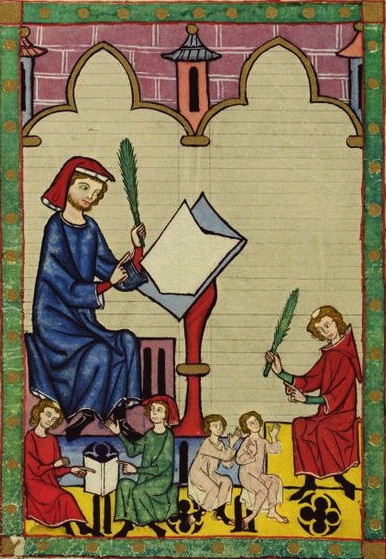
How To Treat the Freshmen — 1495

How To Treat the Freshmen — 1495

From the Blog “Ask the Past: Advice From Old Books”

How to Treat the Freshmen, 1495

See the complete post, and much more, at:

http://askthepast.blogspot.com/2013/08/how-to-treat-freshmen-1495.html

They get smaller every year.
Codex Manesse (c. 1304)

“Statute Forbidding Any One to Annoy or Unduly Injure the Freshmen. Each and every one attached to this university is forbidden to offend with insult, torment, harass, drench with water or urine, throw on or defile with dust or any filth, mock by whistling, cry at them with a terrifying voice, or dare to molest in any way whatsoever physically or severely, any, who are called freshmen, in the market, streets, courts, colleges and living houses, or any place whatsoever, and particularly in the present college, when they have entered in order to matriculate or are leaving after matriculation.”

Leipzig University Statute (1495)

+++++++++++++++++++++++++++++++++++++++++++++++++

Edited by Elizabeth Archibald, who has a Ph.D. in History with a focus on early medieval education. She teaches at the Peabody Institute of the Johns Hopkins University. Read more at:  http://askthepast.blogspot.com/p/blog-page.html

Show and Tell: A Mini-Exhibit in Stone-Campbell Hymnody…reblogged from ACU Special Collections

mac's avatareScriptorium

We had a special treat a few days ago when several participants in the TX Singing School visited Special Collections for a tour.  In response to their request, I pulled several hymnals and related artifacts for a brief show and tell.  We thought you’d like to see the pictures.

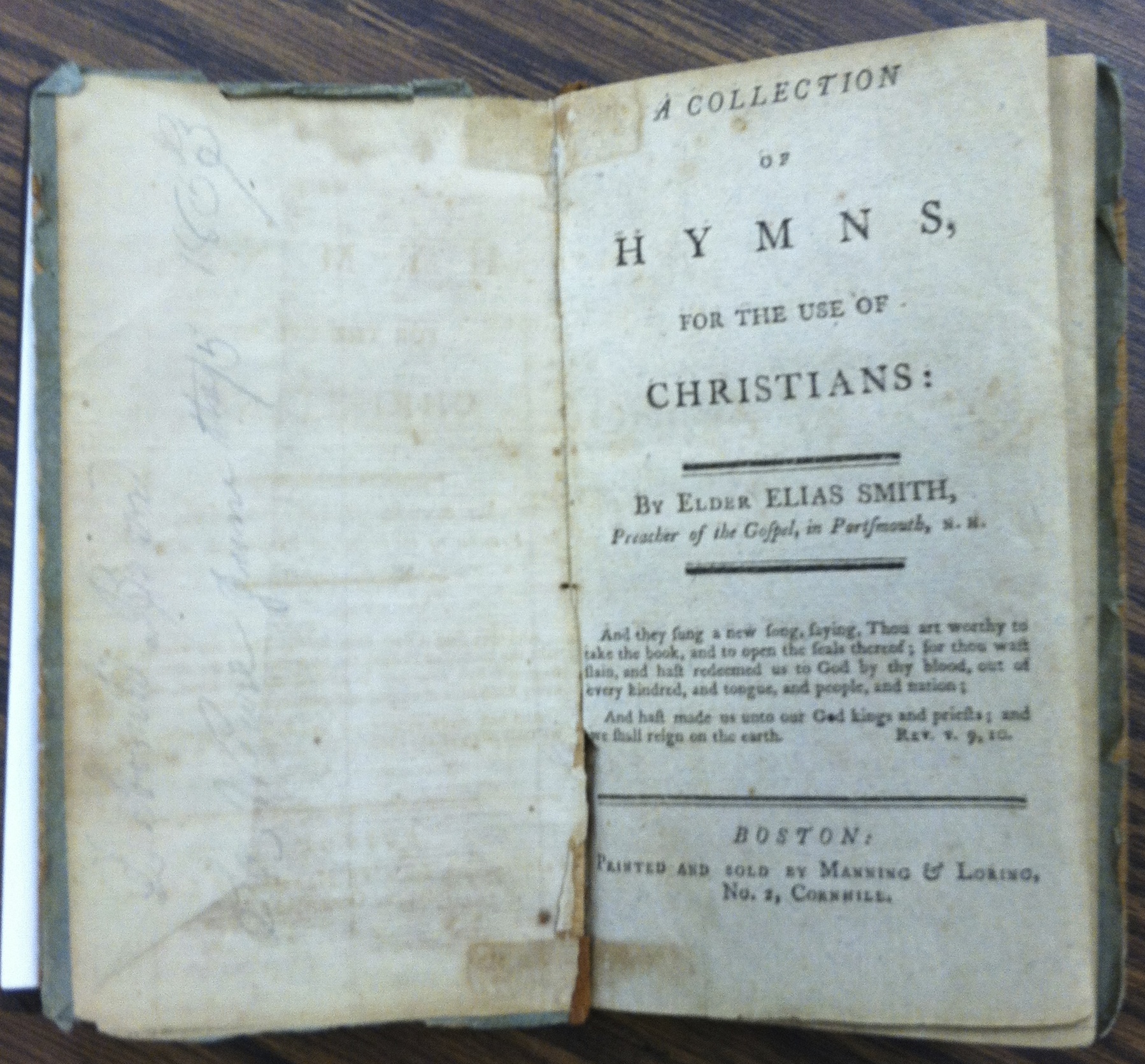
Elias Smith, A Collection of Hymns, for the Use of Christians. Boston: Manning and Loring [1804].

Elias Smith, A Collection of Hymns, 1804

more at ACU Special Collections blog here.

View original post

The Ancient Library of Alexandria: The West’s most important repository of learning

The Ancient Library of Alexandria: The West’s most important repository of learning

The Ancient Library of Alexandria: The West’s most important repository of learning

J. Harold Ellens   •  05/01/2013

J. Harold Ellens’s article “The Ancient Library of Alexandria” originally appeared in Bible Review, along with the sidebars “Greco-Roman Philosophers,” “Whither Aristotle’s Library?” “The Perils of the Alexandria Library: Two Ancient Book-Burnings,” “How to Measure the Earth” and “Alexandria Library Redux.”  

Excerpt follows; read more at http://www.biblicalarchaeology.org/daily/biblical-sites-places/biblical-archaeology-places/the-ancient-library-of-alexandria/

When Alexander the Great died in 323 B.C.E., the Ptolemaic dynasty was given control of Egypt. Ptolemy I (c. 367–283 B.C.E.) established his capital at Alexandria and immediately began to build up the city. Ptolemy’s grandest project, begun in 306 B.C.E., was the Library of Alexandria, a research center that held one million books by the time of Jesus. Scala/Art Resource, NY

——————————————————-

In March of 415 C.E., on a sunny day in the holy season of Lent, Cyril of Alexandria, the most powerful Christian theologian in the world, murdered Hypatia, the most famous Greco-Roman philosopher of the time. Hypatia was slaughtered like an animal in the church of Caesarion, formerly a sanctuary of emperor worship.1 Cyril may not have been among the gang that pulled Hypatia from her chariot, tearing off her clothes and slashing her with shards of broken tiles, but her murder was surely done under his authority and with his approval.

Cyril (c. 375–444) was the archbishop of Alexandria, the dominant cultural and religious center of the Mediterranean world of the fifth century C.E. He replaced his uncle Theophilus in that lofty office in 412 and became both famous and infamous for his leadership in support of what would become known as Orthodox Christianity after the Ecumenical Council of Chalcedon (451), when basic Christian doctrine was solidly established for all time.

Cyril’s fame arose mainly from his assaults on other church leaders, and his methods were often brutal and dishonest. He hated Nestorius, bishop of Constantinople, for example, because Nestorius thought Christ’s divine and human aspects were distinct from one another, whereas Cyril emphasized their unity. At the Council of Ephesus in 431, Cyril arranged for a vote condemning Nestorius to take place before Nestorius’s supporters—the bishops from the eastern churches—had time to arrive. Nor was Cyril above abusing his opponents by staging marches and inciting riots. It was such a mob, led by one of Cyril’s followers, Peter the Reader, that butchered the last great Neoplatonic philosopher, Hypatia.      ……..

One reason Cyril had Hypatia murdered, according to the English historian Edward Gibbon, was that Cyril thought Hypatia had the political ear of Alexandria’s chief magistrate, who vigorously opposed Cyril’s ambition to expel from the city those who held different religious views from his own.  Cyril was also jealous of Hypatia because scholars from all over the world crowded into her lectures in Alexandria, Athens and elsewhere. Socrates (380–450), a church historian from Constantinople, says of Hypatia:

[She] was so learned that she surpassed all contemporary philosophers. She carried on the Platonic tradition derived from Plotinus, and instructed those who desired to learn in…philosophic discipline. Wherefore all those wishing to work at philosophy streamed in from all parts of the world, collecting around her on account of her learned and courageous character. She maintained a dignified intercourse with the chief people of the city. She was not ashamed to spend time in the society of men, for all esteemed her highly, and admired her for her purity.

Hypatia’s father, Theon, was a leading professor of philosophy and science in Alexandria. He had prepared a recension of Euclid’s Elements, which remained the only known Greek text of the great mathematician’s work until an earlier version was discovered in the Vatican Library in this century.  Theon also predicted eclipses of the sun and moon that occurred in 364.

Hypatia, who was born about 355, collaborated with her father from early in her life, editing his works and preparing them for publication. According to one authority, she was “by nature more refined and talented than her father.”7 The extant texts of Ptolemy’s Almagest and Handy Tables were probably prepared for publication by her.8

Such scientific and philosophical enterprises were not new or surprising in Hypatia’s Alexandria, which already boasted a 700-year-old, international reputation for sophisticated scholarship. Founded in 331 B.C.E.9 by command of Alexander the Great, the city contained almost from its beginnings an institution that would remain of immense importance to the world for the next 2,300 years. Originally called the Mouseion, or Shrine of the Muses, this research center and library grew into “an institution that may be conceived of as a library in the modern sense—an organization with a staff headed by a librarian that acquires and arranges bibliographic material for the use of qualified readers.”   ….

Indeed, the Alexandria Library was much more. It “stimulated an intensive editorial program that spawned the development of critical editions, textual exegesis and such basic research tools as dictionaries, concordances and encyclopedias.”11 The library in fact developed into a huge research institution comparable to a modern university—containing a center for the collection of books, a museum for the preservation of scientific artifacts, residences and workrooms for scholars, lecture halls and a refectory. In building this magnificent institution, one modern writer has noted, the Alexandrian scholars “started from scratch”; their gift to civilization is that we never had to start from scratch again.

+++++++++++++++++++++++++++++++++

Notes

a. The best-known book collected from a non-Greek culture and translated into Greek at the library was the Hebrew Bible, known in its Greek form as the Septuagint (LXX). It seems to have reached the state of a largely completed and official Greek text between 150 and 50 B.C.E. Philo Judaeus (30 B.C.E.–50 C.E.) obviously knew and worked with a Greek version of the Hebrew Bible.

1. Maria Dzielska, Hypatia of Alexandria, trans. F. Lyra (Cambridge, MA: Harvard Univ. Press, 1995), p. 93. Cf. J. Harold Ellens, The Ancient Library of Alexandria and Early Christian Theological Development, Occasional Papers 27, Institute for Antiquity and Christianity (Claremont: Claremont Graduate School, 1993), pp. 44–51.

See also Edward A. Parsons, The Alexandrian Library, Glory of the Hellenic World: Its Rise, Antiquities, and Destructions (London: Cleaver-Hume, 1952), p. 356.

++++++  Much more at http://www.biblicalarchaeology.org/daily/biblical-sites-places/biblical-archaeology-places/the-ancient-library-of-alexandria/
Fake “Experts”

Fake “Experts”

While most people might ask, “Who?” – followed quickly by “Who cares?” – regarding the author of yet another pseudo-“scholarly” book about Jesus, evidently the latest installment in the long and undistinguished line of pulp fiction benefited from an virally inept cable-TV interview. As new-media commentator Joe Carter points out, the REAL missed story here is not what is known about Jesus, but that author’s own self-promotional misrepresentation of his credentials.

My, my – where are all the “investigative journalists” when you really need them? And why does the news media – of all stripes and flavors – insist on putting people on air who make fake claims to be “scholars” when they have no real expertise in the areas they write about? Excerpts:

Snickering at FoxNews while getting duped by ‘Zealot’ author

July 29, 2013 By Joe Carter

…  critics are right about the interview — it is a mess. But while New Media journalists were snickering at FoxNews.com, they failed to notice that the person being interviewed was pulling one over on them by getting away with misrepresenting his credentials.

…….

The first question by host Lauren Green on why a Muslim would want to write about Jesus isn’t as out of line as the Fox critics seem to think. It’s a fair question — a softball question — that allows the interviewee to explain away any apparent bias. But Green should have moved on after asking it and not made Aslan’s religious background the primary focus of the interview. More importantly, if she had been better prepared she could have called Aslan out for at least one blatant and seemingly undeniable untruth.

After being asked the first question by Green, Aslan responds:

 “…So it’s not that I’m just some Muslim writing about Jesus I am an expert with a PhD in the history of religions.” Later in the video he says it’s his job as a “professor of religion including the New Testament. That’s what I do for a living, actually.” And to make sure we get the point, he later adds, “I am a historian. I am a PhD in the history of religions.

At this point, Green should have stopped him and asked him to clarify since he appears to be misrepresenting his credentials.

For starters, he does not have a PhD in the history of religions. Aslan has four degrees: a Bachelors of Religious Studies from Santa Clara University; a Master of Theological Studies from Harvard Divinity School; a Master of Fine Arts in Creative Writing from the University of Iowa; and a PhD in sociology of religions from the University of California, Santa Barbara (his dissertation was on “Global Jihadism: a transnational social movement”).

Why would Aslan claim he has a PhD in history when his degree is in sociology? Does he not understand the difference between the two fields of study?

Aslan also claims that he has a degree in the New Testament. But is this true? Santa Clara doesn’t offer a degree in the New Testament so he can’t be talking about his Bachelors. Perhaps he is referring to the Master’s of Theological Studies degree he earned from Harvard Divinity School in 1999. That school does offer an “area of focus” in “New Testament and Early Christianity.” Is Aslan claiming this was his degree’s area of focus at Harvard? (If so, this would make his claim about having a “degree in New Testament” misleading, at best.)

……………….

When exactly has Aslan taught classes on the New Testament? And as a scholar, has he published peer-reviewed academic articles on Jesus?

Aslan’s book should not be dismissed because it was written by a Muslim. But in making untrue claims about his credentials he raises questions about his credibility. It also raises the question of how often so-called experts and authorities with no real expertise or authority on a subject are presented by New Media outlets as representative “scholars.”

Maybe if these journalists spent less time mocking the gaffes of their competitors and more time vetting the so-called “experts” we wouldn’t have to listen to people snicker about the credibility of online media.

++++++++++++++++++++++

Read more at http://www.patheos.com/blogs/getreligion/2013/07/snickering-at-foxnews-while-getting-duped-by-zealot-author/#more-108675

NYT: Did Religious Liberalism Win the Culture War?

NYT: Did Religious Liberalism Win the Culture War?

A Religious Legacy, With Its Leftward Tilt, Is Reconsidered

By JENNIFER SCHUESSLER  —  Published: July 23, 2013

For decades the dominant story of postwar American religious history has been the triumph of evangelical Christians. Beginning in the 1940s, the story goes, a rising tide of evangelicals began asserting their power and identity, ultimately routing their more liberal mainline Protestant counterparts in the pews, on the offering plate and at the ballot box.

But now a growing cadre of historians of religion are reconsidering the legacy of those faded establishment Methodists, Presbyterians and Episcopalians, tracing their enduring influence on the movements for human rights and racial justice, the growing “spiritual but not religious” demographic and even the shaded moral realism of Barack Obama — a liberal Protestant par excellence, some of these academics say.

After decades of work bringing evangelicals, Mormonsand other long-neglected religious groups into the broader picture, these scholars contend, the historical profession is overdue for a “mainline moment.”

As one commenter put it on the blog Religion in American History, “It’s heartening that dead, white, powerful Protestants are getting another look.”

In the last year, some half-dozen books on the subject have been published; Princeton and Yale have held conferences dedicated to religious liberalism, and the recent annual meetings of the American Historical Association and the American Academy of Religion included panel discussions on the topic.

“We now have quite a lot of good stuff on evangelical Protestantism,” said David A. Hollinger, an intellectual historian at the University of California, Berkeley, who delivered a provocative presidential address to the Organization of American Historians in 2011, defending the legacy of what he called ecumenical Protestantism.

“But we ought to be studying the evangelicals,” Mr. Holligner added, in “relation to the people they hated.”

Hated is certainly the word, and the feeling went both ways. In a 1926 editorial on the Scopes trial, TheChristian Century, the de facto house magazine of mainline Protestantism, dismissed fundamentalism as “an event now passed,” a momentary diversion along the march to modern, rational faith.

But by the 1940s evangelicals were mobilizing against the United Nations and other causes endorsed by mainline leaders, many of whom were later denounced as Communists in Christianity Today, the magazine founded in 1956 by the Rev. Billy Graham. The Century shot back, running editorials denouncing Mr. Graham as a Madison Avenue-style huckster leading a “monstrous juggernaut” that threatened to “set back Protestant Christianity a half-century.”

Mr. Graham’s magazine won the immediate battle for readers, surging past The Century in circulation within a year — a sign, Elesha J. Coffman argues in her new book, “The Christian Century and the Rise of the Protestant Mainline,” that The Century’s editors, mostly trained at the same elite institutions, were never as representative of the Protestant majority as they claimed to be.

But other scholars take a markedly different view. In “After Cloven Tongues of Fire: Protestant Liberalism in Modern American History,” published in April by Princeton University Press, Mr. Hollinger argues that the mainline won a broader cultural victory that historians have underestimated. Liberals, he maintains, may have lost Protestantism, but they won the country, establishing ecumenicalism, cosmopolitanism and tolerance as the dominant American creed.

++++++++++++++++++++++++++++++++++++++++++++++++++++

Read more at http://www.nytimes.com/2013/07/24/books/a-religious-legacy-with-its-leftward-tilt-is-reconsidered.html?smid=fb-share&_r=0

What Does Preaching Do To Your Brain? — Christianity Today Online

What Does Preaching Do To Your Brain? — Christianity Today Online

What Does Preaching Do to Your Brain?

Richard Cox explores the findings of neuroscience on how we hear sermons.
William Struthers       [ posted 7/15/2013 8:39 AM ]
Rewiring Your Preaching: How the Brain Processes Sermons
OUR RATING:  4 Stars - Excellent
BOOK TITLE:  Rewiring Your Preaching: How the Brain Processes Sermons
AUTHOR:  Richard H. Cox
PUBLISHER:  IVP Books
RELEASE DATE:  December 6, 2012
PAGES: 182

When I first picked up Rewiring Your Preaching: How the Brain Processes Sermons(InterVarsity Press), by Richard H. Cox, I was a drawn immediately to its title. In today’s day and age, where virtually every scholarly endeavor attempts to pour its topic into the new wineskin of neuroscience, my concern was that this book would fall short of the title’s claim. The premise that preaching is somehow fundamentally different from all other forms of oral communication is one that the majority of people might find curious. But it could certainly resonate with many people of faith. Could it be that there is something “sacred” about active preaching? Does the brain have a unique area or cortical region that helps it make sense of religious teaching? Is it possible that pastors could use the findings of neuroscience to somehow alter their preaching and, in doing so, get the people in the pews to grasp the theological truths they are trying to communicate?

The brain scientist in me instinctively pushed back, and I found myself approaching Cox’s thesis with an element of doubt. As I read through the book, however, I gained an appreciation for what the author was trying to do, the integrative process he was engaged in, the limitations of the scientific claims being made, and the eagerness of publishers to take the brain angle.

The author is a well-known and highly regarded academic and clergyman. He brings a unique perspective to this material and a refreshing sensibility. At times the text is an awkward combination of medicine and psychology, and at other times an insightful fusion of neuroscience and theology. As a result I found myself being pushed and pulled through the different chapters.

++++++++++++++++++++++++++++++++++++++++++++++++++++++++

Read more: http://www.christianitytoday.com/ct/2013/july-web-only/neuroscience-what-does-preaching-do-to-your-brain.html?utm_source=ctweekly-html&utm_medium=Newsletter&utm_term=12912131&utm_content=193524605&utm_campaign=2013

Another Bookstore Casualty — O’Gara & Wilson Leaving Hyde Park/Chicago

Another Bookstore Casualty — O’Gara & Wilson Leaving Hyde Park/Chicago

Hyde Park bookstore O’Gara & Wilson closes after decades in operation — Move to Indiana prompted, in part, by ‘toxic environment for small businesses,’ owner says

Doug Wilson, owner of O’Gara and Wilson bookstore in the Hyde Park neighborhood, says a “toxic environment for small businesses” is partly to blame for him closing his shop, which has been a fixture in the neighborhood for more than 50 years. (Terrence Antonio James, Chicago Tribune / June 25, 2013)

By Mugambi Mutegi, Chicago Tribune reporter  —  July 18, 2013

At the O’Gara & Wilson bookstore in the Hyde Park neighborhood, Rory Preston, 25, was packing more than 27,000 books into 900 brown paper bags Tuesday. Each bag was to contain 35 books of the same genre.

Store owner Doug Wilson, 63, was on a ladder with a drill, trying to get the lighting off the ceiling. Removing the wooden shelves was on the to-do list.

The two had been at it since Sunday, when the store, which specialized in used books and was a fixture in Hyde Park for more than 50 years, officially closed. Wilson cited a restrictive business environment in the neighborhood, compounded by dwindling readership, as reasons for the closing.

“The changes in the book trade with the advent of Internet book sales have altered the number and the vitality of bookstores that still exist,” Wilson said at the 1448 E. 57th St. location, which had served the likes of University of Chicago students and faculty to renowned writer Saul Bellow.

Wilson has seen the business shrink irreversibly but believes “there is life in bookstores, but we will continue seeing less of them in select communities that don’t support the culture.”

His plan is to set up shop in Chesterton, Ind., where he lives. He will run the business with his wife, Jill, and is hoping the town’s annual European Market, held between May and October, will provide the boost his business needs.

National chains are hardly immune to the same kinds of forces that helped prompt Wilson’s store to close.

++++++++++++++++++++++++++++++++++++++++++++++++++++

Read more at http://www.chicagotribune.com/business/ct-biz-0718-bf-bookstore-troubles-20130718,0,7559692.story