Leichty: “We have forty thousand of these things here”

Ferrell Jenkins's avatarFerrell's Travel Blog

The Agade list reports the passing Monday night of Dr. Erle Verdun Leichty (1933-2016), Emeritus Professor of Asian and Middle Eastern Studies (Assyriology) at the University of Pennsylvania.

The announcement says,

In 2006, a number of colleagues and students banded together to produce “If a Man Builds a Joyful House. Assyriological Studies in Honor of Erle Verdun Leichty” (Brill). This volume is available for download at < http://tinyurl.com/zgdf9pb>. In it, his Penn colleague Barry Eichler tells about “Cuneiform Studies at Penn: From Hilprecht to Leichty,” where can also be found details on Leichty’s fine career and contributions.

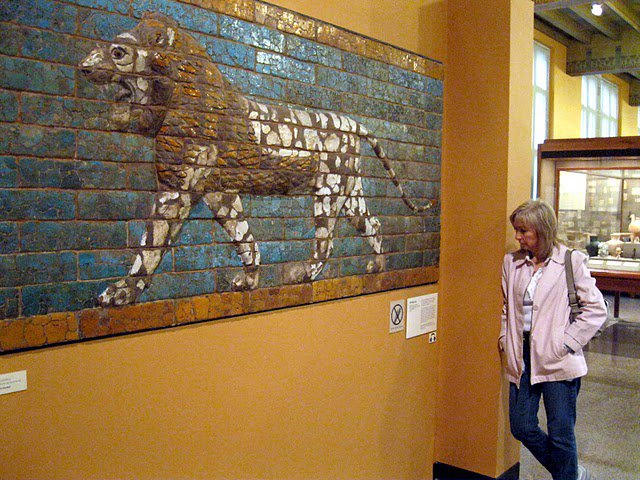
I did not know Dr. Leichty, but did have a chance meeting with him at the University of Pennsylvania Museum of Archaeology and Anthropology in 2004. I was looking for a particular ancient document and inquired of the staff. They could not provide the answer but said that Dr. Leichty might be…

View original post 154 more words

Footnote 34 – John Fabian Witt, Lincoln’s Code: The Laws of War in American History (New York: The Free Press/Simon and Schuster, 2013), p. 213.

Lincoln on Emancipation, the Bible, and God’s Will

Lincoln gave voice to his thinking on the subject in September [1862] when a church delegation from Chicago came to the White House to present a memorial endorsing emancipation… He told the delegates that religious men regularly approached him with advice. They were invariably “certain that they represent the divine will.” But they came with radically opposing views (“the most opposite opinions and advice”), and not all of them could be right. It might even be that all of them were wrong.

And there was the nub of the problem. How could one learn God’s will, and if one could not, how could one make the grave decision…? “If I can learn what it is I will do it!” Lincoln said. But God’s justice was inscrutable. “These are not,” he reminded his memorialists, “the days of miracles.” There would be no “direct revelation.” …Confederate troops were no doubt “expecting God to favor their side” just as Union men thought that God would favor theirs….

But the Chicago Christians replied with a much older idea…Unbeknownst to them, their reply followed the course Lincoln’s own thinking had been taking over the previous weeks. Moral uncertainty, they observed, could not excuse paralysis. “Good men,” they conceded, “differed in their opinions.” But “the truth was somewhere,” and men could not merely set one opinion against another and throw up their hands. The moral leader had to act, had to bring “facts, principles, and arguments” to bear and come to a conclusion as to what justice required

…[W]hen the interview closed, it was clear that Lincoln and his Chicago petitioners were not so far apart after all. “Do not misunderstand me because I have mentioned these objections,” Lincoln told them. “Whatever shall appear to be God’s will I will do.”

34 John Fabian Witt, Lincoln’s Code: The Laws of War in American History (New York: The Free Press/Simon and Schuster, 2013), p. 213.
Statue of an Egyptian official found at Hazor

Hazor excavations – from Ferrell Jenkins’ blog

Ferrell Jenkins's avatarFerrell's Travel Blog

Hebrew University announces this morning the discovery of a statue of an Egyptian official at Tel Hazor.

— “ —

Jerusalem, July 25, 2016 — In a historic find, a large fragment of an Egyptian statue measuring 45 X 40 centimeters [about 18 x 16 inches], made of lime-stone, was discovered in the course of the current season of excavations at Tel-Hazor, north of the Sea of Galilee in Israel. Only the lower part of the statue survived, depicting the crouching feet of a male figure, seated on a square base on which a few lines in the Egyptian hieroglyphic script are inscribed.

The archaeologists estimate that the complete statue would equal the size of a fully-grown man. At present only a preliminary reading of the inscriptions has been attempted, and the title and name of the Egyptian official who originally owned the statue, are not yet entirely clear.

The…

View original post 912 more words

Our “Great River”

rtrube54's avatarBob on Books

A_Home_on_the_Mississippi At Home on the Mississippi — Currier & Ives Print

It is 2,320 miles from its headwaters in Minnesota to its outlet in the Gulf of Mexico. Its watershed covers all orpart of 31 states and parts of twoCanadian provinces. That watershed extends from the Rocky Mountains in the west to the western side of the Appalachians in the east. All told, the watershed covers 1,245,000 square miles. The discharge into the Gulf of Mexico varies between 200 and 700 thousand cubic feet per second. You have probably guessed that I am writing about the Mississippi River, a name which derived from a Native American word meaning “Great River.”

Water draining into the storm drain at the corner of our lot ends up in this watershed. Growing up in Youngstown, the Mahoning River was part of this watershed. So are the Scioto and Olentangy Rivers, within 5 miles of our…

View original post 587 more words

Cache of coins from Hasmonean Period discovered at Modi‘in

Ferrell Jenkins's avatarFerrell's Travel Blog

An excavation at Modi‘in under the direction of the Israel Antiquities Authority has uncovered a hoard of silver coins dating to the Hasmonean period (126 B.C.). The coins were found within an agricultural estate already uncovered at the site of a new neighborhood. Here are some excerpts and photos from the  IAA news release.

According to Avraham Tendler, director of the excavation on behalf of the Israel Antiquities Authority, “This is a rare cache of silver coins from the Hasmonean period comprised of shekels and half-shekels (tetradrachms and didrachms) that were minted in the city of Tyre and bear the images of the king, Antiochus VII and his brother Demetrius II. The cache that we found is compelling evidence that one of the members of the estate who had saved his income for months needed to leave the house for some unknown reason. He buried his money in…

View original post 699 more words

J. M. Barnes on singing and unity

J. M. Barnes on singing and unity

Chris's avatarAnastasis

Justus McDuffie Barnes (1836–1913) Justus McDuffie Barnes (1836–1913)

In July 1896, J. M. Barnes embarked on a month-long preaching tour through the State of Texas, documenting his travels in a series of articles in the Firm Foundation. Barnes was, without question, the leading conservative in Alabama during the years between the close of the Civil War and his own death in the spring of 1913. But he also travelled extensively, and was a regular writer for, among others, the Gospel Advocate and Benjamin Franklin’s American Christian Review.

This is an illuminating series for, among other things, its insights into congregational life in the 1890s. Beginning on the first Sunday in August, Barnes recounts that he preached a ten-days’ meeting at the Pearl and Bryan Streets church in Dallas, “in some respects the most remarkable body in my whole knowledge.”

Barnes is blunt over the course of several articles as he describes the state…

View original post 999 more words

Roman Crucifixion

https://ferrelljenkins.wordpress.com/2016/03/25/only-one-example-of-roman-crucifixion-discovered/

The week leading to the crucifixion & resurrection

The Week Leading to Jesus’ Crucifixion and Resurrection

Ferrell Jenkins's avatarFerrell's Travel Blog

If we consider the Gospel of John a sort of “Day Planner” for Jesus, we have nearly complete activity recorded for two weeks of the earthly ministry of Jesus. The first is in John 1:19—2:11 where activity for six of the seven days is recorded. I think the omitted day is the Sabbath.

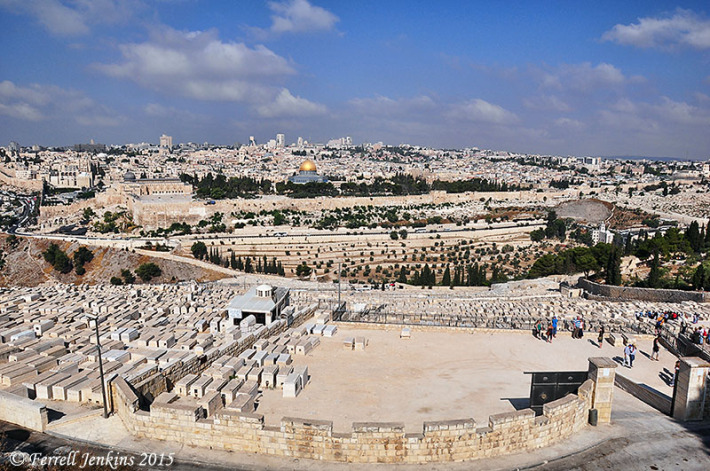
View of Jerusalem from the Mount of Olives. Photo by Ferrell Jenkins.

View of Jerusalem from the Mount of Olives. Imagine the city as it would have appeared to Jesus when he reached the top of the Mount of Olives. Photo by Ferrell Jenkins.

The next nearly complete week is the last week, leading up to the resurrection. John gives more attention to the last week than any other Gospel. Even here we have activities for only six of eight days. This section begins in John 12:1 and continues into John 20. Here is the way I have reconstructed it. Where John does not record the activity I have…

View original post 237 more words

Footnote 33 – Robert H. Gundry, Jesus The Word According to John the Sectarian: A Paleofundamentalist Manifesto (Grand Rapids: Eerdmans, 2002), pp. 73–74.

“[T]he sense of embattlement with the world is rapidly evaporating among many evangelicals, especially evangelical elites, among them those who belong to the “knowledge industry.” In the last half century they have enjoyed increasing success in the world of biblical and theological scholarship. They reacted against the separatism of the fundamentalist forebears, who precisely in their separation from the world knew they had a sure word from God for the world.… with the consequent whetting of our appetite for academic, political, and broadly cultural power and influence are coming the dangers of accommodation, of dulling the sharp edges of the gospel, of blurring the distinction between believers and the world, of softening—or not issuing at all—the warning that God’s wrath abides on unbelievers (John 3:36), in short, of only whispering the word instead of shouting him, speaking him boldly, as the Word himself did.”

Robert H. Gundry, Jesus The Word According to John the Sectarian: A Paleofundamentalist Manifesto for Contemporary Evangelicalism, Especially its Elites, in North America (Grand Rapids: Eerdmans, 2002), pp. 73–74; cited in Steve Wolfgang, “Good News of Victory,” in The Gospel in the Old Testament, Ed. Daniel W. Petty (Temple Terrace, FL: Florida College Press, 2003), p.202, LOGOS edition.

The new look at Magdala

Ferrell Jenkins’ blog is always worth reading!

Ferrell Jenkins's avatarFerrell's Travel Blog

Magdala was high on my list of places to revisit to see the changes taking place.

The town of Magdala is not mentioned in the Bible, but Mary Magdalene is mentioned a total of 12 times in the four gospels. This place may have been her birthplace or her home. A few late manuscripts mention Magdala (Matthew 15:39 KJV), but earlier manuscripts read Magadan. Magdala is located about 4 miles north of Tiberias on the western shore of the Sea of Galilee.

Josephus had his headquarters at Magdala during the first Jewish Revolt against Rome (A.D. 66-70). He was able to get a group of at least 230 boats to go from Magdala to Tiberias (Jewish Wars 2.635-637). Vespasian attacked the town from the sea and destroyed it.

We first learned of the new excavation planned for Magdala in early 2008 (here). Then in September, 2009…

View original post 347 more words