Rare hoard of coins from pre-AD 70 discovered near Jerusalem-Tel Aviv highway

Ferrell Jenkins's avatarFerrell's Travel Blog

The Israel Antiquities Authority announces today the discovery of a box containing 114 bronze coins dating to Year Four of the Great Revolt (Jewish Revolt against the Romans). The discovery was made several months ago during work on the new Highway 1 project (between Jerusalem and Tel Aviv).

Coin hoard as it was found in the excavation. Photo Vladimir Nuhin, IAA. Coin hoard as it was found in the excavation. Photo Vladimir Nühin, IAA.

According to Pablo Betzer and Eyal Marco, excavation directors on behalf of the Israel Antiquities Authority, “The hoard, which appears to have been buried several months prior to the fall of Jerusalem, provides us with a glimpse into the lives of Jews living on the outskirts of Jerusalem at the end of the rebellion. Evidently someone here feared the end was approaching and hid his property, perhaps in the hope of collecting it later when calm was restored to the region”. All of the coins are stamped on one…

View original post 324 more words

Footnote 30 — Rick Atkinson, The Guns at Last Light

Footnote 30  —  Rick Atkinson, The Guns At Last Light: War in Western Europe, 1944-1945 (The Liberation Trilogy, Volume 3).  New York: Henry Holt and Co.. 2013, pp. 23-24 (Kindle Edition Locations 573-609).

The “stuff” of war: Excerpts from Rick Atkinson’s Liberation Trilogy:

“The loading of invasion vessels bound for the Far Shore had begun on May 4 and intensified as the month wore away. Seven thousand kinds of combat necessities had to reach the Norman beaches in the first four hours, from surgical scissors to bazooka rockets, followed by tens of thousands of tons in the days following. Responsibility for embarkation fell to three military bureaucracies with acronyms evocative of the Marx Brothers: MOVCO, TURCO, and EMBARCO. Merchant marine captains sequestered in a London basement near Selfridges department store prepared loading plans with the blueprints of deck and cargo spaces spread on huge tables; wooden blocks scaled to every jeep, howitzer, and shipping container were pushed around like chess pieces to ensure a fit. Soldiers in their camps laid out full-sized deck replicas on the ground and practiced wheeling trucks and guns in and out.

“In twenty-two British ports, stevedores slung pallets and cargo nets into holds and onto decks, loading radios from Pennsylvania, grease from Texas, rifles from Massachusetts. For OVERLORD, the U.S. Army had accumulated 301,000 vehicles, 1,800 train locomotives, 20,000 rail cars, 2.6 million small arms, 2,700 artillery pieces, 300,000 telephone poles, and 7 million tons of gasoline, oil, and lubricants. SHAEF had calculated daily combat consumption, from fuel to bullets to chewing gum, at 41.298 pounds per soldier. Sixty million K rations, enough to feed the invaders for a month, were packed in 500-ton bales. Huge U.S. Army railcars known as war flats hauled tanks and bulldozers to the docks, while mountains of ammunition were stacked on car ferries requisitioned from Boston, New York, and Baltimore. The photographer Robert Capa, who would land with the second wave at Omaha Beach, watched as the “giant toys ” were hoisted aboard…

“Armed guards from ten cartography depots escorted 3,000 tons of maps for D-Day alone, the first of 210 million maps that would be distributed in Europe, most of them printed in five colors. Also into the holds went 280,000 hydrographic charts; town plats for the likes of Cherbourg and St.-Lô; many of the one million aerial photos of German defenses, snapped from reconnaissance planes flying at twenty-five feet; and watercolors depicting the view that landing-craft coxswains would have of their beaches. Copies of a French atlas pinpointed monuments and cultural treasures, with an attached order from Eisenhower calling for “restraint and discipline” in wreaking havoc.

“The U.S. First Army battle plan for OVERLORD contained more words than Gone with the Wind. For the 1st Infantry Division alone, Field Order No. 35 had fifteen annexes and eighteen appendices, including a reminder to “drive on right side of road.” Thick sheaves of code words began with the Pink List, valid from H-hour to two A.M. on D + 1, when the Blue List would succeed it. Should the Blue List be compromised, the White List would be used, but only if the word “swallow” was broadcast on the radio. A soldier could only sigh.

“Day after night after day, war matériel cascaded onto the wharves and quays, a catalogue Homeric in magnitude and variety: radio crystals by the thousands, carrier pigeons by the hundreds, one hundred Silver Stars and three hundred Purple Hearts—dubbed “the German marksmanship medal”— for each major general to award as warranted, and ten thousand “Hagensen packs,” canvas bags sewn by sailmakers in lofts across England and stuffed with plastic explosive. A company contracted to deliver ten thousand metal crosses had missed its deadline; instead, Graves Registration units would improvise with wooden markers. Cotton mattress covers used as shrouds had been purchased on the basis of one for every 375 man-days in France, a formula that proved far too optimistic. In July, with supplies dwindling, quartermasters would be forced to ship another fifty thousand.

“Four hospital ships made ready, “snowy white … with many bright new red crosses painted on the hull and painted flat on the boat deck,” the reporter Martha Gellhorn noted. Each LST also would carry at least two physicians and twenty Navy corpsmen to evacuate casualties, with operating rooms built on the open tank decks— a “cold, dirty trap,” in one officer’s estimation— and steam tables used to heat twenty-gallon sterilization cans. All told, OVERLORD would muster 8,000 doctors, 600,000 doses of penicillin, fifty tons of sulfa, and 800,000 pints of plasma meticulously segregated by black and white donors. Sixteen hundred pallets weighing half a ton each and designed to be dragged across the beaches were packed with enough medical supplies to last a fortnight.


D-Day seventy years later

Like many others who have visited these sites in Normandy, I found it an overwhelming experience tto try to imagine the magnitude of the sacrifice. Take a moment to reflect …..

Ferrell Jenkins's avatarFerrell's Travel Blog

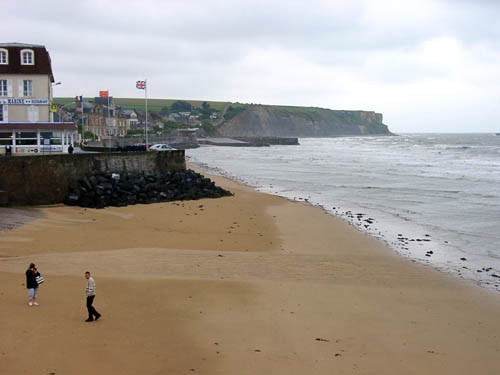
D-Day, June 6, 1944, is a very important day in American history. Here is one of the photos I made of “Omaha” Beach on a rainy day in 2002. This is where many American soldiers landed on that fateful day.

"Omaha" Beach in Normandy. Photo by Ferrell Jenkins.

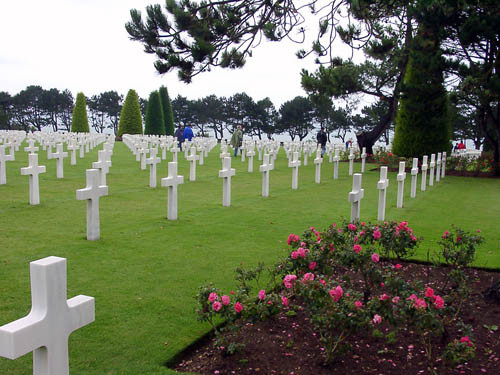
A visit to this area and especially to the American cemetery helps us realize what a great debt we owe to those who gave their lives while fighting for freedom. A few years ago, prior to his death, I visited regularly with a veteran of World War II who was at Normandy. I enjoyed hearing him talk about the war, and asking him questions. I was always encouraged when I left his home.

The American Cemetery at Omaha Beach in Normandy. Photo by F. Jenkins.

View original post

A Film Any Person of Conscience Should Probably See

A Film Any Person of Conscience Should Probably See

Bette and I saw “12 Years A Slave” this weekend (we often wait to see it in one of the inexpensive late-run theaters). 

It was brutal, raw, and offensive on many levels — and ought to be seen by persons of conscience. Here are a few excertps from Crosswalk.com, detailing the particulars. Read more at http://www.crosswalk.com/culture/movies/12-years-a-slave-movie-review.html?ps=0

We’ve seenslavery depicted on film before, but not like this.

12 Years a Slave is the adaptation of a little known memoir by 19th-century African-American Solomon Northup, a free man by birth living in New York who was kidnapped into slavery. It’s a visceral, relentless look, one so unflinching that I became genuinely concerned for the welfare of the actors.

It also examines the business of slavery in detail. Seeing the system at work compounds the oppression. This shame didn’t happen just by force but by calculation, one of perverse sociopathic indifference. Human bondage was not just circumstantial; it was societal. The scope communicates the hopelessness.

Indeed, slavery was the very foundation of an entire economic culture, one on which a civilization was built and sustained. It required people to be kept, moved, and treated worse than animals because there is a spirit and soul in humans that must be dehumanized. We see how the intricacies of a Slavery Society do that, and why slave uprisings – which may make for provocative historical fiction – rarely, if ever, occurred. Violence breaks the body, but it’s the system that breaks the soul.

Read more at http://www.crosswalk.com/culture/movies/12-years-a-slave-movie-review.html?ps=0

At 100, poem ‘Chicago’ still fierce, fresh

At 100, Carl Sandburg’s Poem ‘Chicago’ still fierce,  fresh

http://www.chicagotribune.com/entertainment/ct-carl-sandburg-chicago-poem-20140219,0,1287844.column

Steve Johnson — Tribune reporter  — February 19, 2014

Excerpts:

+++++++++++++++++++++++++++++++++++++++++++++++++++++++++++++++++++

For its issue of March 1914, Harriet Monroe’s Poetry magazine accepted Carl Sandburg’s “Chicago” and seven of his other poems about the city.

A family that had been struggling was on its way to prosperity. A literary career that would see popular adulation and critical scorn and an astonishing amount and range of work was born.

And a city — in the first five lines of the work of an obscure socialist poet in a 2-year-old magazine founded by a Chicago Tribune art critic — had found its enduring descriptors:

“Hog Butcher for the World,

Tool Maker, Stacker of Wheat,

Player with Railroads and the Nation’s Freight Handler;

Stormy, husky, brawling,

City of the Big Shoulders:”

“The poem was absolutely revolutionary when it first came out,” says Bill Savage, who teaches the poem as a distinguished senior lecturer in English at Northwestern University.

“I make a joke about how it’s a Chicago literary union regulation: You have to start with this poem,” Savage says.

Reading “Chicago” now, says the poet Robert Polito, president of the Poetry Foundation, which publishes Poetry Magazine, reminds him of the old joke about “Hamlet”:  Great plot, great characters, but the dialogue is filled with cliches. They are cliches, of course, not because Shakespeare was weak-minded or lazy, but because he was original enough, and accurate enough, to invent phrases that would endure. Ditto for the “clichés” in Sandburg’s “Chicago.”

“They have a kind of omnipresence that makes it a little bit difficult for us to think and feel our way back to how original and daring this was,” Polito says. “You show something like ‘Citizen Kane’ to a group of young students. The techniques of that film have been imitated so many times, they don’t see what was startling about it. That’s a little bit true here. It’s a little bit hard for us a hundred years later to recapture. It’s almost as if it’s a combination of the Book of Genesis and the national anthem for Chicago. It’s the founding myth and the celebratory lyric.”

Or, as Savage says about the poem, “It created a groove that has become a rut.”

++++++++++++++++++++++++++++++++++++++++++++++++++++++++++++++++

Sandburg was the son of Swedish immigrants, born in Galesburg in western Illinois. By the time he made his way to Chicago in the early 1900s, he had been many things, including a hobo, a traveling salesman (of stereoscopes), a public orator and a socialist organizer in Wisconsin.

The Chicago Poems published in Poetry established him as a writer of originality, muscular voice and an unrelenting concern for common people. His first poetry book, “Chicago Poems,” came out two years later.

+++++++++++++++++++++++++++++++++++++++++++++++++++++++++++++++

He was a guitar player and singer, too, and he published “The American Songbag,” a herculean compilation of some 250 American folk songs, words and music, that he had gathered in his travels. The collection remains in print and has proved invaluable to scholars and folk singers.

In “The Day Carl Sandburg Died,” the 2012 documentary for PBS’ “American Masters,” Pete Seeger says the “Songbag” was a touchstone for the likes of him and Woody Guthrie. Bob Dylan’s website links to it, and a young Dylan, on a road trip in 1964, made sure to visit Sandburg at his North Carolina home, Polito says.

And as a day job, he wrote scores of movie reviews for the Chicago Daily News. Here is Sandburg on “Metropolis” in July 1927: “While everybody praises German movies when they are shown on this continent, nobody goes to see them.”

Sandburg in the 1920s also began a career as the precursor to Robert Caro, our era’s meticulous biographer of Lyndon Johnson. Originally conceived as a book for children, Sandburg’s biography of Abraham Lincoln, much of it composed on a typewriter set on an orange crate outside of the Elmhurst home, would grow in ambition and length.

By the time he was done, it had reached six volumes and earned him a Pulitzer Prize for history.

+++++++++++++++++++++++++++++++++++++++++++++++++++++++++++++

Read more at:

www.chicagotribune.com/entertainment/ct-carl-sandburg-chicago-poem-20140219,0,1287844.column
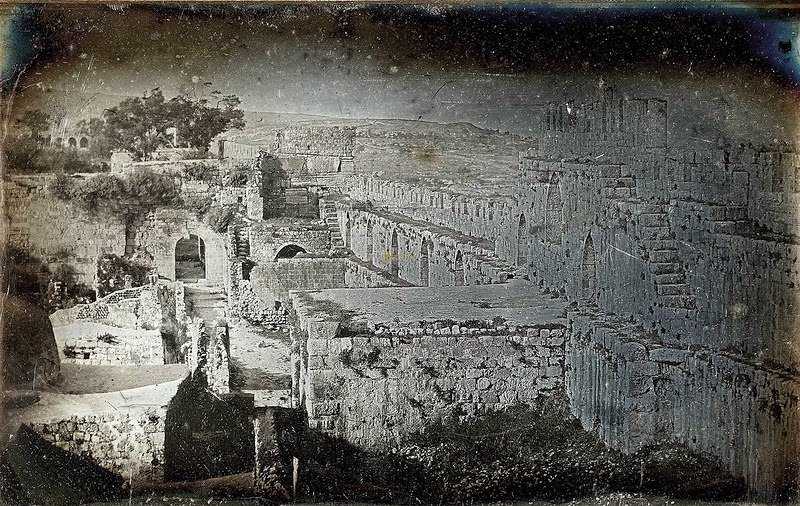
See the First Photographs Ever Taken of Jerusalem | Smart News | Smithsonian

J'lem-Smithsonian-34.jpg.800x0_q85_cropSee the First Photographs Ever Taken of Jerusalem | Smart News | Smithsonian.  http://www.smithsonianmag.com/smart-news/see-first-photographs-ever-taken-jerusalem-180949473/


Footnote 29 — Alistair Cooke, America: A Personal History (1973)

Footnote 29 — Alistair Cooke, America: A Personal History (New York: Basic Books, 1973)

Since I first heard it decades ago, I have been intrigued by the unique perspective, colorfully describing aspects of the American Revolution by Alistair Cooke, BBC and British newspaper correspondent (and, later, host of Masterpiece Theatre). Cooke came to the USA in 1932 on a fellowship to Yale after graduating Cambridge, married a descendant of Ralph Waldo Emerson, became an American citizen on 1 December 1941, and stayed, for the most part, from the Great Depression until his death in 2005.  Cooke toured the US by automobile many times seeking stories to explain to British subjects the enigmatic behaviors of their American cousins, attempting to bridge the chasm described in George Bernard Shaw’s memorable depiction (later borrowed famously by Sir Winston Churchill) of the British and Americans as “one people separated by a common language.”  Cooke’s 13-part television series, The Americans (1973), was accompanied by a book, from which the following passage is excerpted.

“We should not forget that for quite a time the rebels thought of themselves as Englishmen abused, and in many engagements felt an uncomfortable sympathy for the Englishmen sent over to fight them.  In Ridgefield, Connecticut, there is a plaque sunk in the wall of a cemetery.  It says:  ‘In defense of American independence at the Battle of Ridgefield, April 27th, 1777, died Eight Patriots who were laid in this ground, Companioned by Sixteen British  soldiers, Living, their enemies, Dying, their guests.’

“The British arrived as a professional army expecting, with companies of German mercenaries, to fight European set battles. Not enough of them had learned, at first or second hand, the lessons of the French and Indian Wars.  The Americans were at once too shrewd and too untrained to oblige them with an old world war. First of all, as John Adams said, the colonial population divided up into one third that took to arms, one third that was either openly or secretly loyal to the British, and one third that didn’t give a damn – not the best recipe for a disciplined national army.  

      “So against the army of British regulars there stood – besides some French volunteers, immensely valuable as professionals at the start – mainly a large, improvised force of farmers, mechanics, tradesmen, parsons, lawyers, grocers, hunters, trappers, con men, thieves, and hoodlums. ‘Never,’ their sorrowing commander was to lament when the going was bad, ‘such a rabble dignified by the name of army.’  How could they hold off for six years, much less defeat, one of the crack armies of Europe?

     “For one thing, there was weaponry.  The British army for the most part used smooth-bore muskets that allowed a lateral error of three feet at a hundred yards range.  The British infantryman was not trained to pick off single targets; he stood shoulder to shoulder with his fellows and they sprayed, shall we say, in the general direction of the enemy!  The Americans had smooth-bore muskets too, but as the war moved into the interior the British came up against the frontiersmen, who did not use guns for sport.  Their very existence depended on shooting their food on the wing and saving their families by picking off Indians in night raids. They needed a weapon that was light and accurate, and found it in the Pennsylvania flintlock, developed for them by German settlers in Pennsylvania who doubled the length of the barrel and grooved it make the bullet spin and stay on line…

        “At long range, this weapon did bloody damage to shoulder-to-shoulder infantry.  A Pennsylvania Tory who had seen it at work wrote a letter to a London newspaper offering rather chill advice: ‘This province has raised a thousand riflemen, the worst of whom will put a rifle ball in man’s head at a hundred and fifty or two hundred yards.  Therefore, advise your officers who shall hereafter come out to America to settle their affairs in England before their departure.’  This reputation for sharpshooting was magnified in England into a witch’s curse, and there were some lively desertions among men drafted for service in the Colonies.  It is, on the whole, and all-too-true American myth:  that legendary reputation for spotting the bull’s eye which began with the embattled farmers and was sustained down through the next century and a half by Wyatt Earp, Wild Bill Hickok, Annie Oakley, and Sergeant York…

     “A British commander sent home a short report that was read in the House of Commons.  The gist of it was: ‘The Americans will not stand and fight.” They were jack-in-the-box guerillas who would fight like devils for a day and a night and then go home and harvest their crops on the weekend.  They would return, not always in any discernible formation, and after a swift onslaught vanish into the country by night, and then again at some unpredictable time come whizzing in like hornets.  What baffled and eventually broke the British was what broke the Roman armies in their late campaigns against the barbarians, and for so long frustrated the Americans in Vietnam. …. [A]s William Pitt sadly commented, looking at his drawn lines on an alien wilderness: ‘You cannot conquer a map.’

Wendell Berry’s “St. Vith, December 21, 1944”

Wendell Berry’s “St. Vith, December 21, 1944”

Off the Shelf: Wendell Berry’s ‘St. Vith, December 21, 1944′

via Alan Cornett in Pinstripe Pulpit

Part of Wendell Berry’s long running Sabbath series of poems, “St. Vith, December 21, 1944″ captures a moving moment during the brutality of the Battle of the Bulge. American forces withdrew from St. Vith on that date, leaving the Belgian city to the Germans. General Bruce Clarke ordered the Americans out having said, “This terrain is not worth a nickel an acre to me.”

This limited edition signed broadside was handset and printed by the great Gray Zeitz of Larkspur Press in Kentucky, under whom I apprenticed sixteen years ago. It was commissioned by Michael Courtney, proprietor of the best bookstore in Kentucky, Black Swan Books (where I also worked years ago). Michael commissioned annual broadsides for several years from Gray. For me, the confluence of Larkspur Press, Black Swan Books and Wendell Berry brings about a perfect match.

It was one of the first Wendell Berry broadsides I ever purchased, possibly the first. It was framed in Columbia, South Carolina while I was a graduate student. Special instructions were given to display the lovely deckled edges.

I suppose this entry isn’t really “Off the Shelf,” but “Off the Wall” didn’t have quite the same connotation.

A Merry Christmas from Pinstripe Pulpit.

Zondervan Essential Atlas of the Bible

Ferrell Jenkins's avatarFerrell's Travel Blog

Frequently we have mentioned and recommended the Zondervan Atlas of the Bible by Carl G. Rasmussen. Every Bible student needs at least one or two good atlases to assist them in their study of the Scriptures.

Last month I attended some annual professional meetings in Baltimore and was pleased to see that Zondervan already had copies of the new Zondervan Essential Atlas of the Bible. One of the sales reps gave me a copy for review here.

At first appearance, the ZEAB has a beautiful cover of stiff, durable paper. It is a convenient 9 1/8″ x 7 3/8″ in size. The content is basically the same as the larger hard back edition. There has been some editing of the text to condense the book from 303 pages to 159 pages.

There are two major sections to the book: Geographical Section and Historical Section. The Geographical Section includes an Introduction to the…

View original post 256 more words

Canaanite Wine Cellar discovered at Tel Kabri

Ferrell Jenkins's avatarFerrell's Travel Blog

Tel Kabri is a Canaanite site located a few miles east of Nahariya in the Plain of Akko in northern Israel. Excavations have been conducted at the site for several years under the direction of Prof. Eric H. Cline of Washington University and scholars from the University of Haifa, Israel.

A total of forty clay jars were discovered. Each have a capacity of 13 gallons. You may read more about the discovery here and here.

The photo below shows a room in the Canaanite palace at Tel Kbri. The excavators date this structure to 1700 B.C.

This discovery reminds us of the wine cellars discovered at El-Jib (Gibeon) by James Pritchard in 1959. Sixty-three cellars with a possible capacity of 25,000 gallons were excavated (Pritchard, Gibeon, 79-99).

HT: Joseph Lauer

View original post