The theater at Corinth

While I was “temporarily inactive” my friend, brother, and mentor, Ferrell Jenkins, continued to post interesting items, to wit:

Ferrell Jenkins's avatarFerrell's Travel Blog

The theater at Corinth is a short distance from the agora and the Temple of Apollo. Reddish and Fant describe the theater:

The theater dates from the 5th century B.C.E. and later was rebuilt by the Romans, who added a multistory stage building . In Paul’s time it seated approximately 14,000 spectators. (A Guide to Biblical Sites in Greece and Turkey, p. 59)

According to the same source, both the theater and the odeion, “were later used for gladiatorial spectacles; the theater was even fitted for mock sea battles.”

The theater is not on the typical tourist route at Corinth, but it can be reached along a rugged path north of the major excavated area.

The Apostle Paul spent 18 months among the Corinthians.

And he stayed a year and six months, teaching the word of God among them. (Acts 18:11 ESV)

View original post

Jehoash Tablet must be returned to owner

Ferrell Jenkins's avatarFerrell's Travel Blog

The Supreme Court of Israel ordered that the Jehoash Tablet, a 9th century inscription about repairs to the temple in the days of King Jehoash of Judah, must be returned to the owner.

The Jerusalem District Court had earlier ruled that he state had not proved that this  inscription was a forged document.

Chiseled in ancient Hebrew and dated to the ninth century BCE, the tablet describes renovations of the First Temple – which is said to have been built by King Solomon – ordered by Jehoash. It corresponds to the account in II Kings 12:1-17, in which the king laments the state of the temple and commands that money the priests collect from the people be used to fix it up.

îùøã äçéðåêThe Jehoash Tablet

Read the account in today’s Haaretzhere.

Matthew Kalman has been keeping abreast of this decade-long case and reports at Bible and Interpretationhere

View original post 15 more words

Vandalism in Protestant Cemetery on Mount Zion

Ferrell Jenkins's avatarFerrell's Travel Blog

A little over a year ago I visited the Protestant Cemetery on Mount Zion in Jerusalem. Shortly thereafter a series of articles were posted about some of the persons buried there. See here for Spafford; here for Starkey; here for Schick; here for Fisher.

My friends Trent and Rebekah are currently students at the Jerusalem University College that adjoins the cemetery. In fact, one enters the locked cemetery gate through JUC property. Unfortunately, it would be possible for a person to enter the cemetery from the southwest corner where there is no fence.

Trent reports vandalism of some of the tombs with crosses last Sunday.

I’m sure you know of the “price tag” policy and campaign. [Yes, see here.]

At some point on Sunday, not sure exactly when, vandals said to be associated with a Price Tag group entered the cemetery (not hard to do from the back/side) and…

View original post 261 more words

Where Were You?

Numerous posts on Facebook and other social media by friends (virtual and real-life ones) have asked, “What were you doing on 9/11?”

I was prepping to lecture to my Tuesday classes at the University of Kentucky – History of Journalism (JOU 535) and an introductory survey section of HIS 109 – grappling with Reconstruction (which A. Lincoln called the greatest challenge ever presented to practical statesmanship) and the aftermath of the Civil War (stagger your imagination by thinking of the loss 9/11 EVERY Tuesday for four years).

After a brief lecture, I let the students, disturbed and full of emotion (as we all were) talk and ask questions – “Does this mean we are at war?” or “how could this happen?!” – and then dismissed to gather around the TV sets tuned to news broadcasts all over campus. Many of the History of Journalism students (and I) were scheduled to leave the next day for the annual meeting of RTNDA (Radio and Television News Directors’ Association – professional society of the equivalent of “managing editor” bosses in TV newsrooms) which was scheduled for Nashville that year.  The convention was cancelled – which did not help any of the NDs who had already assembled there for advance-prep and committee meetings, and had to manage the biggest news story of their careers via cell phones, trapped hundreds of miles from home with flights cancelled, airlines grounded.

That was one of the eeriest things about the day – the absence of air traffic.  The only aircraft flying that day were Blackhawks transporting the 101st Airborne from Ft. Campbell to guard the Bluegrass Army Depot (chemical weapons storage) south of Lexington.  The other really disturbing matter was the phone conversations with one of our daughters who then worked in one of Atlanta’s a tall buildings. Even routine things were disturbing; trying to eat while watching breaking news on the restaurant TV was appetite-suppressing – even at one of my favorite places near campus (Billy’s Hickory-Pit Bar-B-Q, if you’re ever in Lexington).

Today we live in a Chicago suburb (Naperville) which is on the approaches to both O’Hare and Midway – as well as the flight school at Lewis University and “Clow International Airport” (general aviation) as well as several “flight communities” (homes with attached hangars and access to runways) .  The planes overhead, high enough not to be a nuisance, are comforting in a routine sort of way – a subliminal reminder of the freedoms we enjoy of “life, liberty, and the pursuit of happiness” (or, property, as Jefferson originally wrote).  The other day we were buzzed several times by a B-17 on tour – a reminder of Bette’s father, W.C. Ashworth of blessed memory, who was a B-17 pilot in World War 2. Gotta love suburban Chicago.

Random reflections on a somber day by an average guy happy to be living, despite all its imperfections, in the land of the free and the home of the brave. God bless America!
Homeschooling History and Statistics

Homeschooling History and Statistics

VERY interesting infographic — via Lindsay Wolfgang Mast and

http://campaign.r20.constantcontact.com/render?llr=v8kuxxbab&v=001rFp1utu-80zc_2nWEr2UsAJPvv-ciYesVt7_EcNKJzjZUjgrORDjMPt5p94H3c704Ff137paOZ6q4f2Oz9G2DmiHq195XyoGXtlz_1D4Z0zKs7zWykxLMA%3D%3D

April 2013 TOS
April 2013 TOS
April 2013 TOS
April 2013 TOS
April 2013 TOS
April 2013 TOS
The Old Schoolhouse Magazine | PO Box 8426 | Gray | TN | 37615

On taking yourself too seriously

Ferrell Jenkins's avatarFerrell's Travel Blog

On the way from Luxor to the Valley of the Kings on the West Bank of the Nile one passes two huge statues known as the Colossi of Memnon. The statues are nearly 60 feet tall, and once stood at the entrance to the funerary temple of Amenhotep III (also known as Amenophis III). With their crowns, each statue would have been about 66 feet tall. Amenhotep III ruled Egypt during the 18th Dynasty (14th century B.C.).

During the time of the Roman Empire the statues were mistakenly associated with “Memnon, son of Eos and Tithonus, who was killed by Achilles during the Trojan War” (Baedeker’s Egypt).

The last time I was in the Valley of the Kings I noticed the head and chest of the statue had become a resting place for birds. Just an interesting picture, I thought.

Whether covered by sand or birds, this…

View original post 61 more words

How To Treat the Freshmen — 1495

How To Treat the Freshmen — 1495

From the Blog “Ask the Past: Advice From Old Books”

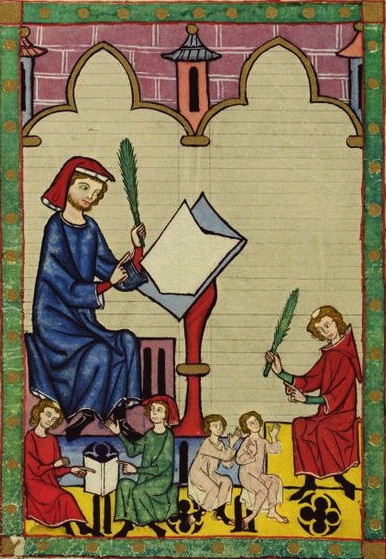
How to Treat the Freshmen, 1495

See the complete post, and much more, at:

http://askthepast.blogspot.com/2013/08/how-to-treat-freshmen-1495.html

They get smaller every year.
Codex Manesse (c. 1304)

“Statute Forbidding Any One to Annoy or Unduly Injure the Freshmen. Each and every one attached to this university is forbidden to offend with insult, torment, harass, drench with water or urine, throw on or defile with dust or any filth, mock by whistling, cry at them with a terrifying voice, or dare to molest in any way whatsoever physically or severely, any, who are called freshmen, in the market, streets, courts, colleges and living houses, or any place whatsoever, and particularly in the present college, when they have entered in order to matriculate or are leaving after matriculation.”

Leipzig University Statute (1495)

+++++++++++++++++++++++++++++++++++++++++++++++++

Edited by Elizabeth Archibald, who has a Ph.D. in History with a focus on early medieval education. She teaches at the Peabody Institute of the Johns Hopkins University. Read more at:  http://askthepast.blogspot.com/p/blog-page.html

Female Soldiers in the Civil War

Female Soldiers in the Civil War

Female Soldiers in the Civil War

ON THE FRONT LINE

BY SAM SMITH

The outbreak of the Civil War challenged traditional American notions of feminine submissiveness and domesticity with hundreds of examples of courage, diligence, and self-sacrifice in battle.  The war was a formative moment in the early feminist movement.

Clayton
Frances Clayton disguised herself as “Frances Clalin” to fight in the Civil War. (Library of Congress)

In July of 1863, a Union burial detail at Gettysburg, Pennsylvania made a startling discovery near Cemetery Ridge.  Among the bodies covering the ground–the wreckage of the Confederate attacks during the battle–the Union men found a dead woman wearing the uniform of a Confederate private.

The burial detail had stumbled upon one of the most intriguing stories of the Civil War: the multitudes of women who fought in the front line.

Although the inherently clandestine nature of the activity makes an accurate count impossible, conservative estimates of female soldiers in the Civil War puts the number somewhere between 400 and 750.  Long viewed by historians as anomalies, recent scholarship argues that the women who fought in the Civil War shared the same motivations as their male companions.

Some women went to war in order to share in the trials of their loved ones.  Others were stirred by a thirst for adventure, the promise of reliable wages, or ardent patriotism.  In the words of Sarah Edmonds Seelye, also known as Franklin Flint Thompson of the 2nd Michigan Infantry: “I could only thank God that I was free and could go forward and work, and I was not obliged to stay at home and weep.”   Seelye holds the honor of being the only woman to receive a veteran’s pension after the war.

++++++++++++++++++++++++++++++++++++++

Read more at http://www.civilwar.org/education/history/untold-stories/female-soldiers-in-the-civil.html

Lamassu of Sargon II — Oriental Institute, University of Chicago

Lamassu of Sargon II -- Oriental Institute, University of Chicago

Steve Wolfgang with grandchildren, Oriental Institute, University of Chicago

Sargon II, Ashdod, and Isaiah 20:1

Ferrell Jenkins's avatarFerrell's Travel Blog

Ashdod was located along an international highway known as the Way of the Sea, the Way of Philistia, or the Via Maris. This was the important route connecting Egypt and Assyria. We have already discussed, in the past few posts, that the Assyrian king Sargon II captured Ashdod in 712/11 B.C. The prophet Isaiah makes reference to this event in Isaiah 20:1.

 The LORD revealed the following message during the year in which King Sargon of Assyria sent his commanding general to Ashdod, and he fought against it and captured it. (Isa 20:1 NET)

Sometime discoveries are made, but get little attention. A discovery at Tel Ashdod in 1963 falls into this category. Tel Ashdod was excavated from 1962 to 1972 under the direction of Moshe Dothan. David Noel Freedman wrote an article in Biblical Archaeologist (26:4, 1963)) about “The Second Season at Ancient Ashdod.” He describes the fragments of…

View original post 615 more words