Laboratory in the Sand: The Diet of Pyramid Builders

Laboratory in the Sand: The Diet of Pyramid Builders

The Diet of Pyramid Builders – University of Michigan Research

July 22, 2013 | by Katie Vloet

Who built them—slaves, or well-compensated workers? How were they built? What are they made of? What do they symbolize?

Nearly everything about the Egyptian pyramids raises questions and inspires scientific investigation; they are the classic riddle, wrapped in a mystery, inside geometric walls of limestone.

One of the greatest mysteries: What did the pyramid builders eat?

It had to be enough to sustain the workers through grueling days, weeks, years. Research led by Richard Redding, a research scientist at the Kelsey Museum of Archaeology, has helped shed light on the answer to this question. In short, the builders ate meat. Lots and lots of meat. Often with a side of meat.

“They probably had better diets than [people] did in the village. They definitely had more meat,” said Redding, (’71, Ph.D. ’81), also chief research officer and archaeozoologist at Ancient Egypt Research Associates (AERA), a nongovernmental organization that runs a field school at the Giza pyramids.

Bringing Up the Bones

Redding’s team made the discovery of the meat-heavy diet based on 175,000 animal bones and bone fragments found at the Giza pyramid settlement—mostly cattle, sheep, and goats, with a smaller number of pig bones. He and other archaeologists from AERA, along with other U-M archaeology students who worked at the site through the years, studied the bones to estimate the large amount of meat that would have gone to the workers. They also looked for an explanation of where the animals were raised and slaughtered.

They made the assumption, based on their findings, that the Giza settlement was run by a central authority or administration. “The administrators would have organized drives of sheep, goats, and cattle from the Nile Delta, along the edge of the high desert, to move the required animals to Giza,” Redding said. The workers’ town was located about 1,300 feet south of the Sphinx, and was used to house workers building the pyramid of the pharaoh Menkaure. The process of taking the meat directly to the workers inspired a news headline about Redding’s research that read, “Ancient Burger Vans.”

While Redding and his AERA team are looking at animal bones, their main goal isn’t to learn more about the animals but rather the people who built the only one of the Seven Wonders of the Ancient World still in existence.

“We’re trying to humanize the pyramids, to put people there, by finding out where the workers lived and how they lived,” said Redding, who began working on Old Kingdom sites in Egypt since 1983 after leaving a politically turbulent Iran.

Math, Maps, and Herds

Unearthing the details about the workers’ lives is a long, often tedious process of, for instance, sorting the tens of thousands of animal bones, while also applying Redding’s rich knowledge of animal behavior to figure out how the raising and transport of such huge numbers of animals was possible in ancient times.

++++++++++++++++++++++++++++++++++++++++++++++++++++++++++++++++++++

Read more at:  http://www.lsa.umich.edu/lsa/ci.thedietofpyramidbuilders_ci.detail

NYT: Did Religious Liberalism Win the Culture War?

NYT: Did Religious Liberalism Win the Culture War?

A Religious Legacy, With Its Leftward Tilt, Is Reconsidered

By JENNIFER SCHUESSLER  —  Published: July 23, 2013

For decades the dominant story of postwar American religious history has been the triumph of evangelical Christians. Beginning in the 1940s, the story goes, a rising tide of evangelicals began asserting their power and identity, ultimately routing their more liberal mainline Protestant counterparts in the pews, on the offering plate and at the ballot box.

But now a growing cadre of historians of religion are reconsidering the legacy of those faded establishment Methodists, Presbyterians and Episcopalians, tracing their enduring influence on the movements for human rights and racial justice, the growing “spiritual but not religious” demographic and even the shaded moral realism of Barack Obama — a liberal Protestant par excellence, some of these academics say.

After decades of work bringing evangelicals, Mormonsand other long-neglected religious groups into the broader picture, these scholars contend, the historical profession is overdue for a “mainline moment.”

As one commenter put it on the blog Religion in American History, “It’s heartening that dead, white, powerful Protestants are getting another look.”

In the last year, some half-dozen books on the subject have been published; Princeton and Yale have held conferences dedicated to religious liberalism, and the recent annual meetings of the American Historical Association and the American Academy of Religion included panel discussions on the topic.

“We now have quite a lot of good stuff on evangelical Protestantism,” said David A. Hollinger, an intellectual historian at the University of California, Berkeley, who delivered a provocative presidential address to the Organization of American Historians in 2011, defending the legacy of what he called ecumenical Protestantism.

“But we ought to be studying the evangelicals,” Mr. Holligner added, in “relation to the people they hated.”

Hated is certainly the word, and the feeling went both ways. In a 1926 editorial on the Scopes trial, TheChristian Century, the de facto house magazine of mainline Protestantism, dismissed fundamentalism as “an event now passed,” a momentary diversion along the march to modern, rational faith.

But by the 1940s evangelicals were mobilizing against the United Nations and other causes endorsed by mainline leaders, many of whom were later denounced as Communists in Christianity Today, the magazine founded in 1956 by the Rev. Billy Graham. The Century shot back, running editorials denouncing Mr. Graham as a Madison Avenue-style huckster leading a “monstrous juggernaut” that threatened to “set back Protestant Christianity a half-century.”

Mr. Graham’s magazine won the immediate battle for readers, surging past The Century in circulation within a year — a sign, Elesha J. Coffman argues in her new book, “The Christian Century and the Rise of the Protestant Mainline,” that The Century’s editors, mostly trained at the same elite institutions, were never as representative of the Protestant majority as they claimed to be.

But other scholars take a markedly different view. In “After Cloven Tongues of Fire: Protestant Liberalism in Modern American History,” published in April by Princeton University Press, Mr. Hollinger argues that the mainline won a broader cultural victory that historians have underestimated. Liberals, he maintains, may have lost Protestantism, but they won the country, establishing ecumenicalism, cosmopolitanism and tolerance as the dominant American creed.

++++++++++++++++++++++++++++++++++++++++++++++++++++

Read more at http://www.nytimes.com/2013/07/24/books/a-religious-legacy-with-its-leftward-tilt-is-reconsidered.html?smid=fb-share&_r=0

Ashkelon through the Ages, Part II

Heat, steam and Roman cooking

From the British Museum blog — check it out!

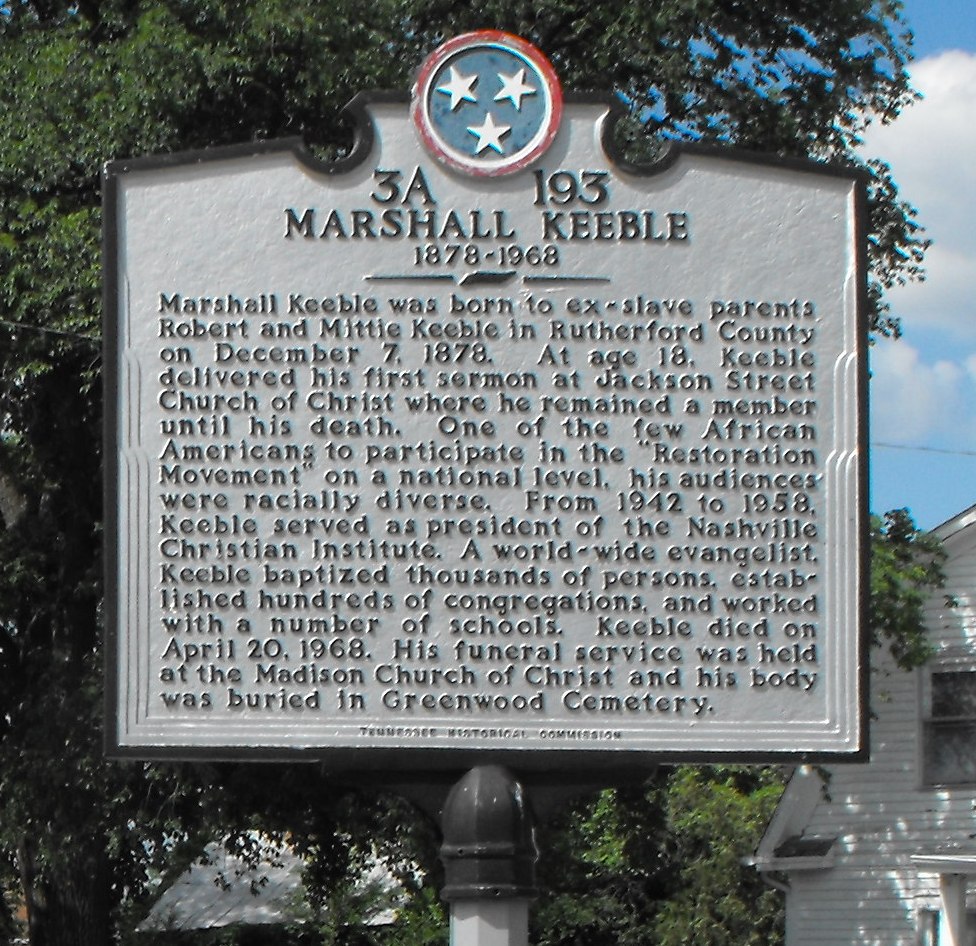
Marshall Keeble Historic Marker, Jackson Street at 14th Avenue, North, Nashville, TN

Frm McGarvey Ice’s blog – worth following!

mac's avatareScriptorium

At the northeast corner of 14th and Jackson stands this historic marker:

Jackson Street Church of Christ, Nashville, Historic Marker at Jackson and 14th Avenue North

Jackson Street Church occupied the northeast corner of the intersection until a new building was built on the west side of 14th.  An historical sketch, with photo of the earlier bulding, can be seen here, click ‘About Us’, then ‘Our History.”  Further west, beyond the current facility, is Fisk University.

I snapped the pic of the marker in June 2012 as part of a tour of Nashville Restoration Movement sites for conferees at Christian Scholars Conference.  Several tour members commented to me this was a highlight of the tour.  Indeed!

View original post

Tenth century B.C. inscription found in Jerusalem

Notice the commentary following

Ferrell Jenkins's avatarFerrell's Travel Blog

Hebrew University announces another significant archaeological discovery today. The entire press release is below.

 —• —

Jerusalem, July 10, 2013 — Working near the Temple Mount in Jerusalem, Hebrew University of Jerusalem archaeologist Dr. Eilat Mazar has unearthed the earliest alphabetical written text ever uncovered in the city.

The inscription is engraved on a large pithos, a neckless ceramic jar found with six others at the Ophel excavation site. According to Dr. Mazar, the inscription, in the Canaanite language, is the only one of its kind discovered in Jerusalem and an important addition to the city’s history.

Dated to the tenth century BCE, the artifact predates by two hundred and fifty years the earliest known Hebrew inscription from Jerusalem, which is from the period of King Hezekiah at the end of the eighth century BCE.

A third-generation archaeologist working at the Hebrew University’s Institute of Archaeology, Dr. Mazar…

View original post 462 more words

Ashkelon through the Ages, Part I

More from Trent and Rebekah at Ashkelon

Egyptian sphinx fragment found at Hazor

Ferrell Jenkins's avatarFerrell's Travel Blog

The Hebrew University of Jerusalem announced today the discovery at Hazor of a sphinx fragment of Pharaoh Mycerinus. Mycerinus is the builder of the smallest of the three great pyramids of Giza in Egypt. The photo below was made facing east toward the Nile Valley. The pyramid of Mycerinus is on the right. The pyramid, built about 2500 B.C., is 204 feet high.

The press release from Jerusalem says,

At a site in Tel Hazor National Park, north of the Sea of Galilee, archeologists from the Hebrew University of Jerusalem have unearthed part of a unique Sphinx belonging to one of the ancient pyramid-building pharaohs.

The Hazor Excavations are headed by Prof. Amnon Ben-Tor, the Yigael Yadin Professor in the Archaeology of Eretz Israel at the Hebrew University’s Institute of Archaeology, and Dr. Sharon Zuckerman, a lecturer at the Hebrew University’s Institute of Archaeology.

Working with a…

View original post 590 more words

Collecting postcards from the Middle East

Short Video: David’s battlefield up close

LukeChandler's avatarBible, Archaeology, and Travel with Luke Chandler

Since this is our last year to excavate in the Elah valley in Israel, I made a short, up-close video of David’s battlefield with Goliath. You can “be there” as we go over the events of 1 Samuel 17.


View original post