JERUSALEM in IMAX

Aerial view of Jerusalem from the east. Photo by Ferrell Jenkins.

Jerusalem in IMAX — via Ferrell Jenkins

Ferrell Jenkins's avatarFerrell's Travel Blog

Friday morning my wife and I joined three Biblical Studies faculty from Florida College, and a handful of other people, in the MOSI IMAX giant screen theater in Tampa to see the National Geographic Entertainment presentation of JERUSALEM.

The original producers of this film have been promoting it for several years, as you can see from the video that we posted nearly three years ago here. The current production is about 45 minutes in length. The thing that really makes the difference is the IMAX giant screen presentation.

JERUSALEM features three young ladies representing the three religions claiming Jerusalem as the home of their origin: Judaism, Christianity, and Islam. The girls guide the viewers through the crowded, winding streets of the Old City to the various religious sites of the city. There are a few scenes in other parts of the country: Capernaum, Caesarea Maritima, Joppa, Masada, and the…

View original post 273 more words

Bad Experiences

From the perrynoble blog; H/T Mike Estes for the link!

My Wife Had a Bad Experience at Chick-Fil-A

I love Chick-Fil-A!  (AND love Tim Hawkins song about it…you should watch it here!)

We eat there at least two or three times a week (not kidding…we’ve actually pushed that number up to 6-7 a few times.)

The food is ALWAYS good, they get the order right nearly every time and their customer service is second to none.  It is always clean and no matter how long the line seems to be people are always served as quickly and efficiently as possible.

So, imagine my surprise when my wife came home the other day and, as we were catching each other up on the things that had taken place while we had been apart all morning and afternoon she told me about a bad experience she had at Chick-Fil-A.

I was immediately frustrated!  (Any husband would be!)  AND…before I knew it I had literally told myself in my mind, “Well, if that’s the way things are going to be then I guess we just won’t be going to Chick-Fil-A anymore, they’ve lost my business.”

TIME OUT!!!  How stupid was THAT thought?  Seriously, let’s review…

  • #1 – They ALWAYS deliver great food!
  • #2 – They ALWAYS have friendly people!
  • #3 – They ALWAYS have a clean environment!
  • #4 – What my wife had experienced was not in line with what normally happens.

(AND…I want to be completely fair to Lucretia, she was NOT saying she would not go back, nor was she angry…she was just telling me about her day and I am the one who became irrational!)  🙂

I lost my mind!  I was literally going to allow one bad experience with one employee ruin a reputation of excellence that had been consistent for years!  (AND…no one knows what was going on in that employees life…she could have had one of the worst days of her life and was trying her best to just hold it together until she could clock out!)

Before you agree with me too quickly…I think there are people who have done the same thing to the church!

It has become quite popular, even in some “Christian” circles, to bash the church for all of the dumb things that she has done.

I have met people since being in ministry for over 20 years that have the same attitude with the church that I almost had with Chick-Fil-A!  They will attend, serve, be devoted to a local church for months or even years…and then, all of a sudden…

  • Someone didn’t call them when they were out for two weeks.
  • Someone said something hurtful to or about them.
  • They didn’t like what the preacher said.
  • They didn’t like what the youth group was doing.

I could go on and on…but you get the point.  There are times when people will allow one thing in the church to trump the decades of ministry and impact that have taken place through that body of believers, and that’s a bit insane.

  • Yes, if you stay in a church long enough I promise you that you will see hypocrisy.
  • Someone will say something to you or about you that will hurt you.
  • Decisions will be made that you do not like.
  • There are going to be sermons that make you mad.

When that happens the enemy is going to try his best to convince you to just walk away…because he knows that the first step away from God is usually getting people to step away from the people of God.

Yes, the church, EVERY church, has made some unwise decisions and, in the process have hurt or disappointed people along the way…but let’s not throw the baby out with the bathwater…

  • She’s STILL being built by Jesus—that makes her important!
  • She’s STILL reaching out to the broken, the forgotten and the poor.
  • She’s STILL making a difference that’s going to be seen for eternity.
  • She’s STILL GOD’S PLAN for reaching the world.
  • She’s STILL necessary for believers!  (If church is not necessary then why did Jesus say He would build it, died for it, will one day redeem it and spends so much time in the NT talking to it and about it?”

No, the church is NOT perfect…but neither are you (or me!)  So, when we’re tempted to walk away because of the one thing that seems to hurt us or trip us up we should simply ask, “is this consistant with this churches character?”

Stay in a church long enough and you will have a bad experience…but let that push you closer to Jesus as you recognize that HE uses imperfect people in His plan, which means sometimes they get it wrong, and then beg the Lord to teach both them and yourself how to best deal with the situation…because, she’s STILL the church and STILL His bride.

Now…anyone want to go to Chick-Fil-A with me?  🙂


http://perrynoble.com/blog/my-wife-had-a-bad-experience-at-chic-fil-a

Visualizing Isaiah 36: Hezekiah and Sennacherib

This installment regarding Isaiah’s prophecies features the “Sennacherib Prism” — one of which is in the University of Chicago’s Oriental Institute, and featured in my tours there as a Docent at the OI. Check out other installments on “Ferrell’s Travel Blog.”

Ferrell Jenkins's avatarFerrell's Travel Blog

Two significant historical characters are mentioned together in Isaiah 36. Sennacherib, the king of Assyria from 704–681 B.C., claims to have taken 46 cities of Judah in the days of Hezekiah. The biblical account says,

In the fourteenth year of King Hezekiah, Sennacherib king of Assyria came up against all the fortified cities of Judah and took them. (2 Kings 18:13 ESV)

There are three known clay prisms in which Sennacherib mentions Hezekiah, king of Judah.

  1. The Taylor Prism, in the British Museum
  2. The Oriental Institute Prism in Chicago
  3. The Jerusalem Prism, in the Israel Museum

Sennacherib admits in the prism-account that Hezekiah did not submit to his yoke, but was “shut up in Jerusalem” like a caged bird.

The Jerusalem Prism, now displayed in the Israel Museum, is perhaps the least well-known of the three documents. Our photo shows that document displayed under the replica of the relief of…

View original post 22 more words

“Jesus’ Wife Fragment”: Further Observations

“Jesus’ Wife Allegations Are ‘Misleading Tripe:” Hurtado

larryhurtado's avatarLarry Hurtado's Blog

As a follow-up to my initial observations yesterday, I’ll offer a few more to underscore where I think things are at this point.

  • First, let me reiterate that all references to “The Gospel of Jesus’ Wife” are completely misleading tripe.  What we have is a purported small fragment with several incomplete lines on each side, in which one line contains the words “my wife” ascribed to Jesus there.  If the fragment is authentic (i.e., from some Christian hand ca. 7th-10th century CE, as per the Harvard radio-carbon test), only God knows what it was.  But it’s totally mischievous to claim that it comes from some “Gospel of Jesus’ Wife”.  We have a “Jesus’ Wife fragment.”  That’s it.
  • The most recent palaeographical, chemical and radio-carbon tests reported in the latest issue of Harvard Theological Review support the conclusion that the writing material is old, that the ink seems composed per…

View original post 405 more words

“Jesus’ Wife” Articles in HTR: Initial Thoughts

Careful analysis — countering a lot of speculative publicity.

larryhurtado's avatarLarry Hurtado's Blog

From an initial (and rapid) reading of the articles in the latest issue of Harvard Theological Review about the “Jesus’ Wife” fragment, I’ll offer the following preliminary thoughts.  (I had planned to pursue another project today, but an email early this a.m. alerting me to the HTR publications drew my attention to this “breaking” story.)

First, I’ll speak to Malcolm Choat’s preliminary observations about the fragment from a papyrological and palaeographical perspective.  (Choat is a recognized figure in these matters, with special expertise in things Coptic.)  I note that essentially Choat concludes that he wasn’t able to find “a smoking gun,” i.e., some clear indication of inauthenticity.  I was particularly impressed with his note that there didn’t appear to be any ink-traces on the part(s) of the fragment that seem to have suffered damage.  So, either the damage happened after the text was written, or else a supposed forger damaged…

View original post 625 more words

The Porn-Free Family

The Porn-Free Family

From Tim Challies’ Blog — Informing the Reforming

I’m a father of three children who are fully part of the digital generation. They are as comfortable with iPods as I am with a paperback and have only ever known a world where almost all of us have cell phones with us at all times, where Facebook is a teenager’s rite-of-passage, where every home has five or ten or twenty devices that can access the rest of the world through the Internet. Yet I know of the dangers that are lurking out there, waiting to draw them in.

I want to protect my children in a world like this, but I want to do more than that. I want to disciple my children to live virtuously, to use these new technologies for good purposes instead of bad ones. I believe this is a crucial part of my calling as a parent. To address this great need, I have put together what I call The Porn-Free Family Plan. It is a plan designed to protect my children from online dangers so that I can train them to use their devices and technologies well.

THE PORN-FREE FAMILY PLAN

A thorough plan needs to account for three types of device:

  • Fixed devices. These are the devices will only ever be used in the home. Here we have desktop computers in the home office or Internet-enabled televisions and gaming consoles. Parents can have a significant level of control over these devices.
  • Mobile devices. These are the laptops, tablets, smart phones and other devices that can be used in the home but also carried out of the home and used elsewhere. Parents can have as lesser degree of control over these devices.
  • Other people’s devices. These are the computers children may use at another person’s home or the tablets other children may show to their friends. Parents can have no control over these devices.

In all of this there are two broad goals: To prevent those who want to find pornography and to protect those who do not want to find it but who may otherwise find themselves exposed to it, to confound those who want to see porn and to shield those who don’t. And while the plan is geared specifically to combat pornography, it will also help battle other online dangers.

The Porn Free Family Plan has four steps: Plan, Prepare, Meet and Monitor….

 Read more at: http://www.challies.com/articles/the-porn-free-family-plan

There’s a cost?

Recent post by a new blogger, Derrick Victor. Well said — and on a crucial topic. I preached on this subject last week, including these “famous” comments from Bonhoeffer’s Cost of Discipleship: ” Cheap grace is the preaching of forgiveness without requiring repentance, baptism without church discipline, communion without confession…. Cheap grace is grace without discipleship, grace without the cross, grace without Jesus Christ, living and incarnate.” p.47 His comments on “Costly Grace” in following passages are also worth reading.

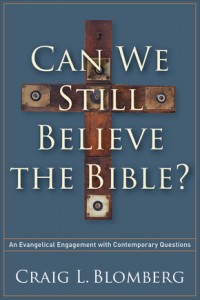
Can We Still Believe the Bible?

Daniel B. Wallace's avatarDaniel B. Wallace

Can-We-Still-Believe-the-Bible-200x300

Craig Blomberg, Distinguished Professor of New Testament at Denver Seminary, has written another outstanding volume. Blomberg is a committed evangelical, but not one with a closed mind. As he says in his preface about the environment of Denver Seminary (quoting Vernon Grounds, former president of the school), “Here is no unanchored liberalism—freedom to think without commitment. Here is no encrusted dogmatism—commitment without freedom to think. Here is a vibrant evangelicalism—commitment with freedom to think within the limits laid down by Scripture.” Blomberg’s writings have always emulated this philosophy. His research in the secondary literature is consistently of superb quality, and his discussions of problem passages and issues, especially in the Gospels, is always well informed. Rather than clutter the narrative with documentation, Blomberg has wisely used endnotes instead of footnotes (though I personally prefer footnotes, I understand that most readers see them as a distraction). This book has nearly…

View original post 3,073 more words

An Offering That Costs Us Something

An Offering That Costs Us Something.

Not What You Think: Most Popular Bible Translation?

Not What You Think: Most Popular Bible Translation?

NIV vs. KJV: Surveys and searches suggest the translation that most Americans are reading is actually not the bookstore bestseller.

Excerpts from Christiaity Today — read more at http://www.christianitytoday.com/gleanings/2014/march/most-popular-and-fastest-growing-bible-translation-niv-kjv.html?utm_source=ctweekly-html&utm_medium=Newsletter&utm_term=13563403&utm_content=255150180&utm_campaign=2013

Sarah Eekhoff Zylstra        [ posted 3/13/2014 11:17AM ]The Most Popular and Fastest Growing Bible Translation Isn't What You Think It Is

When Americans reach for their Bibles, more than half of them pick up a King James Version (KJV), according to a new study advised by respected historian Mark Noll. The 55 percent who read the KJV easily outnumber the 19 percent who read the New International Version (NIV). And the percentages drop into the single digits for competitors such as the New Revised Standard Version, New America Bible, and the Living Bible.

So concludes “The Bible in American Life,” a lengthy report by the Center for the Study of Religion and American Culture at Indiana University–Purdue University Indianapolis (IUPUI). Funded by the Lilly Foundation, researchers asked questions on what David Briggs of the ARDA, which first reported the results, calls “two of the most highly respected data sources for American religion”—the General Social Survey and the National Congregations Study.

The numbers are surprising, given the strong sales of NIV translations in bookstores. The NIV has topped the CBA’s bestselling Bible translation list for decades, and continued to sell robustly in 2013. The high numbers of KJV readers confirm the findings of last year’s American Bible Society (ABS) State of the Bible report. On behalf of ABS, Barna Group found that 52 percent of Americans read the King James or the New King James Version, compared with 11 percent who read the NIV.

The KJV also received almost 45 percent of the Bible translation-related searches on Google, compared with almost 24 percent for the NIV, according to Bible Gateway’s Stephen Smith.  In fact, searches for the KJV seem to be rising distinctly since 2005, while most other English translations are staying flat or are declining, according to Smith’s Google research.

Smith, whose research on how technology is shaping Bible use is profiled in this month’s CT cover story, blended data from Google Trends and the Google Keyword Tool to see how English Bible translations compare in search terms. Bible translation searches may not necessarily be an indicator of Bible translation usage—a Bible Gateway study earlier this year found dramatic differences between the cities most likely to search for Bible verses and the American Bible Society’s list of top “Bible-minded” cities.

Nevertheless, other studies also indicate that the KJV remains the translation powerhouse. A 2011 Lifeway study, for example, found that 62 percent of Americans—and 82 percent of Americans who regularly read the Bible—own a copy of the KJV.

“Although the bookstores are now crowded with alternative versions, and although several different translations are now widely used in church services and for preaching, the large presence of the KJV testifies to the extraordinary power of this one classic English text,” Noll commented in the IUPUI report. “It also raises most interesting questions about the role of religious and linguistic tradition in the makeup of contemporary American culture.”

READ MORE AT http://www.christianitytoday.com/gleanings/2014/march/most-popular-and-fastest-growing-bible-translation-niv-kjv.html?utm_source=ctweekly-html&utm_medium=Newsletter&utm_term=13563403&utm_content=255150180&utm_campaign=2013

CT has reported on ABS’s State of the Bible reports, including how the Bible gained 6 million new antagonists in 2013.