Up To Bethany

Whew!! Today is a “decompression day” after a truly “WOW!!” week with 50+ “Restoration History” or “Stone-Campbell” (choose your own terminology) enthusiasts packed onto a bus with “all the comforts” (WiFi, on-board restroom, wireless PA, video screen and great driver!) on a trip from Nashville, “up to Bethany” and back. Some of the sites packed into 6 days: Lipscomb sites in Nashville; Mt. Olivet Cemetery (gravesites and discussion of DL, Tolbert Fanning, Sewell family, etc.); Bowen-Campbell House at Mansker’s Station (BW Stone’s home after marrying Celia Bowen following Eliza Stone’s death); James A. Harding gravesite at Bowling Green (and continuing discussions); speaking in the Midway church on the site where one of the first musical instruments was introduced — the melodeon now at Midway College (formerly Dr. L.L. Pinkerton’s Kentucky Female Orphan School); BW Stone and Bacon College sites in Georgetown); speaking in the Old Morrison Hall chapel using JW McGarvey’s Chapel Talks, delivered in that very hall by JWM himself, and singing some of the hymns JWM discusses in some of those lectures); hiking through Lexington Cemetery (one of the nation’s most beautiful) to see gravesites and discuss the lives of Henry Clay, McGarvey, John Rogers, Robert Graham [1st president of what’s now the University of Arkansas, 2nd President of Kentucky University], “Raccoon” John Smith, John T. Johnson, L.L. Pinkerton, Robert J. Breckinridge, Robert Milligan, Isaiah Boone Grubbs, Robert B. Crawley, Henry Hampton Halley [of Halley’s Bible Handbook], and Charles C. Moore {BW Stone’s grandson who became, and was jailed for his writings as, a “freethinker” {atheist}, among others; Cane Ridge and museum, May’s Lick (home and grave of Walter Scott and church where he preached); and then “up to Bethany” to the Campbell home and Cemetery and Old Main at Bethany College; through the country roads of West Virginia to Washington, PA, and the site of the printing of Thomas Campbell’s “Declaration and Address” in 1809; and then back to KY to Winchester for JW and JA Harding sites and the location of the Neal-Wallace debate on premillennialism) finally to the Shaker Village at Pleasant Hill near Danville, whence two of the signers of the famous “Last Will and Testament of the Springfield Presbytery” defected, leaving BW Stone and David Purviance alone of the signers; and many other sites, lectures, and conversations too numerous to mention! What a trip – exhausting and exhilarating all at the same time!

Books As Friends


Here’s the fairly well-known account of J.W. McGarvey’s farewell to his “friends” (his books) from the Facebook page, “Friends of the Restoration.” As someone on the page observed, “One who does not have them cannot understand the sentiment involved.”

https://books.google.com/books?id=zITVAAAAMAAJ&printsec=frontcover&dq=%22lands+of+th One who does not have them cannot understand the sentiment involved e+bible%22+mcgarvey&hl=en&sa=X&ei=GAAGVbLpFe_dsAS44IKgAQ&ved=0CB4Q6AEwAA#v=onepage&q=%22lands%20of%20the%20bible%22%20mcgarvey&f=false

“I had already been upstairs in my library to take a last look there, and as I gazed upon the rows of familiar books I said within myself, ‘goodbye, my dear old friends; and if I never see you again, God bless you for the good you have done me and the happy hours we have spent together.” (Lands of the Bible, p. 387).

Solomon’s Quarries discovered by American Medical Doctor J. T. Barclay

Ferrell Jenkins's avatarFerrell's Travel Blog

Dr. James Turner Barclay was sent to Jerusalem by the American Christian Missionary Society in 1851 as a medical and evangelistic missionary. During his first trip he stayed until 1854 and  returned for a second stint from 1858 to 1861. Barclay was active in medical work, treating more than 2,000 cases of malaria during his first year in the city.

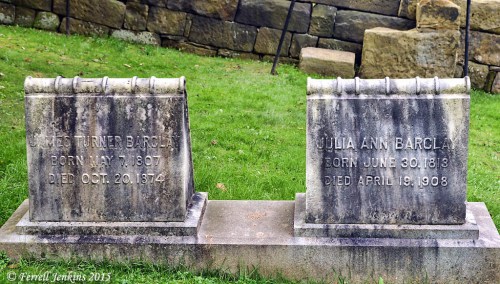
Grave stone of James T. Barclay, and his wife Julia, in the Campbell Cemetery at Bethany, WVA. Photo by Ferrell Jenkins. Grave stone of Dr. James T. Barclay, and his wife Julia, in the Campbell Cemetery at Bethany, West Virginia. Photo by Ferrell Jenkins.

Barclay wrote a book in 1858 about the city of Jerusalem under the title The City of the Great King; or, Jerusalem As It Was, As It Is, and As It Is To Be. In it he tells about some of his explorations in and around the Old City. In a section dealing with nether Jerusalem he discusses the discovery of what is commonly called Solomon’s Quarry…

View original post 495 more words

Traveling Music (ReMix)

Here is yet another iteration of a “re-run” post from a different venue several years ago, engendered this time by scanning old iPod tracks on the ever-more-repetitious journey down I-65 from Chicago to Indianapolis.  It is likely just babel/babble to anyone but me.  FWIW.

Mumford and Sons – Babel – ROCKS!

But it also engenders reservations, similar to their first album, about which I posted the following on 21 January 2011.

In an earlier post I mentioned listening to the musical group, Mumford & Sons while driving near the end of long trip.  Due to some questions, I took it down, lest anyone think I condone the use of profanity on that CD (Sigh No More).  I do not.  Here’s a response of sorts to some of the questions:

Presumably most people understand that mentioning a group, person, or work of art does not imply endorsement of everything in, on, or about it.  The track Timshel, referencing Genesis 4 and resonating Steinbeck’s East of Eden, does not imply endorsement of Steinbeck or all that is in the book.  Quoting a commentary on Genesis 4 does not mean accepting or recommending everything in it.  This is, one hopes, elementary for anyone willing to think about it.

I’m a sucker for clever lyrics, especially those with religious implications – even cryptic ones (especially when married to great harmonious melodies).  Who could not like the opening lines of the first track: “Serve God, love me, and mend – this is not the end…Sigh no more, no more.  One foot in sea and  one on shore.  My heart was never pure – You know me.”   Or, “If only I had an enemy bigger than my apathy I could have won” (from “I Gave You All”).

Or this:  “You told me that I would find a hole Within the fragile substance of my soul, And I have filled this void with things unreal And all the while my character it steals”  — followed by, “It seems all my bridges have been burned, But you say that’s exactly how this grace thing works – It’s not the long walk home that will change this heart, But the welcome I receive with the restart” (Roll Away Your Stone).

However, admixed with admirable thoughts expressed with dexterity are others of a baser sort…of infidelity and betrayal, doubt and denial.  Of course, many people, even those of strong faith, have experienced such thoughts and possibly even behaviors, as we succumb to various temptations to one degree or another.

Most vexing and disturbing is the gratuitous use (in Little Lion Man, CD track 7) of a common vulgarism meant to describe one of the most divinely pleasurable of human experiences – made into a cheap swear-word.  That is, of course the nature of profanity – taking something which is a should be special or limited to particular circumstances and profaning it by making it common or ordinary.  As several before me have noticed, if one wished to express extreme displeasure, one could at least use something REALLY unpleasant, like “Audit you, buddy!”

I realize one can hear such vulgarities at the mall or at a high school sporting event (to say nothing or college or pro games).  But it pains me to spend money to download or rip such junk.  One man’s opinion.

Other issues raised by such questions include how those who find such things objectionable should react.  Bury head in sand and ignore?  Boycott?  Draw up the bridge and retreat behind the moat?  Or recognize and engage when possible?  Do we read only that which has no objectionable material?  Hard to come by.  Can we be “fans” only of athletes, teams, or artists without flaw?  Good luck.

Late night thoughts from a fried brain at the end of a long day. Anybody want to sound off on this?  No obligation.

(A closing thought:  It is sobering, when contemplating passing an 18-wheeler in snow, to hear lyrics like, “In these bodies we will live, in these bodies we will die…for you were made to meet your maker.”  Hmmmmm)


Assyrian Nimrud (Calah) destroyed

Tragic.

Ferrell Jenkins's avatarFerrell's Travel Blog

The phrase “Assyrian Triangle” came to be used of three famous Assyrian cities of northern Mesopotamia: Nimrud, Khorsabad, and Nineveh. I think an understanding of this helps when we study Jonah 3:3.

Then the word of the LORD came to Jonah the second time, saying, 2 “Arise, go to Nineveh, that great city, and call out against it the message that I tell you.” 3 So Jonah arose and went to Nineveh, according to the word of the LORD. Now Nineveh was an exceedingly great city, three days’ journey in breadth. (Jonah 3:1-3 ESV)

Parrot says that the word Nineveh might have been understood by those living far away from Assyria by what we now call “‘the Assyrian triangle’ which stretches from Khorsabad in the north to Nimrud in the south, and with an almost unbroken string of settlements, covers a distance of some twenty six miles” (Nineveh and the Old…

View original post 291 more words

The Bulge

Map_of_Malmedy-Stavelot_December_1944

Seventy years ago, in the early morning hours of 16 December 1944, Allied troops in Europe were awakened by artillery barrages and the sounds of German armored infantry beginning a surprise attack that penetrated Allied lines, creating a “bulge” in the front over the next few days and weeks.

My father, now 92 but then only 22 years old, was serving with the 654th Engineering Battalion – a unit of map-makers, printers and lithographers, trained largely in the urban Midwestern technical high schools of Chicago, Milwaukee, Indianapolis, Cleveland, etc. (in my father’s case, Arsenal Technical High School in Indianapolis). Like most of the common soldiers and support troops of WW2, they were largely drawn from the high school classes of 1940,’41, ’42, and ’43.

In the very first chapter of Citizen Soldiers (arguably his best book), Stephen Ambrose identifies the production and distribution of maps such as those produced by the 654th Engineering Battalion as “a critical and never-ending process – eventually in the Normandy campaign, the U.S. First Army passed out 125 million maps.” About 25 years ago, I found in the bookshop of London’s Imperial War Museum several copies of a history of WW2 told by the use of the maps used by any Allied unit wondering what’s the best way to get where they were supposed to go next – several of the maps in that book bore the imprint of the 654th Engineering Battalion.

In December 1944, Dad’s unit had established a map depot containing 1.5 million maps in the Bock Tannery on the banks of the River Ambleve at Stavelot, Belgium. Here’s the account from the official unit history of the 654th Engineering Battalion, produced shortly after V-E day in 1945 by those who served in the unit:

“Although we had a paratroop alert, and heard some unexplained artillery racket from the direction of Malmedy [about 6 miles away, and about which more later—JSW] nobody expected any real excitement. The first indication that things were getting pretty warm was on the evening of Sunday, December 17, when a sentry from another engineer outfit rushed into our orderly room with word that he had seen German tanks and had been fired on at a road block less than a mile away, across the river. He was sent back to his unit to report, and a little later ha and another man from his unit recrossed the bridge in a jeep to see if the road back was still being held. They had just got across the bridge when they drew a heavy burst of enemy fire, wounding both of them and wrecking the jeep…In the meantime we had taken up defensive positions along the riverbank with our machine gun set up to guard the bridge…

“Since our orders were to hold out until relief arrived, we knew we were in for a hot night. Heavy firing broke out along the river. Mortar shells and machine gun slugs were coming our way, and we answered them with our carbines. From midnight until dawn of December 18th we alone held Stavelot against the German First SS Panzer Division. If the German commander had known that the east bank of the Ambleve, which he wanted very badly to cross, was being held by a mere handful of surveyors, draftsmen, and clerks, he could have sent his tanks roaring across the bridge and up the back road to Spa and Liege. As it worked out, we kept Jerry ducking all night long. Our carbines silenced at least one German machine gun which was operating only fifty yards from the main warehouse of the map depot, and by morning, when the armored infantry arrived to take over the defense of Stavelot, our line was intact, and the line of the main German thrust had swung to the south, trying to find a softer spot in American lines… When we pulled out in the morning [under orders from above to fall back toward Spa and Trois-Ponts, deemed by the Allied brass to be more defensible] we hadn’t lost a man, we had held our position, and we had caused the enemy, with his determination, casualties and plenty of trouble.”

According to some of the “standard” histories of WW2 – usually composed decades later by using many such unit histories, interviews, letters, and many other source documents – the engineers from the “other unit” were elements of the 291st Engineering Battalion, which was in part responsible for the removal and documentation of at least 76 American corpses slaughtered – machine-gunned to death while standing in an open field, having surrendered and been disarmed by the Germans. This was the infamous Malmedy Massacre at the Baugnez Crossroads, only about 6-7 miles from Stavelot where the 654th was stationed (the definitive account is Crossroads of Death by James J. Weingarten, University of California Press, 1979). They were not the only disarmed POW’s massacred by German forces during the Battle of the Bulge.

Had the 654th realized that the Germans they were facing across the Ambleve was the notorious Kampfgruppe Peiper, they might have had a more sobering perspective on their predicament. The commander, Joachim Peiper, was the “point of the spear” of the German attack sweeping west to seize river bridges all the way to Huy. Indeed, even the armored infantry which replaced the 654th at Stavelot was unable to hold the bridge the following day; an attempt to blow the bridge before the Germans could cross was evidently stymied in part by the infiltration of at least two of Colonel Otto Skorzeny’s English-speaking German troops operating behind the Allied lines in captured American uniforms and Jeeps. Peiper’s uncharacteristic hesitation that night at Stavelot was probably as much an attempt to regroup his men, who had been fighting steadily for 36 hours, as well as allow the remainder of his armor, stretched out for miles behind him, to catch up to Peiper’s lead elements. Had Peiper known that Stavelot was the site not only of the map depot, but also one of the largest Allied fuel depots in all of Europe, storing millions of gallons of gasoline, he would no doubt have stormed across the bridge without hesitation.

Over the decades, often relying on the first-person accounts in the 654th unit history, I have tracked the course of where my father was stationed all across Europe, beginning at Tetbury, England (near the current summer palace of Prince Charles in the Cotswolds – where the 654th assembled the huge 6-inches-to-the-mile 3-D relief map of the Normandy beaches used by Eisenhower and the top brass for the main briefing in London, including Churchill himself, of the D-Day invasion – described in the opening chapter of Rick Atkinson’s Liberation Trilogy, and formerly discussed on this blog). The trail then led across Omaha Beach, through Paris, across France and Belgium, and ultimately across the ruined Siegfried Line and the wreckage of Aachen into Germany (first stop at Bad Godesburg, north of Koblenz and about 2 miles from the famous Bridge at Remagen).

One of the most memorable evenings in our “family history” was taking my children to Bad Godesburg nearly 50 years after their grandfather was there, having supper at a sidewalk café within sight of the stanchions of the ruined “Bridge at Remagen,” explaining to a very attentive audience the significance of WW2 and the “citizen soldiers” like their grandfather who each played their part in the “Mighty Endeavor.”

Often accompanied by my good friend and former student, Steve Wallace – who during his 20+ years living in Germany has forgotten more about WW1 & WW2 battlefields than most of us will ever know – I have located many of the places my father’s unit occupied decades before. This included a foray into the Belgian woods with a metal detector (with permissions from the museums and authorities controlling those sites) which produced a buried, mud-encrusted but relatively well-preserved Nazi helmet not far from Spa; it occurred to me then that “the guy who wore this might well have shot at my Dad!” That helmet now resides in my office at home.

Today my father is in a nursing home in Indianapolis, his mind still clear and his resolve strong despite the fact that his body will no longer do everything he wants it to. My thoughts and prayers are with him tonight, as I consider the circumstances he and millions of his comrades faced seven decades ago. Thanks, Dad – I love you!JHW-WW2

Life in the Trenches–Ashkelon Grid 16

What archaeologists do …. from Trent & Rebekah’s Blog

The Bosphorus − “a liquid line”

A truly fascinating place — and concept!

Ferrell Jenkins's avatarFerrell's Travel Blog

For years I have received Saudi Aramco World (Saudi was added to the name a few years ago). From time to time there are articles pertaining to some portion of the Bible World. The March/April 2014 issue has an article by Louis Werner entitled “Bosporus: Strait Between Two Worlds.” The leading paragraph sets the tone for the article.

Look at an atlas of the oceans, and one place always seems to catch the eye. The Bosporus, that narrow waterway connecting the Black Sea to the Sea of Marmara, which cuts the city of Istanbul into two halves, stands out alone among the world’s other major straits and canals. Along with the wider twin, the Dardanelles, the Bosporus famously divided east and west, while the rest − the Suez and Panama Canals, the Malacca and Magellan Straits, to name but a few − link different regions.

Its function as a…

View original post 233 more words

July 4th at Lachish

July 4th is celebrated by Americans all over the world ….

Ferrell Jenkins's avatarFerrell's Travel Blog

In the previous post I mentioned that several former students and friends are participating in the dig at Tel Lachish this year.

Six years ago on this day I wrote about Lachish on July 4th, 1980. Since we have many more readers now I think it appropriate to re-post that entry here.

— • —

On July 4, 1980, I was participating in the excavation at Tel Lachish in Israel along with three of my colleagues from Florida College (James Hodges, Phil Roberts, and Harold Tabor). There were sizable numbers of participants from Israel, United States, Australia, South Africa, and Germany. In addition to the hard work out in the sun, we had some fun. On the morning of July 4th a few of the guys got an American flag and put together a drum and bugle corp and marched across the tel. Note especially the plastic bucket being used…

View original post 413 more words

Iditrarod Adventures: The Big Envelope

Iditrarod Adventures: The Big Envelope

Iditrarod Adventures —  by Jan Distel

The Big Envelope

Grant proposals were due November 1, with the results not to be announced until mid-February.
I tried not to think of it much during those three long months.  When it would come to mind, I would try not to hope and wish.  I would get out my red pen and grade more essays, plan some lessons, work on other school projects…anything to avoid thinking about the grant 24/7.

As the time for the announcement grew closer and closer, one of my teacher friends–who had also submitted a grant proposal–commented that she could not believe all of the things she had committed to do if she were a successful candidate.  I silently agreed, especially when she exclaimed, “This is going to change my life!”

One cold, snowy Saturday in February, one of my dear friends who had also applied let me know she had received a letter about it.  I was convinced that I would be notified that day, too.  We checked the mail time after time, but the box was always empty, mail having been delayed because of several days of bad weather.

……..  Read more at http://iditarodadventures.blogspot.com/ — by my cousin, Jan Distel