
Footnote 41 – David Edwin Harrell, Jr., “B.C. Goodpasture: Leader of Institutional Thought,” in Melvin D. Curry, ed., They Being Dead Yet Speak (Florida College Lectures, 1981), pp. 249-250. (Excerpt from a section entitled “The Emergence of Denominational Leadership”).

The stages of development often seen in religious fellowships, related here by historian David Edwin Harrell, Jr., are well worth contemplating in these times.

1. From truth-oriented to group-oriented.

2. From open controversy to closed controversy.

3. From self-conscious rejection of society to self-conscious acceptance of society.

4. From builders to preservers.

B. C. Goodpasture fits neatly into a sociological model of second generation religious leaders. One can pretty well trace the evolution of a religious group by the changes in skills from first to second generation leaders.

1. From truth-oriented to group-oriented. First generation religious leaders are committed to ideas, often being forced to abandon their parent groups because of that commitment. Like the evangelists of New Testament days they preach their message regardless of the consequences. The second generation shows a growing concern about the good of the group, though ostensibly doctrine must still be measured by truth. But the emphasis changes. Instead of the church growing out of the truth, the truth becomes the possession of the church. The type of man demanded for the first work is a preacher, a Bible student, a defender of the truth; what is needed for the second is a conciliator and manager.

2. From open controversy to closed controversy. The method used to spread the message in a young religious movement, including the New Testament church, is open confrontation. Both in the first century and in more recent times the spread of the gospel has been marked by open discussion and debate. When one is truth-oriented, he has nothing to defend except his teachings and he has no tools for fighting except his ideas. When one’s religion becomes institutional other forces come into play. Open debate (even limited debate) may no longer seem wise if it disturbs the peace of the group and threatens the health of institutions. Furthermore, the institutions, capable of exerting pressure in indirect ways, exercise leadership which can be totally divorced from ideology. In short, B. C. Goodpasture’s leadership, it seems to me, begins a second period of religious controversy in the churches of Christ in the twentieth century, a period marked by the use of new techniques. Foy Wallace scorched heretics; Goodpasture warned them that they would lose their position in the brotherhood.

3. From self-conscious rejection of the society to self-conscious acceptance of the society. First generation religious leaders generally disdain the society they live in and openly attack the dominant religious institutions of that society. This sense of world-separation and its accompanying call for conversion is clearly present in the New Testament and in the early history of the restoration movement. Christians knew that the world considered them fanatics; they were not ashamed to be thought strange; they forged no truces with the dominant religions of their time. Second generation leaders are more apt self-consciously to seek peace with their society as the churches come to crave respectability…. “Plain” preachers and those of the next generation who are no longer “plain” generally do not say the same things.

4. From builders to preservers. There comes a time in the life of all religious groups when evangelists become confused with pastors, when evangelistic fervor turns to revivalistic concern, when debaters and polemicists turn to brotherhood managers, and when local churches become little more than sources of money for promoters. Such changes call for a shift to managerial leadership.

In the 1950s the preserving of the churches of Christ empire became central in the thought of many people. There was still a will to work, but it was directed toward preserving and improving the image of what had been hewn out of the society by the previous generation. There is a vast difference, though not always an apparent one, between preaching the gospel and converting sinners and in promoting the church of Christ.

Seeing Ourselves in Our Leaders

In every time some men have been widely visible to the Christians of their day. It has always been treacherous to view such men as “brotherhood leaders,” since such thinking almost inevitably conjures up a “brotherhood” to lead. But it also assigns a distorted weight of importance to such men; we tend to overestimate their influence; to see things in terms of what they have done to us.

Actually, these highly visible men are more like speedometers than steering wheels. They are not so much taking us some place as they are telling us where we are. B. C. Goodpasture did not make the churches of Christ what they were in the 1950s. He was a product of what they had become, perhaps the ablest product. And he led the people in the way that they had determined to go.

Footnote 40 – James H. Garrison, “Another Sin,” Gospel Echo (June, 1869), pp. 228-229.

In the process of refreshing some older material for an upcoming series on the Quest for Undenominational Christianity, I came across this reference from an article I wrote a half-century ago.

“I presume to say that it has not escaped the notice of the careful reader of our religious periodicals, that there is, among our brethren, an increasing tendency to mercilessly criticize each other for any supposed error that they may harbor… Our religious papers are full of such controversies. One brother sets forth his views upon a certain subject, in all good conscience. Another objects to the reasoning and proof, and severely flogs him for advocating an absurd position. The first brother, finding his logic assailed, and even his motives sometimes impugned, is incensed and replies accordingly. ‘Like begets like,’ and so the controversy continues, increasing in virulence, abounding in sarcastic thrusts and personal allusions, until the ‘brother’ is lost sight of in the ‘antagonist.’ But little attention is paid now to the original matter of difference, but the greater portion of the replies are occupied in discussing ‘false issues,’ ‘exposing fallacies,’ ‘exposing non sequiturs,’ correcting ‘false impressions,’ etc.”

Observations:

(1) It has not escaped the notice of careful readers that this phenomenon is not limited these days to religious periodicals, but often is featured in social-media disputes and other venues regarding sports, politics, health issues, entertainment, and nearly any other topic one can name.

(2) Even when “another objects to the reasoning and proof” but, rather than “severely flogging” the “antagonist” for his “absurd position,” merely offers a reasoned dissent from the original, the discussion often devolves into a melee when the original proponent is the one who begets the flogging of “absurdities” which oppose her/his viewpoint. Others then join the fray.

(3) It is possible to speak truth in an unseemly, and ungracious manner which may deter some from seeing the truths thus disguised or obscured. It is also possible to lead some astray with a winsome, seemingly gracious manner that disguises the ugly truths of an unbiblical message.

(4) Historically, James H. Garrison was a “moderate” or “middle-of-the-road” voice in the late 19th-century division which produced the Disciples of Christ in the controversy over instrumental music, missionary/evangelistic societies, and other emerging denominational agencies. As “moderate” as he may have been, Garrison served as a bridge to ever more radical views and positions in the next generation of younger preachers and scholars – including his own son, W.E Garrison, a religious modernist who was long associated with the Disciples Divinity House at the University of Chicago, and helped produce the full-grown Disciples denomination.

James H. Garrison’s “moderate” views, expressed in the Christian-Evangelist, of which he was a founding editor, and his 1891 book, The Old Faith Re-Stated, attempted to convince readers that the leftward drift into modernist viewpoints of late-19th century Disciples were really no different from the positions of prior generations of believers, including Alexander Campbell, Barton W. Stone, and many others who left various denominations in their quest to become “Christians only.”

While James H. Garrison’s views may have seemed, to some, compatible with more “conservative” or Biblical views, in hindsight it becomes clear that his influence lay with those who walked a much more liberal/modernistic path back into some of the denominational structures which prior generations had left in their attempts to be independent of any denomination.

Biblical inscription from Mt. Ebal, but a note of caution

Mind the Gap, indeed!

LukeChandler's avatarBible, Archaeology, and Travel with Luke Chandler

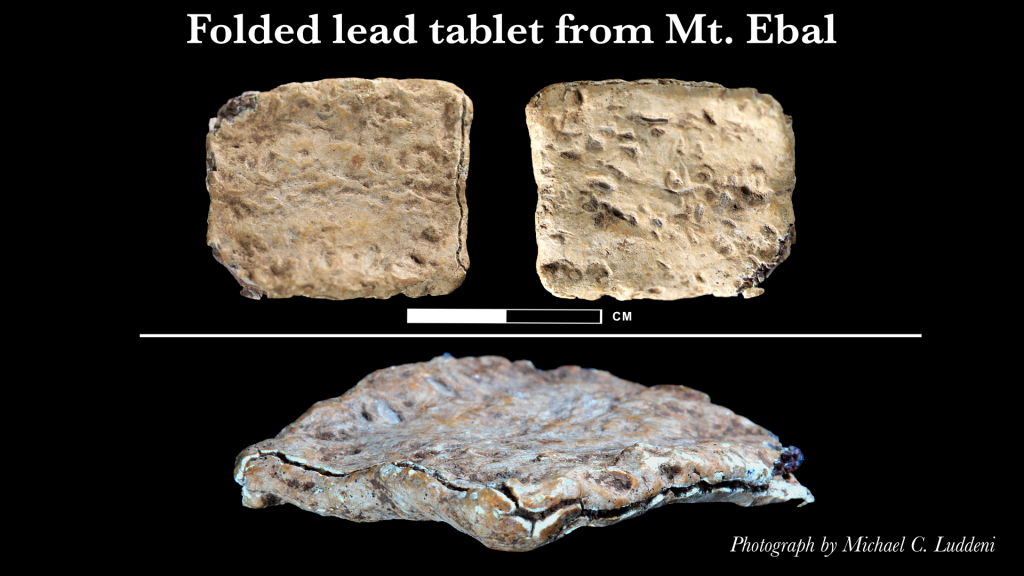
Archaeologists have revealed a small, ancient lead amulet with an inscription that was discovered on Mt. Ebal in the rubbish pile of a previous excavation. Back in the 1980s, Dr. Adam Zertal uncovered a stone structure atop Mt. Ebal that some interpret as an altar built by Joshua in the Bible (Josh 8:30-31) Mt. Ebal is also one of the mountains of blessing & cursing in Deut. 27 and Josh. 8. These types of amulets are known from the ancient world and contained inscriptions folded and sealed inside thin sheets of lead. The lead folds on this amulet couldn’t be opened without breakage so researchers employed tomographic scans of the exterior and interior to try and discern the hidden inscription.

Images of the folded lead tablet found on Mt. Ebal. The object is small, roughly 1 inch square.
Photo by Michael C. Luddeni. (Courtesy of Associates for Biblical Research)

Dr…

View original post 840 more words

Grace, Faith, and Obedience

Footnote 42 — Christopher JH Wright, Knowing Jesus Through the Old Testament (Downers Grove: InterVarsity Press, 1992), p68 LOGOS edition

“The promise to Abraham was effective because he believed it and acted upon it, continuing to do so long after it had become humanly impossible. The exodus was promised by God, but it would not have happened if the Israelites had not responded to the leading of Moses, and even then some of them did so reluctantly. The same people received the promise of the land, but because their faith and obedience failed at the crucial point, they never received it and perished in the wilderness. And so it goes on all the way through scripture. The promise comes as the initiative of God’s grace and always depends on his grace. But that grace has to be accepted and responded to by faith and obedience.”

Prohibition Mythologies

Footnote 41 — Michael Lewis and Richard F. Hamm, eds., Prohibition’s Greatest Myths: The Distilled Truth About America’s Anti-Alcohol Campaign (Baton Rouge: Louisiana State University Press, 2020).

This is an intriguing scholarly volume of essays marking the centennial of Prohibition in the United States. From the Preface: “This volume began at a conference in the Netherlands when a few prohibition scholars were collectively bemoaning the gap between what historians know about prohibition and what much of the public believes about it…

“As the contributors to the volume were finishing their essays, potent signs of how disruptive alcohol is in our society gave this topic renewed urgency. In a public hearing before a vast audience connected to the scene electronically, a US senator and a nominee for the US Supreme Court questioned each other about whether they drank to the point of memory loss or blackout. Just a week earlier, the World Health Organization had released a massive report on the ill effects of alcohol. It declared that more than 3 million people died because of harmful use of alcohol in 2016. Further, the WHO concluded, “alcohol caused more than 5% of the global disease burden.” Yet, in response to the manifest problems caused by alcohol today, there is no movement seeking to ban alcohol in the United States or throughout much of the world.

“One reason for the lack of such a movement today is that prohibition, especially the American experience of national prohibition, is widely perceived to have been a colossal failure.”

Some of the chapter headings, and myths exploded, in this volume:

“Religious Conservatives Spearheaded the Prohibition Movement”

“Alcohol Consumption Increased During the Prohibition Era”

“Repeal Happened Because Prohibition Was a Failure”

“Prohibition Was Uniquely American”

“Prohibition Changed Little About American Drinking Habits”

“The Current Debates About Marijuana Legalization Are the Same as Those That Ended Prohibition”

And more.

Oblivion Shuns Its Pages

Footnote 40 — Abraham Heschel, God in Search of Man (New York: Farrar, Strauss, and Giroux, 1983), 242.

“Irrefutably, indestructibly, never wearied by time, the Bible wanders through the ages … as if it belonged to every soul on earth. It speaks in every language and in every age … We all draw upon it, and it remains pure, inexhaustible, and complete. In three thousand years it has not aged a day. It is a book that cannot die. Oblivion shuns its pages. Its power is not subsiding. In fact, it is still at the very beginning of its career.”

“How Archaeology Works” webinar!

LukeChandler's avatarBible, Archaeology, and Travel with Luke Chandler

There is a special opportunity to see and learn how archaeology really works this Sunday evening, August 9, at 8pm Eastern Time. For just $10 (only $5 for ASOR members) you can attend a live webinar from the Biblical Archaeology Society on “Digging Deeper: How Archaeology Works.”

This affordable webinar is hosted by Dr. Eric Cline, an internationally renowned archaeologist with more than thirty seasons of excavation experience. His archaeological work ranges from Greece and Crete to Egypt, Israel, and Jordan. Dr. Cline is also a Pulitzer-nominated author and is currently co-directing a new dig at biblical Hazor with Yossi Garfinkel, the archaeologist with whom I have worked for years.

Your $10 (or $5) registration includes several benefits:

  • Get a firsthand look at how archaeology really does work. Break through media misconceptions and see how archaeologists perform their craft. How do they know where to dig? What is it like…

View original post 328 more words

Footnote 34 – John Fabian Witt, Lincoln’s Code: The Laws of War in American History (New York: The Free Press/Simon and Schuster, 2013), p. 213.

Lincoln on Emancipation, the Bible, and God’s Will

Lincoln gave voice to his thinking on the subject in September [1862] when a church delegation from Chicago came to the White House to present a memorial endorsing emancipation… He told the delegates that religious men regularly approached him with advice. They were invariably “certain that they represent the divine will.” But they came with radically opposing views (“the most opposite opinions and advice”), and not all of them could be right. It might even be that all of them were wrong.

And there was the nub of the problem. How could one learn God’s will, and if one could not, how could one make the grave decision…? “If I can learn what it is I will do it!” Lincoln said. But God’s justice was inscrutable. “These are not,” he reminded his memorialists, “the days of miracles.” There would be no “direct revelation.” …Confederate troops were no doubt “expecting God to favor their side” just as Union men thought that God would favor theirs….

But the Chicago Christians replied with a much older idea…Unbeknownst to them, their reply followed the course Lincoln’s own thinking had been taking over the previous weeks. Moral uncertainty, they observed, could not excuse paralysis. “Good men,” they conceded, “differed in their opinions.” But “the truth was somewhere,” and men could not merely set one opinion against another and throw up their hands. The moral leader had to act, had to bring “facts, principles, and arguments” to bear and come to a conclusion as to what justice required

…[W]hen the interview closed, it was clear that Lincoln and his Chicago petitioners were not so far apart after all. “Do not misunderstand me because I have mentioned these objections,” Lincoln told them. “Whatever shall appear to be God’s will I will do.”

34 John Fabian Witt, Lincoln’s Code: The Laws of War in American History (New York: The Free Press/Simon and Schuster, 2013), p. 213.

June 6th

Interesting day: Yesterday was the 47th anniversary of marriage to my best friend. (Steve: “How did this happen?!” — Bette: “One day at a time”). However, Bette was not feeling well, so we postponed the “celebration” to June 6th (quiet dinner in a corner booth at one of our favorite restaurants). This series of days in early June is bittersweet in many ways — my father’s only trip to Europe was via Omaha Beach, and D-Day has always been a solemn date to me (and many others, of course). My parents’ wedding occurred on June 8, the year following the end of WW2. Had he lived another 15 months, this would have been their 70th anniversary. Verily, nothing in this fallen world is truly “permanent.” I am content to be “in the moment.”

God of the Living, in Whose Eyes

God of the Living, in Whose Eyes

Carl Peterson on John Ellerton – worth reading!

Carl O. Peterson's avatarStrains Divine

When the hymnal Psalms, Hymns, and Spiritual Songs (PHASS) was published in 2012 by Sumphonia Productions, it introduced to its users a number of texts which had not been available previously in hymnals commonly in circulation among its primary audience. Some of these were more recent texts that had not yet had opportunity to do so (or had not been sought out until this publication); others were much older, going back 100 years or more, that for various reasons had never penetrated “the brotherhood.”

One such hymn (to my knowledge and ability to research) is “God of the Living, in Whose Eyes.” The text was written by John Ellerton, whose hymn, “The Day Thou Gavest,” is well regarded in some quarters and has appeared in brotherhood hymnals since at least Jorgensen’s Great Songs of the Church (both editions). The tune used in PHASS was composed by C. E. Couchman in 2011, presumably…

View original post 1,391 more words