A HYMN FOR TODAY – Praise, My Soul, the King of Heaven

A HYMN FOR TODAY

Praise, my soul, the King of heaven;
To His feet thy tribute bring.
Ransomed, healed, restored, forgiven,
Evermore His praises sing:
Alleluia! Alleluia!
Praise the everlasting King.

Praise Him for His grace and favor
To our fathers in distress.
Praise Him still the same as ever,
Slow to chide, and swift to bless.
Alleluia! Alleluia!
Glorious in His faithfulness.

Fatherlike He tends and spares us;
Well our feeble frame He knows.
In His hands He gently bears us,
Rescues us from all our foes.
Alleluia! Alleluia!
Widely yet His mercy flows.

Angels, help us to adore Him,
As you see Him face to face;
Sun and moon, bow down before Him,
All who dwell in time and space.
Alleluia! Alleluia!
Praise with us the God of grace.

8.7.8.7 – Henry F. Lyte, 1834
From Psalm 103:1-8, 13-14, 20-22

Tune: REGENT SQUARE – Henry T. Smart, 1867 alt.

#43 in Psalms, Hymns, and Spiritual Songs, 2012

A sunrise few have seen

Ferrell Jenkins's avatarFerrell's Travel Blog

Trent and Rebekah are “vagabonding” for forty days in Israel between the close of the Ashkelon excavation and the opening of their fall semester at Jerusalem University College (also known as the American Institute of Holy Land Studies). Last Thursday morning they were at Masada for the sunrise. I didn’t ask if they spent the night there.

This view from Masada to the east at sunrise is one I have not seen. They graciously allowed me to post it here.

There is more to this photo than just the beauty of it. In their photo you see the Lisan (or Tongue) that extends from the east into the Dead Sea. You may also see the canal through which water is pumped to the southern end of the Sea.

The photo below was made near mid-day from Masada.

The same photo below has been enhanced further in Photoshop to reveal the…

View original post 144 more words

Show and Tell: A Mini-Exhibit in Stone-Campbell Hymnody…reblogged from ACU Special Collections

mac's avatareScriptorium

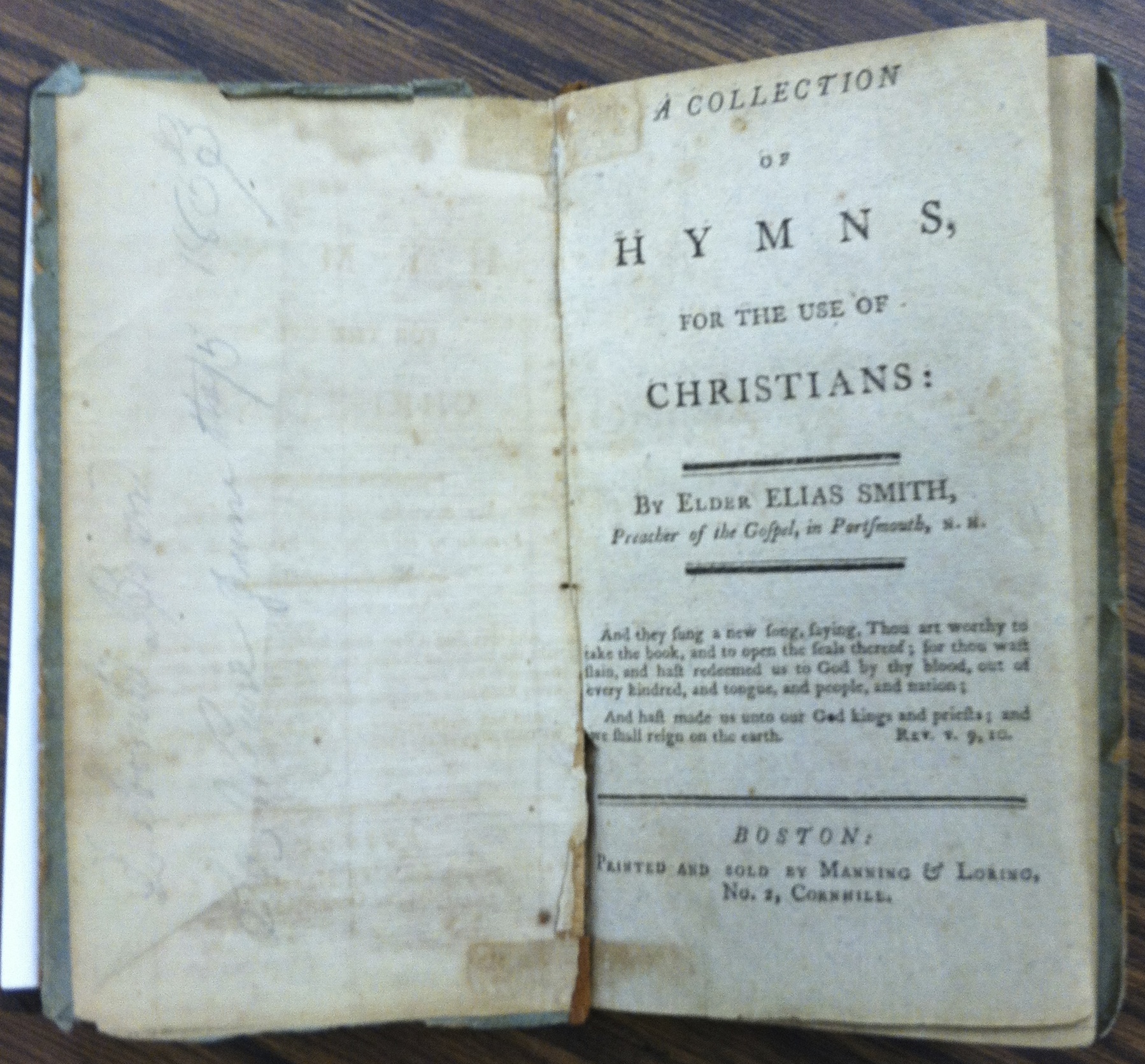
We had a special treat a few days ago when several participants in the TX Singing School visited Special Collections for a tour.  In response to their request, I pulled several hymnals and related artifacts for a brief show and tell.  We thought you’d like to see the pictures.

Elias Smith, A Collection of Hymns, for the Use of Christians. Boston: Manning and Loring [1804].

Elias Smith, A Collection of Hymns, 1804

more at ACU Special Collections blog here.

View original post

Sophomore Spirituality – Gary Henry

Sophomore Spirituality – Gary Henry

Second-Stage Spirituality 

From Gary Henry’s WordPoints – read more at http://wordpoints.com/blog/second-stage-spirituality-august-3/

“And if anyone thinks that he knows anything, he knows nothing yet as he ought to know” (1 Corinthians 8:2).

WHEN WE’VE JUST GOTTEN PAST THE BEGINNING STAGE OF SPIRITUAL LIFE, THERE IS A PARTICULAR DANGER THAT WE FACE. It is the danger always encountered in the second stage of any endeavor: THE DANGER OF THINKING THAT WE KNOW MORE THAN WE DO. If we don’t deal with this danger in the proper way, we will find ourselves blocked from any further progress.

The greatest barrier to gaining greater knowledge is the illusion of knowledge, the mistaken notion that we already know much, when in reality we know very little. This barrier is often met by the “sophomore” in any field of learning. This is the individual, hardly more than a beginner himself, who looks down on others who are just starting out. The sophomore has gone far enough to have just a little wisdom (sophos, wise), but he’s a fool (moros, foolish) for failing to see how far he has yet to go.

One measure of our attitude with respect to knowledge is the amount of listening we do compared to the amount of talking. If those who know us best observe that we’re more eager to talk than to listen, then we’ve probably overestimated how much we know. It’s good to have learned a thing or two, but it’s not good to see every person we meet as a potential audience. Solomon said, “A fool has no delight in understanding, but in expressing his own heart” (Proverbs 18:2). And James advised, “Let every man be swift to hear, slow to speak . . .” (James 1:19).

There is so much more of God than any of us have ever experienced, even in our moments of greatest maturity. His bounty is beyond what any of us have ever sought from Him. Let us not be so proud of what we know that we keep ourselves from learning what we still need to know. If the truth be told, most of us are not yet even in the second stage of spiritual understanding. There are many leagues yet to travel before we leave the first! Let us be humbled at the thought of our ignorance. And having been humbled, let us have a grander vision of what there is yet to know about our great God. The half has not yet been told.

“If you have lived far from God, you may think you are very near him when you finally start a life with him. The peasant thinks he has been to court because he saw the king pass by one day” (Francois de Fenelon).

Gary Henry – WordPoints.com

+++++++++++++++++++++++++++++++++++++++++++++

This is a fabulous site, chock-full of excellent nuggets on a variety of spiritual topics — visit often!

Hymn Voted Out of Hymnal for Using the Phrase “Wrath of God”

Hymn Voted Out of Hymnal for Using the Phrase “Wrath of God”

‘Wrath of God’ Keeps Popular Worship Song Out of 10,000-Plus Churches

‘In Christ Alone’ blocked from new PCUSA hymnal over atonement language.
Abby Stocker  —  posted 8/1/2013 12:27PM
Excerpts follow — read more at http://www.christianitytoday.com/gleanings/2013/august/wrath-of-god-in-christ-alone-blocked-pcusa-hymnal.html
The “wrath of God” has kept one of today’s most-popular worship songs from being sung in many Presbyterian churches.

A Presbyterian Church (U.S.A.) committee desired to add “In Christ Alone” to the denomination’s new hymnal, Glory to God, set to be released this fall. But it firstrequested permission to avoid theological controversy by altering the modern hymn’s lyrics from “Till on that cross as Jesus died/the wrath of God was satisfied” to “Till on that cross as Jesus died/the love of God was magnified.”

However, authors Keith Getty and Stuart Townend rejected the proposal. So the committee voted six to nine to bar the hymn.

“The song has been removed from our contents list, with deep regret over losing its otherwise poignant and powerful witness,” committee chair Mary Louise Bringle told The Christian Century. The “view that the cross is primarily about God’s need to assuage God’s anger” would have a negative impact on worshippers’ education, according to Bringle.

….

In a widely-circulated response to the PCUSA that the Gettys called “spot on” on their Facebook page, Timothy George argued that although debating doctrine through hymns is not a new phenomenon, failing to recognize God’s capacity for wrath can effectively trivialize God’s power. “God’s love is not sentimental; it is holy. It is tender, but not squishy,” he wrote. “It involves not only compassion, kindness, and mercy beyond measure … but also indignation against injustice and unremitting opposition to all that is evil.”

Russell Moore observed in the Washington Post that singing about doctrines such as God’s wrath serves as a direct reminder of God’s mercy to Christians.

+++++++++++++++++++++++++++++
Read more at http://www.christianitytoday.com/gleanings/2013/august/wrath-of-god-in-christ-alone-blocked-pcusa-hymnal.html

NYT: Some Mormons Search the Web and Find Doubt

NYT: Some Mormons Search the Web and Find Doubt

Some Mormons Search the Web and Find Doubt

By   —   Published: July 20, 2013 

EXCERPTS FOLLOW — READ MORE AT  http://www.nytimes.com/2013/07/21/us/some-mormons-search-the-web-and-find-doubt.html?smid=fb-share&_r=0

PLAY VIDEO

A Mormon Doubts: Hans Mattsson was once a high-ranking leader for the Mormon church in Europe. He joins others who are experiencing a crisis of faith and finding few answers from their church.

In the small but cohesive Mormon community where he grew up, Hans Mattsson was a solid believer and a pillar of the church. He followed his father and grandfather into church leadership and finally became an “area authority” overseeing the Church of Jesus Christ of Latter-day Saints throughout Europe.

When fellow believers in Sweden first began coming to him with information from the Internet that contradicted the church’s history and teachings, he dismissed it as “anti-Mormon propaganda,” the whisperings of Lucifer. He asked his superiors for help in responding to the members’ doubts, and when they seemed to only sidestep the questions, Mr. Mattsson began his own investigation.

But when he discovered credible evidence that the church’s founder, Joseph Smith, was a polygamist and that the Book of Mormon and other scriptures were rife with historical anomalies, Mr. Mattsson said he felt that the foundation on which he had built his life began to crumble.

Around the world and in the United States, where the faith was founded, the Mormon Church is grappling with a wave of doubt and disillusionment among members who encountered information on the Internet that sabotaged what they were taught about their faith, according to interviews with dozens of Mormons and those who study the church.

“I felt like I had an earthquake under my feet,” said Mr. Mattsson, now an emeritus area authority. “Everything I’d been taught, everything I’d been proud to preach about and witness about just crumbled under my feet. It was such a terrible psychological and nearly physical disturbance.”

Mr. Mattsson’s decision to go public with his disaffection, in a church whose top leaders commonly deliberate in private, is a sign that the church faces serious challenges not just from outside but also from skeptics inside.

Greg Prince, a Mormon historian and businessman in Washington who has held local leadership positions in the church, shares Mr. Mattsson’s doubts. “Consider a Catholic cardinal suddenly going to the media and saying about his own church, ‘I don’t buy a lot of this stuff,’ ” Mr. Prince said. “That’s the level we’re talking about here.”

He said of Mr. Mattsson, “He is, as far as I know, the highest-ranking church official who has gone public with deep concerns, who has had a faith crisis and come forward to say he’s going to talk about it because maybe that will help us all to resolve it.”

Every faith has its skeptics and detractors, but the Mormon Church’s history creates special challenges. The church was born in America only 183 years ago, and its founder and prophet, Joseph Smith, and his disciples left behind reams of papers that still exist, documenting their work, exposing their warts and sometimes contradicting one another.

“The Roman Catholic Church has had 2,000 years to work through the hiccups in its history,” said Terryl L. Givens, a professor of English, literature and religion at the University of Richmond and a Mormon believer. “Mormonism is still an adolescent religion.”

Mr. Givens and his wife, Fiona, recently presented what they called “Crucible of Doubt” sessions for questioning Mormons in England, Scotland and Ireland. Hundreds attended each event.

+++++++++++++++++++++++++++++++++++++++++++++++

Read more at:  http://www.nytimes.com/2013/07/21/us/some-mormons-search-the-web-and-find-doubt.html?smid=fb-share&_r=0

A Palace of David Discovered at Khirbet Qeiyafa?

LukeChandler's avatarBible, Archaeology, and Travel with Luke Chandler

The latest big archaeological news is the press announcement that a Palace of King David has been discovered in the Judean foothills at Khirbet Qeiyafa, a city dating to the time of his reign. Besides the palace, a large pillared storehouse to manage taxes in kind (oil, wine, grain, etc.) was discovered along the northern edge of the city.

These discoveries are from the site I’ve worked the past five seasons. I mentioned the Iron Age fortress (“David’s Palace”) last year in a post that included a photo. The long wall was identifiable as the central building of the Iron Age city and was a large factor in the decision to excavate one more season at Qeiyafa in 2013.

The “David’s Palace” title is certainly tweaked for media exposure. For better and for worse, it worked. The story hit Israelinewssources and moved to Americanmedia in less than a…

View original post 958 more words

The Ancient Library of Alexandria: The West’s most important repository of learning

The Ancient Library of Alexandria: The West’s most important repository of learning

The Ancient Library of Alexandria: The West’s most important repository of learning

J. Harold Ellens   •  05/01/2013

J. Harold Ellens’s article “The Ancient Library of Alexandria” originally appeared in Bible Review, along with the sidebars “Greco-Roman Philosophers,” “Whither Aristotle’s Library?” “The Perils of the Alexandria Library: Two Ancient Book-Burnings,” “How to Measure the Earth” and “Alexandria Library Redux.”  

Excerpt follows; read more at http://www.biblicalarchaeology.org/daily/biblical-sites-places/biblical-archaeology-places/the-ancient-library-of-alexandria/

When Alexander the Great died in 323 B.C.E., the Ptolemaic dynasty was given control of Egypt. Ptolemy I (c. 367–283 B.C.E.) established his capital at Alexandria and immediately began to build up the city. Ptolemy’s grandest project, begun in 306 B.C.E., was the Library of Alexandria, a research center that held one million books by the time of Jesus. Scala/Art Resource, NY

——————————————————-

In March of 415 C.E., on a sunny day in the holy season of Lent, Cyril of Alexandria, the most powerful Christian theologian in the world, murdered Hypatia, the most famous Greco-Roman philosopher of the time. Hypatia was slaughtered like an animal in the church of Caesarion, formerly a sanctuary of emperor worship.1 Cyril may not have been among the gang that pulled Hypatia from her chariot, tearing off her clothes and slashing her with shards of broken tiles, but her murder was surely done under his authority and with his approval.

Cyril (c. 375–444) was the archbishop of Alexandria, the dominant cultural and religious center of the Mediterranean world of the fifth century C.E. He replaced his uncle Theophilus in that lofty office in 412 and became both famous and infamous for his leadership in support of what would become known as Orthodox Christianity after the Ecumenical Council of Chalcedon (451), when basic Christian doctrine was solidly established for all time.

Cyril’s fame arose mainly from his assaults on other church leaders, and his methods were often brutal and dishonest. He hated Nestorius, bishop of Constantinople, for example, because Nestorius thought Christ’s divine and human aspects were distinct from one another, whereas Cyril emphasized their unity. At the Council of Ephesus in 431, Cyril arranged for a vote condemning Nestorius to take place before Nestorius’s supporters—the bishops from the eastern churches—had time to arrive. Nor was Cyril above abusing his opponents by staging marches and inciting riots. It was such a mob, led by one of Cyril’s followers, Peter the Reader, that butchered the last great Neoplatonic philosopher, Hypatia.      ……..

One reason Cyril had Hypatia murdered, according to the English historian Edward Gibbon, was that Cyril thought Hypatia had the political ear of Alexandria’s chief magistrate, who vigorously opposed Cyril’s ambition to expel from the city those who held different religious views from his own.  Cyril was also jealous of Hypatia because scholars from all over the world crowded into her lectures in Alexandria, Athens and elsewhere. Socrates (380–450), a church historian from Constantinople, says of Hypatia:

[She] was so learned that she surpassed all contemporary philosophers. She carried on the Platonic tradition derived from Plotinus, and instructed those who desired to learn in…philosophic discipline. Wherefore all those wishing to work at philosophy streamed in from all parts of the world, collecting around her on account of her learned and courageous character. She maintained a dignified intercourse with the chief people of the city. She was not ashamed to spend time in the society of men, for all esteemed her highly, and admired her for her purity.

Hypatia’s father, Theon, was a leading professor of philosophy and science in Alexandria. He had prepared a recension of Euclid’s Elements, which remained the only known Greek text of the great mathematician’s work until an earlier version was discovered in the Vatican Library in this century.  Theon also predicted eclipses of the sun and moon that occurred in 364.

Hypatia, who was born about 355, collaborated with her father from early in her life, editing his works and preparing them for publication. According to one authority, she was “by nature more refined and talented than her father.”7 The extant texts of Ptolemy’s Almagest and Handy Tables were probably prepared for publication by her.8

Such scientific and philosophical enterprises were not new or surprising in Hypatia’s Alexandria, which already boasted a 700-year-old, international reputation for sophisticated scholarship. Founded in 331 B.C.E.9 by command of Alexander the Great, the city contained almost from its beginnings an institution that would remain of immense importance to the world for the next 2,300 years. Originally called the Mouseion, or Shrine of the Muses, this research center and library grew into “an institution that may be conceived of as a library in the modern sense—an organization with a staff headed by a librarian that acquires and arranges bibliographic material for the use of qualified readers.”   ….

Indeed, the Alexandria Library was much more. It “stimulated an intensive editorial program that spawned the development of critical editions, textual exegesis and such basic research tools as dictionaries, concordances and encyclopedias.”11 The library in fact developed into a huge research institution comparable to a modern university—containing a center for the collection of books, a museum for the preservation of scientific artifacts, residences and workrooms for scholars, lecture halls and a refectory. In building this magnificent institution, one modern writer has noted, the Alexandrian scholars “started from scratch”; their gift to civilization is that we never had to start from scratch again.

+++++++++++++++++++++++++++++++++

Notes

a. The best-known book collected from a non-Greek culture and translated into Greek at the library was the Hebrew Bible, known in its Greek form as the Septuagint (LXX). It seems to have reached the state of a largely completed and official Greek text between 150 and 50 B.C.E. Philo Judaeus (30 B.C.E.–50 C.E.) obviously knew and worked with a Greek version of the Hebrew Bible.

1. Maria Dzielska, Hypatia of Alexandria, trans. F. Lyra (Cambridge, MA: Harvard Univ. Press, 1995), p. 93. Cf. J. Harold Ellens, The Ancient Library of Alexandria and Early Christian Theological Development, Occasional Papers 27, Institute for Antiquity and Christianity (Claremont: Claremont Graduate School, 1993), pp. 44–51.

See also Edward A. Parsons, The Alexandrian Library, Glory of the Hellenic World: Its Rise, Antiquities, and Destructions (London: Cleaver-Hume, 1952), p. 356.

++++++  Much more at http://www.biblicalarchaeology.org/daily/biblical-sites-places/biblical-archaeology-places/the-ancient-library-of-alexandria/
Fake “Experts”

Fake “Experts”

While most people might ask, “Who?” – followed quickly by “Who cares?” – regarding the author of yet another pseudo-“scholarly” book about Jesus, evidently the latest installment in the long and undistinguished line of pulp fiction benefited from an virally inept cable-TV interview. As new-media commentator Joe Carter points out, the REAL missed story here is not what is known about Jesus, but that author’s own self-promotional misrepresentation of his credentials.

My, my – where are all the “investigative journalists” when you really need them? And why does the news media – of all stripes and flavors – insist on putting people on air who make fake claims to be “scholars” when they have no real expertise in the areas they write about? Excerpts:

Snickering at FoxNews while getting duped by ‘Zealot’ author

July 29, 2013 By Joe Carter

…  critics are right about the interview — it is a mess. But while New Media journalists were snickering at FoxNews.com, they failed to notice that the person being interviewed was pulling one over on them by getting away with misrepresenting his credentials.

…….

The first question by host Lauren Green on why a Muslim would want to write about Jesus isn’t as out of line as the Fox critics seem to think. It’s a fair question — a softball question — that allows the interviewee to explain away any apparent bias. But Green should have moved on after asking it and not made Aslan’s religious background the primary focus of the interview. More importantly, if she had been better prepared she could have called Aslan out for at least one blatant and seemingly undeniable untruth.

After being asked the first question by Green, Aslan responds:

 “…So it’s not that I’m just some Muslim writing about Jesus I am an expert with a PhD in the history of religions.” Later in the video he says it’s his job as a “professor of religion including the New Testament. That’s what I do for a living, actually.” And to make sure we get the point, he later adds, “I am a historian. I am a PhD in the history of religions.

At this point, Green should have stopped him and asked him to clarify since he appears to be misrepresenting his credentials.

For starters, he does not have a PhD in the history of religions. Aslan has four degrees: a Bachelors of Religious Studies from Santa Clara University; a Master of Theological Studies from Harvard Divinity School; a Master of Fine Arts in Creative Writing from the University of Iowa; and a PhD in sociology of religions from the University of California, Santa Barbara (his dissertation was on “Global Jihadism: a transnational social movement”).

Why would Aslan claim he has a PhD in history when his degree is in sociology? Does he not understand the difference between the two fields of study?

Aslan also claims that he has a degree in the New Testament. But is this true? Santa Clara doesn’t offer a degree in the New Testament so he can’t be talking about his Bachelors. Perhaps he is referring to the Master’s of Theological Studies degree he earned from Harvard Divinity School in 1999. That school does offer an “area of focus” in “New Testament and Early Christianity.” Is Aslan claiming this was his degree’s area of focus at Harvard? (If so, this would make his claim about having a “degree in New Testament” misleading, at best.)

……………….

When exactly has Aslan taught classes on the New Testament? And as a scholar, has he published peer-reviewed academic articles on Jesus?

Aslan’s book should not be dismissed because it was written by a Muslim. But in making untrue claims about his credentials he raises questions about his credibility. It also raises the question of how often so-called experts and authorities with no real expertise or authority on a subject are presented by New Media outlets as representative “scholars.”

Maybe if these journalists spent less time mocking the gaffes of their competitors and more time vetting the so-called “experts” we wouldn’t have to listen to people snicker about the credibility of online media.

++++++++++++++++++++++

Read more at http://www.patheos.com/blogs/getreligion/2013/07/snickering-at-foxnews-while-getting-duped-by-zealot-author/#more-108675

A HYMN FOR TODAY – The Master Has Come

A HYMN FOR TODAY

The Master has come, and He calls us to follow
The track of the footprints He leaves on our way;
Far over the mountain and through the deep hollow,
The path leads us on to the mansions of day.

The Master has called us, the children who fear Him,
Who march ‘neath Christ’s banner, His own little band;
We love Him and seek Him, we long to be near Him,
And rest in the light of His beautiful land.

The Master has called us, in life’s early morning,
With spirits as fresh as the dew on the sod;
We turn from the world, with its smiles and its scorning,
To cast in our lot with the people of God.

The Master has called us, His sons and His daughters;
We plead for His blessing and trust in His love;
And through the green pastures, beside the still waters,
He’ll lead us at last to His kingdom above.

12.11.12.11.D – Sarah Doudney, 1871

Tune: ASH GROVE – Jones’ Bardic Museum, 1802

arr. Katherine K. Davis – 1939

#637 in Psalms, Hymns, and Spiritual Songs, 2012