Tag Archives: Ancient History
Pay your taxes and do not fear the authorities

While reading Romans 13 I came to Paul’s admonition to the saints at Rome, “Would you have no fear of the one who is in authority? Then do what is good.” My mind immediately turned to the mosaic which was discovered during the excavation of the Byzantine public area at Caesarea Maritima.
The context in Paul’s Epistle to the Romans reads this way.
For rulers are not a terror to good conduct, but to bad. Would you have no fear of the one who is in authority? Then do what is good, and you will receive his approval, for he is God’s servant for your good. But if you do wrong, be afraid, for he does not bear the sword in vain. For he is the servant of God, an avenger who carries out God’s wrath on the wrongdoer. (Romans 13:3-4 ESV)
The sign at the site describes the building…
View original post 48 more words
Guardian: Hanging Gardens of……
Guardian: Hanging Gardens of……
Babylon’s hanging garden: ancient scripts give clue to missing wonder
A British academic has gathered evidence suggesting garden was created at Nineveh, 300 miles from Babylon
- The Guardian, Sunday 5 May 2013 13.52 EDT

Stephanie Dalley pieced together ancient texts to reveal a garden that recreated a mountain landscape. Photograph: Bettmann/Corbis
The whereabouts of one of the seven wonders of the ancient world – the fabled Hanging Garden of Babylon – has been one of the great mysteries from antiquity. The inability of archaeologists to find traces of it among Babylon’s ancient remains led some even to doubt its existence.
Now a British academic has amassed a wealth of textual evidence to show that the garden was instead created at Nineveh, 300 miles from Babylon, in the early 7th century BC.
After 18 years of study, Stephanie Dalley of Oxford University has concluded that the garden was built by the Assyrians in the north of Mesopotamia – in modern Iraq – rather than by their great enemies the Babylonians in the south.
She believes her research shows that the feat of engineering and artistry was achieved by the Assyrian king, Sennacherib, rather than the Babylonian king, Nebuchadnezzar.
The evidence presented by Dalley, an expert in ancient Middle Eastern languages, emerged from deciphering Babylonian and Assyrian cuneiform scripts and reinterpreting later Greek and Roman texts. They included a 7th-century BC Assyrian inscription that, she discovered, had been mistranslated in the 1920s, reducing passages to “absolute nonsense”.
She was astonished to find Sennacherib’s own description of an “unrivalled palace” and a “wonder for all peoples”. He describes the marvel of a water-raising screw made using a new method of casting bronze – and predating the invention of Archimedes’ screw by some four centuries.
Dalley said this was part of a complex system of canals, dams and aqueducts to bring mountain water from streams 50 miles away to the citadel of Nineveh and the hanging garden. The script records water being drawn up “all day”.

Recent excavations have found traces of aqueducts. One near Nineveh was so vast that Dalley said its remains looked like a stretch of motorway from the air, and it bore a crucial inscription: “Sennacherib king of the world … Over a great distance I had a watercourse directed to the environs of Nineveh …”
Having first broached her theory in 1992, Dalley is now presenting a mass of evidence in a book, The Mystery of the Hanging Garden of Babylon, which Oxford University Press publishes on 23 May. She expects to divide academic opinion, but the evidence convinces her that Sennacherib’s garden fulfils the criteria for a wonder of the world – “magnificent in conception, spectacular in engineering, and brilliant in artistry”.
Dalley said: “That the Hanging Garden was built in Babylon by Nebuchadnezzar the Great is a fact learned at school and … ‘verified’ in encyclopaedias … To challenge such a universally accepted truth might seem the height of arrogance, revisionist scholarship … But Assyriology is a relatively recent discipline … Facts that once seemed secure become redundant.”
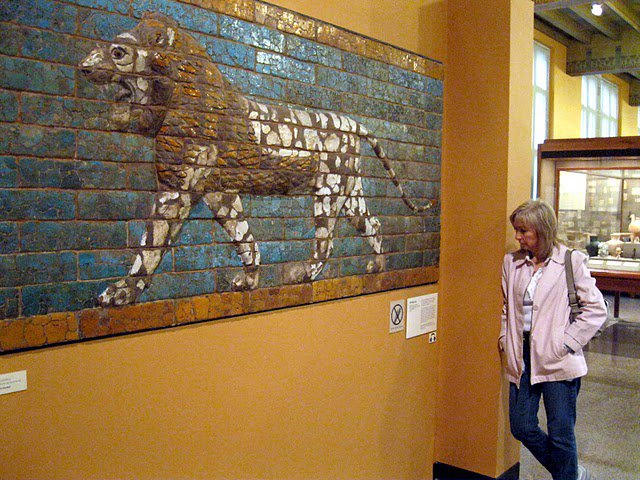
Sennacherib’s palace, with steps of semi-precious stone and an entrance guarded by colossal copper lions, was magnificent. Dalley pieced together ancient texts to reveal a garden that recreated a mountain landscape. It boasted terraces, pillared walkways, exotic plants and trees, and rippling streams.
The seven wonders appear in classical texts written centuries after the garden was created, but the 1st-century historian Josephus was the only author to name Nebuchadnezzar as creator of the Hanging Garden, Dalley said. She found extensive confusion over names and places in ancient texts, including the Book of Judith, muddling the two kings.
Little of Nineveh – near present-day Mosul – has so far been explored, because it has been judged too dangerous until now to conduct excavations.
Footnote 13 – Martin Hengel, Crucifixion in the Ancient World and the Folly of the Message of the Cross
Footnote 13 – Martin Hengel, Crucifixion in the Ancient World and the Folly of the Message of the Cross (Philadelphia: Fortress Press, 1977), pp. 83, 87, 89-90.
“When Paul spoke…about the ‘crucified Christ,’ every hearer in the Greek-speaking East…knew that this ‘Christ’ …had suffered a particularly cruel and shameful death, which as a rule was reserved for hardened criminals, rebellious slaves, and rebels against the Roman state.”
“That this crucified Jew, Jesus Christ, could truly be a divine being sent on earth, God’s son, the Lord of all and the coming judge of the world, must inevitably have been thought of by any educated man to be utter ‘madness’ and presumptuousness.”
“By the public display of a naked victim in a prominent place – at a crossroads, in the theater, on high ground, at the place of his crime – crucifixion also represented his utmost humiliation… With Deuteronomy 21:23 in the background, the Jew in particular was very aware of this.”
“When Paul talks of the ‘folly’ of the message of the crucified Jesus, he is therefore not speaking in riddles or using an abstract cipher…he deliberately wants to provoke his opponents, who are attempting to water down the offence caused by the cross.”
“Thus in a way the ‘word of the cross’ is the spearhead of his message…it is impossible to dissociate talk of the atoning death of Jesus or the blood of Jesus from this ‘word of the cross.’ The spearhead cannot be broken off the spear.”
Hebrews 12:2 – Fixing our eyes on Jesus, the author and perfecter of faith, who for the joy set before Him endured the cross, despising the shame, and has sat down at the right hand of the throne of God. NASB
Hebrews 13:13 – Let us, then, go to him outside the camp, bearing the disgrace he bore. NIV
Acts 5:41– So they went on their way from the presence of the Council, rejoicing that they had been considered worthy to suffer shame for His name. NASB
1 Peter 2:6– Because it is contained in scripture, Behold, I lay in Zion a chief corner stone, elect, precious: And he that believeth on him shall not be put to shame. ASV
 ἐκλεκτικός