Canaanite Wine Cellar discovered at Tel Kabri

Ferrell Jenkins's avatarFerrell's Travel Blog

Tel Kabri is a Canaanite site located a few miles east of Nahariya in the Plain of Akko in northern Israel. Excavations have been conducted at the site for several years under the direction of Prof. Eric H. Cline of Washington University and scholars from the University of Haifa, Israel.

A total of forty clay jars were discovered. Each have a capacity of 13 gallons. You may read more about the discovery here and here.

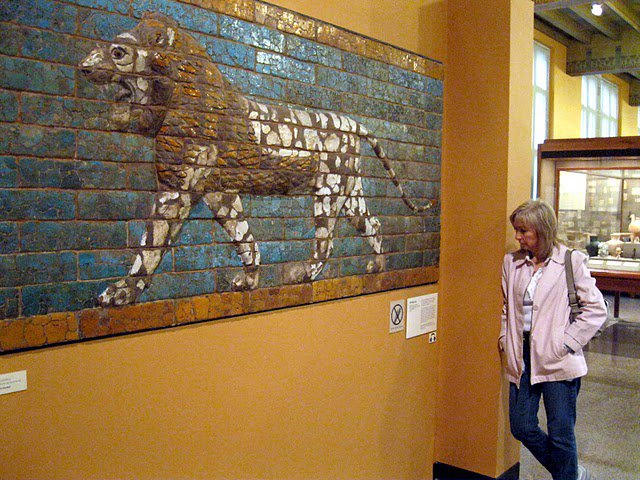
The photo below shows a room in the Canaanite palace at Tel Kbri. The excavators date this structure to 1700 B.C.

This discovery reminds us of the wine cellars discovered at El-Jib (Gibeon) by James Pritchard in 1959. Sixty-three cellars with a possible capacity of 25,000 gallons were excavated (Pritchard, Gibeon, 79-99).

HT: Joseph Lauer

View original post

Temple Mount: Past and Present

Trying to keep up with Trent and Rebekah!

Excitement at Carchemish

Ferrell Jenkins's avatarFerrell's Travel Blog

It must have been exciting to be at Carchemish in 605 B.C. when Pharaoh Neco came all the way from Egypt to this city now on the border between Syria and Turkey. On an earlier excursion from Egypt to Carchemish in 609 B.C., Neco killed Josiah, king of Judah, at Megiddo.

Pharaoh Neco came to assist the Assyrians as they fought the Babylonians. But the emerging world power from the southern Euphrates city of Babylon overpowered the Assyrians and the Egyptians and sent Neco running back to Egypt. Nebuchadnezzar, king of Babylon, chased Neco to the border of Egypt.

It is still exciting at Carchemish. I have been within sight of Carchemish once. The military installations were clearly visible on top of the tell. The tour operator handling my tour in Turkey a previous time advised me not to go to Carchemish (Karkamis) because it is “zero on the border”…

View original post 472 more words

Jerome Murphy-O’Connor – 1935-2013

Ferrell Jenkins's avatarFerrell's Travel Blog

The École Biblique et Archéologique in Jerusalem announced Monday the death of Jerome Murphy-O’Connor (1935-2013).

Fr. Jerome Murphy-O’Connor, O.P., passed away peacefully on Monday, November 11, 2013. He was 78 years old.

Fr. Murphy-O’Connor taught for more than four decades at the École Biblique et Archéologique. He was a world-renowned biblical scholar and author of numerous books on St. Paul and the Holy Land. Many throughout the world counted him their friend.

The writings of Murphy-O’Connor have been helpful to me. I have especially enjoyed The Holy Land An Oxford Archaeological Guide which is now in its 5th edition. In my recommendations of books for those traveling to Israel I have annotated this book with the words “Excellent. The Best.” I am pleased to say that I have seen several tour members using their copy of the book. I see the book is now available for the Kindle.

Holy Land

St…

View original post 66 more words

The Meat Market at Corinth

Continuing discussion regarding Corinthian archaeology — from Ferrell Jenkins

Ferrell Jenkins's avatarFerrell's Travel Blog

Paul taught the saints at Corinth to,

Eat whatever is sold in the meat market without raising any question on the ground of conscience. (1 Corinthians 10:25 ESV)

The Greek word used here for “meat market” is makellon. Archaeological discoveries at Corinth include inscriptions mentioning the meat market and the fish market.

Henry J. Cadbury writes about visiting the Corinth excavations in July, 1933. He says he especially wanted to see “first hand the Erastus inscription….” Some of his comments in the article are still interesting today.

But what was particularly unexpected by me was to note among the inscribed fragments of marble in the new museum one containing quite clearly MACELLV.

As the piece has only seven other letters and these quite unintelligible the discovery of this single word is extremely tantalizing. But since the fragment in question was found in 1898, now thirty-five years ago, while so…

View original post 363 more words

The Erastus inscription at Corinth

Ferrell Jenkins's avatarFerrell's Travel Blog

Even though the relationship between the Apostle Paul and the Corinthians was always a strained one, we know the names of numerous saints at Corinth who were helpful to Paul in his ministry.

Paul calls attention to a person named Erastus who was a “city treasurer.” He would be one of the few (“not many”) Christians who were among the socially elite at Corinth (1 Corinthians 1:26). A person named Erastus is mentioned three times in the New Testament. Whether these are two or three different persons, or all the same person, I do not know. Here are the biblical references:

  1. “And having sent into Macedonia two of his helpers, Timothy and Erastus, he himself stayed in Asia for a while.” (Acts 19:22 ESV)
  2. “Gaius, who is host to me and to the whole church, greets you. Erastus, the city treasurer, and our brother Quartus, greet you.” (Romans 16:23 ESV)…

View original post 254 more words

Project #3 — Back to School

“Catching Up” with Trent and Rebekah — and looking forward to having them in Chicago!

The theater at Corinth

While I was “temporarily inactive” my friend, brother, and mentor, Ferrell Jenkins, continued to post interesting items, to wit:

Ferrell Jenkins's avatarFerrell's Travel Blog

The theater at Corinth is a short distance from the agora and the Temple of Apollo. Reddish and Fant describe the theater:

The theater dates from the 5th century B.C.E. and later was rebuilt by the Romans, who added a multistory stage building . In Paul’s time it seated approximately 14,000 spectators. (A Guide to Biblical Sites in Greece and Turkey, p. 59)

According to the same source, both the theater and the odeion, “were later used for gladiatorial spectacles; the theater was even fitted for mock sea battles.”

The theater is not on the typical tourist route at Corinth, but it can be reached along a rugged path north of the major excavated area.

The Apostle Paul spent 18 months among the Corinthians.

And he stayed a year and six months, teaching the word of God among them. (Acts 18:11 ESV)

View original post

Jehoash Tablet must be returned to owner

Ferrell Jenkins's avatarFerrell's Travel Blog

The Supreme Court of Israel ordered that the Jehoash Tablet, a 9th century inscription about repairs to the temple in the days of King Jehoash of Judah, must be returned to the owner.

The Jerusalem District Court had earlier ruled that he state had not proved that this  inscription was a forged document.

Chiseled in ancient Hebrew and dated to the ninth century BCE, the tablet describes renovations of the First Temple – which is said to have been built by King Solomon – ordered by Jehoash. It corresponds to the account in II Kings 12:1-17, in which the king laments the state of the temple and commands that money the priests collect from the people be used to fix it up.

îùøã äçéðåêThe Jehoash Tablet

Read the account in today’s Haaretzhere.

Matthew Kalman has been keeping abreast of this decade-long case and reports at Bible and Interpretationhere

View original post 15 more words

On taking yourself too seriously

Ferrell Jenkins's avatarFerrell's Travel Blog

On the way from Luxor to the Valley of the Kings on the West Bank of the Nile one passes two huge statues known as the Colossi of Memnon. The statues are nearly 60 feet tall, and once stood at the entrance to the funerary temple of Amenhotep III (also known as Amenophis III). With their crowns, each statue would have been about 66 feet tall. Amenhotep III ruled Egypt during the 18th Dynasty (14th century B.C.).

During the time of the Roman Empire the statues were mistakenly associated with “Memnon, son of Eos and Tithonus, who was killed by Achilles during the Trojan War” (Baedeker’s Egypt).

The last time I was in the Valley of the Kings I noticed the head and chest of the statue had become a resting place for birds. Just an interesting picture, I thought.

Whether covered by sand or birds, this…

View original post 61 more words