
Steve Wolfgang with grandchildren, Oriental Institute, University of Chicago
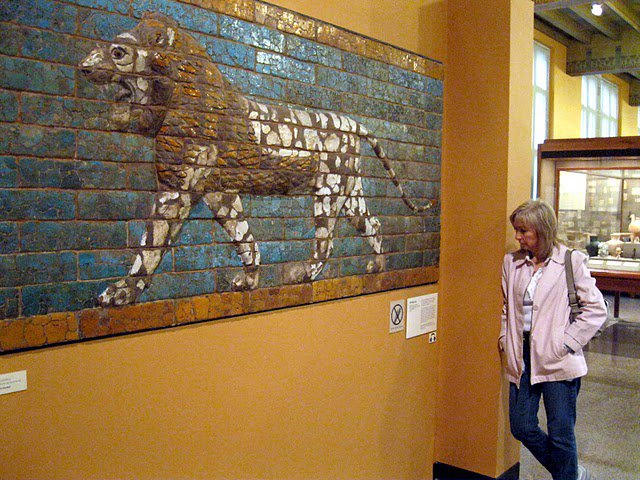
Steve Wolfgang with grandchildren, Oriental Institute, University of Chicago
Ancient wall in Israel matches up with Bible’s tale of Assyrian attack
Ancient wall in Israel matches up with Bible’s tale of Assyrian attack

Archaeologists say they have unearthed the remains of massive fortifications built about 2,700 years ago around an Iron Age Assyrian harbor in present-day Israel. The ruins appear to have a connection to Assyria’s takeover of the region, as mentioned in the Book of Isaiah.
“The fortifications appear to protect an artificial harbor,” Tel Aviv University’s Alexander Fantalkin, leader of the excavations at theAshdod-Yam archaeological dig, said in anews release issued Monday. “If so, this would be a discovery of international significance, the first known harbor of this kind in our corner of the Levant.”
The discovery was announced at the end of the first excavation season at Ashdod-Yam in the contemporary coastal city of Ashdod, just south of Tel Aviv. At the heart of the fortifications is a mud-brick wall measuring more than 12 feet wide (3.6 meters wide) in some places, and 15 feet (4.5 meters) high. The wall is covered in layers of mud and sand that stretch for hundreds of feet on either side.
When they were built in the 8th century B.C., the crescent-shaped fortifications would have defended an inland area covering more than 17 acres (7 hectares).

Age of Sargon II
During the late 8th century B.C., Assyrian King Sargon II ruled the entire southeastern part of the Mediterranean basin, including Egypt and the Middle East. Inscriptions tell of a Philistine king in Ashdod, named Yamani, who tried to organize a revolt against the Assyrian Empire. The Assyrians responded harshly, took control of Ashdod in 711 B.C. and eventually destroyed the city. As a result, power shifted to the nearby area of Ashdod-Yam, the site of the current excavations.
Tel Aviv University said the fortifications appear to be related to these events, although the precise relationship is not yet clear. They could have been built before or after the Ashdod rebellion was put down, either at the initiative of the local defenders or at the orders of the Assyrians.
Based on earlier excavations, the late Israeli archaeologist Jacob Kaplan concluded that the rebels built the fortifications in anticipation of the attack — but Fantalkin said the construction seems too monumental to have been done under such circumstances.
“An amazing amount of time and energy was invested in building the wall and glacis [embankments],” he said.
Staying out of the fight
Sargon II’s harsh action against Ashdod was mentioned in Isaiah 20, as a warning to those who backed the rebellion. “In that day, the people who live on this coast will say, ‘See what has happened to those we relied on, those we fled to for help and deliverance from the king of Assyria!'”
Hezekiah, king of Judah, stayed out of the fight —presumably at the urging of Isaiah.
Fantalkin and his team found more recent ruins on top of the sand of the Iron Age fortifications, dating to the Hellenistic period, between the 4th and 2nd centuries B.C.
+++++++++++++++++++++++++++++++++++++++++++++++++++++++
Read the entire article at http://www.nbcnews.com/science/ancient-wall-israel-matches-bibles-tale-assyrian-attack-6C10953508
Alan Boyle is NBCNews.com’s science editor. Connect with the Cosmic Log community by “liking” the NBC News Science Facebook page

The latest big archaeological news is the press announcement that a Palace of King David has been discovered in the Judean foothills at Khirbet Qeiyafa, a city dating to the time of his reign. Besides the palace, a large pillared storehouse to manage taxes in kind (oil, wine, grain, etc.) was discovered along the northern edge of the city.
These discoveries are from the site I’ve worked the past five seasons. I mentioned the Iron Age fortress (“David’s Palace”) last year in a post that included a photo. The long wall was identifiable as the central building of the Iron Age city and was a large factor in the decision to excavate one more season at Qeiyafa in 2013.
The “David’s Palace” title is certainly tweaked for media exposure. For better and for worse, it worked. The story hit Israelinewssources and moved to Americanmedia in less than a…
View original post 958 more words
Laboratory in the Sand: The Diet of Pyramid Builders
The Diet of Pyramid Builders – University of Michigan Research
Who built them—slaves, or well-compensated workers? How were they built? What are they made of? What do they symbolize?
Nearly everything about the Egyptian pyramids raises questions and inspires scientific investigation; they are the classic riddle, wrapped in a mystery, inside geometric walls of limestone.
One of the greatest mysteries: What did the pyramid builders eat?
It had to be enough to sustain the workers through grueling days, weeks, years. Research led by Richard Redding, a research scientist at the Kelsey Museum of Archaeology, has helped shed light on the answer to this question. In short, the builders ate meat. Lots and lots of meat. Often with a side of meat.
“They probably had better diets than [people] did in the village. They definitely had more meat,” said Redding, (’71, Ph.D. ’81), also chief research officer and archaeozoologist at Ancient Egypt Research Associates (AERA), a nongovernmental organization that runs a field school at the Giza pyramids.

Bringing Up the Bones
Redding’s team made the discovery of the meat-heavy diet based on 175,000 animal bones and bone fragments found at the Giza pyramid settlement—mostly cattle, sheep, and goats, with a smaller number of pig bones. He and other archaeologists from AERA, along with other U-M archaeology students who worked at the site through the years, studied the bones to estimate the large amount of meat that would have gone to the workers. They also looked for an explanation of where the animals were raised and slaughtered.
They made the assumption, based on their findings, that the Giza settlement was run by a central authority or administration. “The administrators would have organized drives of sheep, goats, and cattle from the Nile Delta, along the edge of the high desert, to move the required animals to Giza,” Redding said. The workers’ town was located about 1,300 feet south of the Sphinx, and was used to house workers building the pyramid of the pharaoh Menkaure. The process of taking the meat directly to the workers inspired a news headline about Redding’s research that read, “Ancient Burger Vans.”
While Redding and his AERA team are looking at animal bones, their main goal isn’t to learn more about the animals but rather the people who built the only one of the Seven Wonders of the Ancient World still in existence.
“We’re trying to humanize the pyramids, to put people there, by finding out where the workers lived and how they lived,” said Redding, who began working on Old Kingdom sites in Egypt since 1983 after leaving a politically turbulent Iran.
Unearthing the details about the workers’ lives is a long, often tedious process of, for instance, sorting the tens of thousands of animal bones, while also applying Redding’s rich knowledge of animal behavior to figure out how the raising and transport of such huge numbers of animals was possible in ancient times.
++++++++++++++++++++++++++++++++++++++++++++++++++++++++++++++++++++
Read more at: http://www.lsa.umich.edu/lsa/ci.thedietofpyramidbuilders_ci.detail
Archaeological digs in Israel are winding down and the maximalists are having a great time. Today’s report comes from the excavation of Khirbet Qeiyafa which is conducted jointly by Professor Yossi Garfinkel of the Hebrew University and Saar Ganor of the Israel Antiquities Authority.
Here is today’s Press Release from the Israel Antiquities Authority.
King David’s Palace was Uncovered in the Judean Shephelah
Royal storerooms were also revealed in the joint archaeological excavation of the Hebrew University and the Israel Antiquities Authority at Khirbet Qeiyafa ***
These are the two largest buildings known to have existed in the
tenth century BCE in the Kingdom of Judah
Two royal public buildings, the likes of which have not previously been found in the Kingdom of Judah of the tenth century BCE, were uncovered this past year by researchers of the Hebrew University and the Israel Antiquities Authority at Khirbet Qeiyafa –…
View original post 794 more words
A few chalices dating to the time of the destruction of the Philistine city of Gath by Hazael, king of Aram (Syria), have been announced during the current excavation at Tel es-Safi/Gath. The most recent, larger than usual, chalice was announced by Prof. Aren Maeir on Monday and Tuesday. Follow the excavation reports here.
Prof. Maeir displays the large chalice after the stand was excavated. (I like the T-shirt. Maybe there is another step down — a human stooped over with a mobile phone.)
Vessels of this type were sometimes used for burning incense.
Gath was one of five cities of the Philistine Pentapolis (1 Samuel 6:17). The city was destroyed by the Aramean King Hazael shortly after the middle of the 9th century B.C.
At that time Hazael king of Syria went up and fought against Gath and took it. But when Hazael set his face to go…
View original post 61 more words
Great photos — reminiscing about prior visits to several of those locations. We look forward to having Trent & Rebekah back with us in Chicagoland when their sojourn there is over!
Last weekend I had the privilege to be with Trent and Rebekah Dutton. The Duttons are a great couple with an interesting story. Both are computer programmers with experience in military applications. Their interest in biblical geography and archaeology grew as they taught Bible classes at church, and piqued after a tour of Israel with Ferrell Jenkins in 2012. In short, they made a career change and are starting the two-year process to earn an M.A. in Biblical Archaeology at Wheaton College. (They were both accepted to Wheaton and are going through the program concurrently.) The first stage of their program is to excavate at Ashkelon with the Leon Levy Expedition for its full six-week season, followed by a semester of coursework in Jerusalem. They will then move to the Chicago area for the remaining 1-1/2 years of the program (with another Bible Lands dig next summer to boot.)
They and I…
View original post 398 more words
Notice the commentary following
Hebrew University announces another significant archaeological discovery today. The entire press release is below.
—• —
Jerusalem, July 10, 2013 — Working near the Temple Mount in Jerusalem, Hebrew University of Jerusalem archaeologist Dr. Eilat Mazar has unearthed the earliest alphabetical written text ever uncovered in the city.
The inscription is engraved on a large pithos, a neckless ceramic jar found with six others at the Ophel excavation site. According to Dr. Mazar, the inscription, in the Canaanite language, is the only one of its kind discovered in Jerusalem and an important addition to the city’s history.
Dated to the tenth century BCE, the artifact predates by two hundred and fifty years the earliest known Hebrew inscription from Jerusalem, which is from the period of King Hezekiah at the end of the eighth century BCE.
A third-generation archaeologist working at the Hebrew University’s Institute of Archaeology, Dr. Mazar…
View original post 462 more words
Resources for congregational worship in song
Just another WordPress.com site
It's EVERYBODY'S "Holy Land"
Around the World, or Just in my Thoughts.
Discussing Sites, Peoples, and Events Related to the Bible, Ancient Near East, and Classical Studies
Steve Wolfgang's view of the world from suburban Chicago -- or wherever he may be on any given day
It's about calling.
Steve Wolfgang's view of the world from suburban Chicago -- or wherever he may be on any given day
Executive Director of CSNTM & Senior Research Professor of NT Studies at Dallas Theological Seminary
Steve Wolfgang's view of the world from suburban Chicago -- or wherever he may be on any given day
They hymned their King in strains divine; I heard the song and strove to join.
"I think I can. I think I can. I think I can." -The Little Engine That Could
Steve Wolfgang's view of the world from suburban Chicago -- or wherever he may be on any given day
Comments on the New Testament and Early Christianity (and related matters)

 ἐκλεκτικός