My List of 20 Authors and Significant Books – What’s Yours?

SW Lib S-CGiving in to a fad which I strongly resisted for awhile, here’s a list of 20 books which have shaped my personal intellectual development. It was frustrating but enlightening to do the introspection necessary to accumulate and then pare down to 20. All such stand-alone lists are probably sterile, unless (as they were with me) they are integrated into broader reading in conversation with an extensive web of other classical and “Great Books” authors. But these were “first introductions” to a protracted corpus of similar works, or provided multiple significant “aha moments” in their own right. Many of the specific titles are representative of a “train” of comparable works by the same author and/or others who interacted with them in an intellectual engagement. In more or less chronological order as I encountered them, this list omits MUCH (and, yes, it has notes at the end!)

1 – Jack Finegan, Light From the Ancient Past
2 – Earl West, Search for the Ancient Order (multi-volume)
3 – E.L. Jorgenson, Great Songs of the Church
4 – Harper Lee, To Kill A Mockingbird
5 – C.S. Lewis, Mere Christianity
6 – The Diary of Anne Frank
7 – William F. Buckley, God and Man at Yale, Blackford Oakes novels
8 – Homer Hailey, The Minor Prophets, John, Isaiah and other commentaries
9 – Ed Harrell, Social History of the Disciples of Christ, 2 volumes
10 – Bernard Ramm, The Pattern of Authority
11 – John RW Stott, Christ the Controversialist
12 – John Warwick Montgomery, Where is History Going? and The Suicide of Christian Theology
13 – Thomas Kuhn, The Structure of Scientific Revolutions
14 – G.A. Kerkut, Implications of Evolution
15 – Fernand Braudel, The Mediterranean and the Mediterranean World in the Age of Philip II
16 – Kenneth A. Kitchen, Ancient Orient and Old Testament
17 – Bernard Bailyn, Ideological Origins of the American Revolution, and Voyagers to the West
18 – C. Vann Woodward, The Strange Career of Jim Crow, and so much more
19 – Gordon Fee & Stuart, How to Read the Bible For All Its Worth
20 – Ronald Numbers, The Creationists

Other “honorable mention” influences would certainly include G.K. Chesterton, Richard Hofstadter, N.B. Hardeman, James McPherson, George Marsden, Everett Ferguson, Stephen Ambrose, D.A. Carson, Mark Noll, George Will, N.T Wright, Fred Craddock, Rick Atkinson, and Fleming Rutledge, among others. This list of 20 could easily become 50 or even 100, especially if older classics were included. Three other works are significant, though in somewhat different ways.

A – The Geneva Bible – I omitted the most continuously-formative work (”the Bible”) but I’ll single out the Geneva, a 1599 copy of which (as well as several more recent replicas) has been in my family for generations. Purchased from a Chicago bookdealer by my great-uncle, who lived here following his discharge from the US Navy in WWI, it then passed to my grandfather, James Otto Wolfgang, and upon his death in 1975 to my father, James Harold Wolfgang, and thence to James Stephen Wolfgang. Not only the text, but the marginal notations, the typography, the woodcut illustrations, and even the paper contain lessons in their own right.

B&C – Two works for which I served as a “knowledge contributor” rather than simply a “knowledge consumer” are the Encyclopedia of the Stone-Campbell Movement (Eerdmans, 2004), and the new hymnal Psalms, Hymns, and Spiritual Songs (Sumphonia Productions, 2012). Working on the “other side of the page” provided new insights, and these works continue to teach me afresh.

NOTES:

1 – A part of my early teenage intellectual awakening, Finegan’s LFAP was on my grandfather’s bookshelves, and I spent many fascinating Sunday afternoons trying to wrap my developing brain around its contents. In this text, and several to follow, Finegan introduced me to the worlds of Biblical archaeology and chronology, and the world of Ancient Near Eastern texts and Biblical manuscripts.

2 – Earl West was a multi-generational family friend (performed my parents’ wedding ceremony), whose multi-volume history of the “Restoration Movement” (also on my grandparents’ and parents’ bookshelves) taught me at an early age the basic plotline and biographical storyline of the movement and its controversies – and ignited a passion to learn more.

3 – Jorgenson was one of several hymnals I sang from as a child, including L.O. Sanderson’s Christian Hymns #2, which often contained simple melodies and harmonies which sounded good when everyone sang their part. But Jorgenson took things to a new level. I was singing from his hymnal during the same time I was playing in high school and regional music groups under a very good conductor (a graduate of the world-class School of Music at Indiana University – as were several of the song leaders at church, who in turn instructed other song leaders, including my father, in the basics of leading a congregation in the worship of God in song, skillfully and with insight). Great Songs helped integrate what I was learning at school in music and English composition, including poetry, with what was happening “in church.”

4 – Began to help me confront the reality of evil, both as an act and as a power – as well as the power of story.

5 – C. S. Lewis’ classic (and others, read later) opened up new and different ways of “explaining” Christianity, as well as modeling excellent writing as the Brits do it.

6 – Ditto # 4 – Began to help me confront the reality of evil, both as an act and as a power – in other contexts outside the USA.

7 – Buckley introduced me to the world of the “public intellectual,” the confusing maze of academic discourse and pretensions, the wonders of arcane vocabulary, the importance of intellectual rigor in political discourse, and the power of fiction to expound truth with an impact sometimes lacking in non-fiction. I have read most of his books.

8 – As with other authors on this list, Homer Hailey’s influence on my life was not limited to his books, or even as a preacher, professor, and counselor, but also as mediated through other influential figures in my intellectual development, including but not limited to Ferrell Jenkins, Melvin Curry, and Phil Roberts. As with Buckley and Harrell and Montgomery below, I have consumed nearly everything he wrote.

9 – Probably the closest thing to a formal “intellectual mentor” in my life (I once called him “the surrogate older brother I never had”), Ed introduced me to the stubborn fact that theological issues are not merely theological. There are “layers of the onion” which must be peeled back to reveal how social forces, including class, race (and gender), and many other factors influence theological ideology and religious behavior, and the necessity to integrate the study of religion into the broader descriptions of political, economic, social, intellectual, military, and other aspects of the human endeavor. Ed once said that I was perhaps the only person who had read everything he’d ever written (adding, “but Steve even reads cereal boxes and the phone directories” – too true!)

10 – Ramm, whose book on authority came to me by way of Harry Pickup, Jr., (another profound influence in my life as a young preacher), was one of the bright stars in the early evangelical constellation; this foundational work led me to a string of others.

11 – John RW Stott, first encountered through his book on Christ as a controversialist, was introduced to me by John Clark, a self-educated intellectual and formative influence on my early spiritual development. In many ways, it replicates themes in Stott’s other works, expounding “Basic Christianity,” the gigantic paradox of the cross of Christ and the scandal of worshiping a crucified man, murdered by state sanction as a common criminal or worse.

12 – Montgomery, like Stott, served as both an introduction and a bridge into the worldview of evangelicalism, at once alike (not least in its rejection of both modernist and post-modernist ideologies) and different from the “restorationism” I have written about myself. As with many other works on this list, what I found most attractive was JWM’s broad, interdisciplinary background in classics, philosophy, library science, Biblical studies, history, and modern theology.

13 – Kuhn is often at the head of “Most Influential Books,” especially of the 20th century – and deservedly so as one of very few works which has had widespread cross-disciplinary impact. Read with fascination as I began a doctoral program in the History of Science at Emory University (along with his Copernican Revolution), Kuhn was, as for many, one of the most formative influences on my thinking, surpassing even many on this list and opening up a long list of related works.

14 – Kerkut’s compact but tightly argued monograph taught me not only important distinctions between “general” and “special” evolution (“macro-“ and “micro-“) but also to challenge prevailing assumptions and “received wisdom” – and that doing so is not always received well by others. To actually meet and interview him (and be “served tea”) in his laboratory at the University of Southampton while I was working on my own dissertation, was a special treat, putting a human face to a respected scientific name.

15 – Braudel demonstrated with staggering breadth how much of the human enterprise can and should fall under the historian’s gaze and pen, describing it in a single (and yes, again, multi-volume) work. Despite its title, this work surveys everything from demography to warfare to numismatics to zoology and nearly everything in between, from the Bronze Age to modernity, as well as confronting concepts of stasis and change over time with which every historian must grapple.

16 – From AO&OT to his “magnum opus” On the Reliability of the Old Testament, the breadth of Kitchen’s output is stunning, ranging from the scholarly translation of ancient texts to academic works on Egyptology and “popular” books on Ancient Near Eastern and Biblical history. I first encountered his work (in the library but not on the reading lists) at the seminary where I earned my MDiv. There, his “conservatism” was ridiculed and snickered at by small-minded faculty and grad students – none of whom could carry water for Kitchen, intellectually. Legends in their own minds, they seemed intent on demonstrating their own snobbish “superiority” – which attracted me to his work, first out of curiosity and then with respect.

17 – Bailyn is one of the the most influential American historians of the 20th century, not only for his own Pulitzer- and other prize-winning works, but also as the advisor of a long train of Harvard PhDs who became influential (on me and many others) in their own right, including other Pulitzer Prize winners like Gordon S. Wood (my favorite and, yeah, the guy Matt Damon cites in Good Will Hunting), Mary Beth Norton, Richard Bushman, Jack N. Rakove, Pauline Maier, Philip Greven, Michael Kammen, and MANY others.

18 – Woodward, the dean of a whole corps of Southern historians, introduced me to the thicket of questions of how race, slavery, the Civil War, Reconstruction, the civil rights movement, and a host of other related issues have played out in American history – at a time when this Midwesterner, recently married to a lovely Southern lass, engaged in graduate studies at Emory University in Atlanta, was preaching for a church in a racially “transitioning” neighborhood in the midst of racial tensions only three years following the King assassination. An intriguing and challenging read, it was not only formative in its own right, but lead down numerous other worthwhile rabbit trails.

19 – It is difficult to single out one book in a whole cluster of important works on crucially important questions of hermeneutics and interpretation of texts, but this one stands out and has become a classic.

20 – A path-breaking, even-handed, award-winning monograph on an important subject previously ignored by historians and other segments of academia (and an area I’ve worked in, and published a bit myself), this is a model of following the evidence where it leads. If there is “a book I wish I’d written,” this might be it.

Books As Friends


Here’s the fairly well-known account of J.W. McGarvey’s farewell to his “friends” (his books) from the Facebook page, “Friends of the Restoration.” As someone on the page observed, “One who does not have them cannot understand the sentiment involved.”

https://books.google.com/books?id=zITVAAAAMAAJ&printsec=frontcover&dq=%22lands+of+th One who does not have them cannot understand the sentiment involved e+bible%22+mcgarvey&hl=en&sa=X&ei=GAAGVbLpFe_dsAS44IKgAQ&ved=0CB4Q6AEwAA#v=onepage&q=%22lands%20of%20the%20bible%22%20mcgarvey&f=false

“I had already been upstairs in my library to take a last look there, and as I gazed upon the rows of familiar books I said within myself, ‘goodbye, my dear old friends; and if I never see you again, God bless you for the good you have done me and the happy hours we have spent together.” (Lands of the Bible, p. 387).

Book on the origin of Israel available

This book is still available on Kindle at $2.99

Ferrell Jenkins's avatarFerrell's Travel Blog

Daniel I. Block’s book, Israel: Ancient Kingdom or Late Invention?, is available in Kindle format today for $2.99. The retail price of the hardback is $28.

The publisher (B&H) of the 2008 book describes it as

a collection of essays responding to the radical claims that Israel and its history actually began following the Babylonian exile, and that the history of Israel we read about in the Bible is a fictionalized account.

Contributors are leading Bible and archaeology scholars who bring extra-biblical evidence to bear for the historicity of the Old Testament and provide case studies of new work being done in the field of archaeology.

The book includes the following essays dealing with some of the current discussions in Biblical studies.

  • Israel – Ancient Kingdom or Late Invention? – Daniel I. Block
  • The Value and Limitations of the Bible and Archaeology – Alan R. Millard
  • Contextual Criticism…

View original post 151 more words

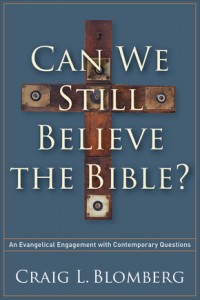
Can We Still Believe the Bible?

Daniel B. Wallace's avatarDaniel B. Wallace

Can-We-Still-Believe-the-Bible-200x300

Craig Blomberg, Distinguished Professor of New Testament at Denver Seminary, has written another outstanding volume. Blomberg is a committed evangelical, but not one with a closed mind. As he says in his preface about the environment of Denver Seminary (quoting Vernon Grounds, former president of the school), “Here is no unanchored liberalism—freedom to think without commitment. Here is no encrusted dogmatism—commitment without freedom to think. Here is a vibrant evangelicalism—commitment with freedom to think within the limits laid down by Scripture.” Blomberg’s writings have always emulated this philosophy. His research in the secondary literature is consistently of superb quality, and his discussions of problem passages and issues, especially in the Gospels, is always well informed. Rather than clutter the narrative with documentation, Blomberg has wisely used endnotes instead of footnotes (though I personally prefer footnotes, I understand that most readers see them as a distraction). This book has nearly…

View original post 3,073 more words

Zondervan Essential Atlas of the Bible

Ferrell Jenkins's avatarFerrell's Travel Blog

Frequently we have mentioned and recommended the Zondervan Atlas of the Bible by Carl G. Rasmussen. Every Bible student needs at least one or two good atlases to assist them in their study of the Scriptures.

Last month I attended some annual professional meetings in Baltimore and was pleased to see that Zondervan already had copies of the new Zondervan Essential Atlas of the Bible. One of the sales reps gave me a copy for review here.

At first appearance, the ZEAB has a beautiful cover of stiff, durable paper. It is a convenient 9 1/8″ x 7 3/8″ in size. The content is basically the same as the larger hard back edition. There has been some editing of the text to condense the book from 303 pages to 159 pages.

There are two major sections to the book: Geographical Section and Historical Section. The Geographical Section includes an Introduction to the…

View original post 256 more words

Footnote 27 – C.S. Lewis: The Discarded Image

Footnote 27 – C.S. Lewis, The Discarded Image: An Introduction to Medieval and Renaissance Literature (Cambridge University Press, 1964), p. 89.

Earlier I posted information about CS Lewis’ death on November 22, 1963. Normally this would have received significant press and public attention – the death of a respected scholar at both Oxford and Cambridge who became a wartime fixture in Britain for his radio discussions during the dark days of World War 2; the former atheist who became of the most significant and widely-read apologists for the truth of Christianity – was “overtaken by events” of the same day.

The significance of CS Lewis as an academician and scholar is sometimes overlooked or dismissed by those who know him only through his more popular apologetics books, or who cavalierly dismiss his views.  But his work as a scholar of medieval literature and the trans-generational and cross-cultural transmission of knowledge is significant.  His posthumously-published work,The Discarded Image (Cambridge University Press, 1964) is one of my “favorites” – describing how medieval texts assimilated the Greco-Roman corpus of “natural history” (what would, in the 19th century, be dubbed “science”) – useful to a green graduate student in the History of Science at Emory University in Atlanta, grappling with bestiaries and other strange accumulations of knowledge. .

As a young man, I once had a flash of insight that youthful hubris allowed me to imagine at the time to be one of the few truly “original” ideas I ever had (everyone should have one or two such ideas in a lifetime, no?) It was the notion that God does not really “foreknow” what happens in the future (as though He were limited to looking at the future through a keyhole, or the “wrong” end of a telescope – actually an apt description of the limited view of prophets and angels described in 1 Peter 1:10-12). Rather, since He is not time-bound, and therefore is already “at” tomorrow, or next year, He knows what decisions I make in my future since he is already “there.” In the same way that I know what choices I made for breakfast this morning (bacon and eggs, cereal, bagel? – ALWAYS go for the bacon, if available), similarly, He knows my “future-to-me” choices, without limiting them in any way. The insight seemed so profound and original at the time…..

Then I encountered Lewis’ comments below, published while I was still a high school kid only beginning to contemplate such matters.  Ah, well….there is no shame in being superseded, or pre-dated, by C.S. Lewis!

Here’s the text:

“God is eternal, not perpetual.  Strictly speaking, He never foresees; He simply sees.  Our ‘future’ is only an area, and only for us a special area, of His infinite Now.  He sees (not remembers) your yesterday’s acts because yesterday is still ‘there’ for him; He sees (not foresees) your tomorrow’s acts because He is already in tomorrow.  Just as a human spectator, by watching my present act, does not at all infringe its freedom, so I am free to act as I choose in the future because God, in that future (His present) watches me acting.”

        C.S. Lewis, The Discarded Image: An Introduction to Medieval and Renaissance Literature (Cambridge University Press, 1964), p. 89.

Did you know C. S. Lewis died Nov. 22, 1963?

C.S. Lewis, one of the foremost apologists of the 20th century, died on November 22, 1963. His passing was, of course, “overtaken by events” which overshadowed his passing. I mentioned this in a lesson Sunday in which I quoted Lewis’ famous quip that there are two equal and opposite errors about Satan (one being to totally disbelieve, the other to become overly consumed by him – and that he is equally pleased with either error). Ferrell elaborates on Lewis’ life and death here.

Ferrell Jenkins's avatarFerrell's Travel Blog

Recently I have been reading C. S. Lewis – A Life: Eccentric Genius, Reluctant Prophet by Alister McGrath. He says that Warnie found his brother dead at the foot of his bed at 5:30 p.m. [in Oxford], “Friday, 22 November 1963.” Then comes this paragraph:

At that same time, President John F. Kennedy’s motorcade left Dallas’s Love Field Airport, beginning its journey downtown. An hour later, Kennedy was fatally wounded by a sniper. He was pronounced dead at Parkland Memorial Hospital. Media reports of Lewis’s death were completely overshadowed by the substantially more significant tragedy that unfolded that day in Dallas.

C. S. Lewis was buried in the churchyard of Holy Trinity, Headington Quarry, Oxford after a private, and very small service. Warnie chose a phrase from a Shakespearean calendar that was in their home back in Belfast at the time of their mother’s death in August 1908: “Men must endure…

View original post 113 more words

‘November Twenty Six Nineteen Hundred Sixty Three’ by Wendell Berry & Ben Shahn

‘November Twenty Six Nineteen Hundred Sixty Three’ by Wendell Berry & Ben Shahn

‘November Twenty Six Nineteen Hundred Sixty Three’ by Wendell Berry & Ben Shahn

From Alan Cornett’s blog, Pinstripe Pulpit — read more at:http://pinstripepulpit.com/off-the-shelf-november-twenty-six-nineteen-hundred-sixty-three-by-wendell-berry-ben-shahn/

Wendell Berry’s poem can be read here: http://thenation.s3.amazonaws.com/pdf/jfkpoem1963.pdf

Berry Nov 26 text 1

So much symbolism is bound up in John F. Kennedy it is difficult to separate the myth from the reality. For those my age, and even a decade older, JFK is someone we know only from photographs and old video clips. It is that last video clip from Dallas that transformed the man into the legend.

Wendell Berry, a novelist and poet still in his twenties at the time, was understandably moved. In response to Kennedy’s assassination on November 22, and his state funeral on November 25, Berry wrote his reflections in verse as “November 26, 1963,” a consideration the day after.

Berry Nov 26 text 2

Berry published the poem in The Nation magazine (December 21) where it was read by artist Ben Shahn (1898-1969). Lithuianian born, Shahn’s father had been exiled to Siberia by the czars as a political dissident. Eventually the family emigrated from their homeland to the United States.

Shahn embraced leftist ideology in his politics and social realism in his art. Among Shahn’s famous subjects were Sacco and Vanzetti and, later, Martin Luther King, Jr. for TIME magazine. He was also well-known as a Depression-era photographer for the Farm Security Administration.

Shahn Nov 26 illust horse

Kennedy’s assassination was, then, a perfect subject for Shahn, and Berry’s poem was the perfect vehicle. Shahn writes,

It was shortly after those shattering few days that the following poem appeared in The Nation. I found it extraordinarily moving. It was right in every way; it was modest and unrhetorical. It examined soberly and sensitively just this event in its every detail. Its images were the images of those days, no others. In so sharply scrutinizing his own feelings, the poet has discovered with an uncanny exactness all our feelings. His words have created a certain monument, not pretentious, but real, and shared.

When I read the poem, I wanted it preserved, read, not lost in the pages of a last week’s magazine. I turned it into a book, accompanied by the images that it invokes for me. I have hoped, in some small way, to help monumentalize those days so that we may not so soon become inured to an unacceptable violence, a failure, a profound sadness.

What resulted was a lovely oblong slipcased volume published by George Braziller in May 1964, only Berry’s second book. Shahn frequently used a block style calligraphic text with his artwork, and he employs the technique with great effect here. His hand drawn title fills the front cover, and the text of the poem is rendered in the same style throughout faced with Shahn’s illustrations on the left.

Berry Nov 26 cover

There are two editions, a limited signed edition and a regular trade edition. According to Russell Freedman’s Wendell Berry bibliography, 3013 copies of the limited signed edition were issued, printed on hand laid paper from the Italian mill Fabriano. Somewhat mysteriously, online bookseller Daedalus found a cache of new, uncirculated copies a few years ago, and sold them for a reasonable sum (I’m sure all are long gone now). The trade edition, also slipcased but slightly smaller in size, is fairly easily found for not too much money. The black slipcase is often faded, and the cloth cover is often foxed.

Berry Shahn signatures

As the nation remembers its most recent fallen president, take a moment to read Berry’s thoughtful poem. It well captures the mood of our nation fifty years ago.

Shahn Nov 26 illust color

Another Bookstore Casualty — O’Gara & Wilson Leaving Hyde Park/Chicago

Another Bookstore Casualty — O’Gara & Wilson Leaving Hyde Park/Chicago

Hyde Park bookstore O’Gara & Wilson closes after decades in operation — Move to Indiana prompted, in part, by ‘toxic environment for small businesses,’ owner says

Doug Wilson, owner of O’Gara and Wilson bookstore in the Hyde Park neighborhood, says a “toxic environment for small businesses” is partly to blame for him closing his shop, which has been a fixture in the neighborhood for more than 50 years. (Terrence Antonio James, Chicago Tribune / June 25, 2013)

By Mugambi Mutegi, Chicago Tribune reporter  —  July 18, 2013

At the O’Gara & Wilson bookstore in the Hyde Park neighborhood, Rory Preston, 25, was packing more than 27,000 books into 900 brown paper bags Tuesday. Each bag was to contain 35 books of the same genre.

Store owner Doug Wilson, 63, was on a ladder with a drill, trying to get the lighting off the ceiling. Removing the wooden shelves was on the to-do list.

The two had been at it since Sunday, when the store, which specialized in used books and was a fixture in Hyde Park for more than 50 years, officially closed. Wilson cited a restrictive business environment in the neighborhood, compounded by dwindling readership, as reasons for the closing.

“The changes in the book trade with the advent of Internet book sales have altered the number and the vitality of bookstores that still exist,” Wilson said at the 1448 E. 57th St. location, which had served the likes of University of Chicago students and faculty to renowned writer Saul Bellow.

Wilson has seen the business shrink irreversibly but believes “there is life in bookstores, but we will continue seeing less of them in select communities that don’t support the culture.”

His plan is to set up shop in Chesterton, Ind., where he lives. He will run the business with his wife, Jill, and is hoping the town’s annual European Market, held between May and October, will provide the boost his business needs.

National chains are hardly immune to the same kinds of forces that helped prompt Wilson’s store to close.

++++++++++++++++++++++++++++++++++++++++++++++++++++

Read more at http://www.chicagotribune.com/business/ct-biz-0718-bf-bookstore-troubles-20130718,0,7559692.story

Book Riot: Libraries of the Rich and Famous

Book Riot: Libraries of the Rich and Famous

Book Riot: Libraries of the Rich and Famous

As I’ve been unpacking boxes and realizing that I don’t even have enough bookshelves to put my books on, I decided to torture myself and look at homes of people who can dedicate an entire room to being a library (most likely with the help of an uber-expensive designer to organize and make it look scrumptious). Would you like to be tortured too? Brace yourself…

Karl Lagerfield’s Personal Library: Not as cozy as I would pick for my own, but I would pay money to look through those titles… that’s a LOAD of books, folks! Aren’t you the least bit curious what is on those shelves?

*****

Diane Keaton’s Personal Library: Loving the lighting, loving the colors, the writing on the wall is pretty cool — but where are the chairs? I like to be able to sit down while perusing (or reading, for that matter). 

*****

Woody Allen’s Personal Library: Although I’m highly disgusted when someone marries their daughter (please, people… he helped raise her – adoptive/step-daughter/what-ever-kind-of-name-you-put-in-front-of-the-word daughter equals daughter), his library rocks. It’s comfortable, cozy, and old-school east coast-looking; love it. 

*****

Keith Richards’ Personal Library: This is a sweet personal library, but really… what did we expect from Keith Richards. I would really like to know what he has on his shelves. 

*****

William Randolph Hearst’s Library: This is a dream of a library.  If it was mine, I would invite all of my friends over and we would have a big library party; everyone would be offered something to nosh on and then instructed find a place in the room and be super quiet while we all enjoyed devouring the books. Rocking party, I know… that’s how I roll. 

____________________________
Here we are again… you didn’t think I’d leave you hanging with only one installment of fabulous libraries did you? What if we pooled together money and created a house where there were no rooms what-so-ever beside libraries? All different, all wonderful, all ours? Divine. Let’s get going on that, shall we? In the meantime, grab a napkin because you’re about to be drooling over these lovelies…

Thanks to a reader from last week pointing out Neil Gaiman’s library to me. HELLO, this man reads. Think he’s read all of these, or might some of these be his to-be-read shelves?!?

*****

Sting’s library at the top of his staircase in London is beautiful. Very law school-philosophy vibe going on here… I dig it. Do you?

*****

Um, yes please! This is the library of designers Mark Badgley and James Mischka’s in their weekend house. I’ll take the weekend house and the library. The black painted wood adds a modern twist to this library, and I enjoy that they combined an eating area with their books. In fact, I think this would inspire me to have a reading dinner party. Wine, books, friends, and a game guessing passages from books? I’m there.

*****

Here is Julia Child’s personal library from when she lived in Cambridge, Massachusetts. This cozy, warm, neutral-toned library makes me want to curl up next to that fireplace and get lost in a book — or possibly a conversation with Julia and Paul about the books they own. Can you imagine the books that must be in that library? Paul was known as a very smart, well read man… I’m sure they have some treasures in there. If the walls could speak.

*****

This by far is my favorite library we’ve featured, and probably my favorite personal library that I’ve ever seen. It belongs to Professor Richard A. Macksey. Macksey is an author in his own right along with being a well-known, beloved professor at Johns Hopkins University, and co-founder of the university’s Humanities Center. He is the owner of one of the largest personal libraries in the state of Maryland, with over 70,000 ($4 million worth) books and manuscripts along with art work. Macksey’s course on Proust is famous among underground students at Johns Hopkins, and he is known to hold graduate level courses in his famous library.

____________________________
Apparently Parts One and Two weren’t enough for you – you wanted more. Don’t we all? More books, more nooks, more time to read. Here are four more extravagant libraries to whet your appetites. Now, if I could just figure out how to get inside of one of these grand ladies, I’d be a happy girl. 

Harlan Crow, real estate magnate from Dallas, Texas. It is said that he has a collection of over 8,000 books and 3,500 manuscripts, along with a collection of artwork, photographs, and correspondence. His library also contains a deed to George Washington’s Mount Vernon estate, as well as a silver tankard created by Paul Revere. US History fanatics… welcome to heaven. 

*****

Welcome to Skywalker Ranch – a residence of director and producer George Lucas. “A filmmaker’s retreat.” Lucas conducts a large portion of his business on his land. The home also boasts man-made Lake Ewok, a 300-seat theater, and its own fire station. The ranch is not open to the public, so we’ll all just have to hold our breath until we garner an invitation to read. 

*****

Readers from the last two posts have called out for this personal library to be showcased. Jay Walker is an inventor, entrepreneur, and chairman of Walker Digital. The founder of Priceline didn’t take price into account when building his personal library (bad pun?), did he? It’s said that Walker’s home was built around his library! Now that’s my kind of architecture. It would be a disservice to not lead you to an in depth article about this library. Caution: don’t forget to breathe while looking at the photos. 

*****

This is the library of the Biltmore House, the largest privately owned home in the United States. This is a Vanderbilt house (are you surprised?) built by George Washington Vanderbilt II. In a house that boasts 135,000 square feet and 250 rooms, I’m sure it would be easy to find somewhere quiet and cozy to read if this ornate room isn’t your style. 

____________________________

Sign up for our newsletter to have the best of Book Riot delivered straight to your inbox every two weeks. No spam. We promise.

To keep up with Book Riot on a daily basis, follow us on Twitter or like us on Facebook. So much bookish goodness–all day, every day.

About Wallace Yovetich

Wallace Yovetich is a freelance writer. She runs a series of Read-a-Longs throughout the year (as well as posting fun bookish tidbits throughout the week) on her blog, Unputdownables. Follow her on Twitter: @WallaceYovetich

All posts by Wallace Yovetich