https://ferrelljenkins.wordpress.com/2016/03/25/only-one-example-of-roman-crucifixion-discovered/
Tag Archives: Crucifixion
The week leading to the crucifixion & resurrection
The Week Leading to Jesus’ Crucifixion and Resurrection

If we consider the Gospel of John a sort of “Day Planner” for Jesus, we have nearly complete activity recorded for two weeks of the earthly ministry of Jesus. The first is in John 1:19—2:11 where activity for six of the seven days is recorded. I think the omitted day is the Sabbath.
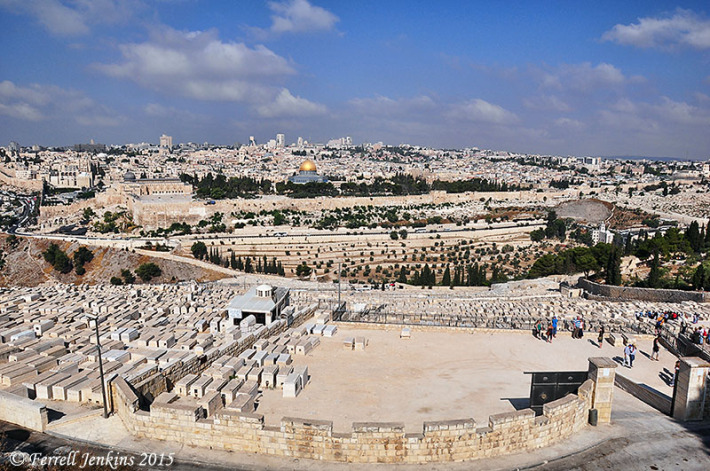
View of Jerusalem from the Mount of Olives. Imagine the city as it would have appeared to Jesus when he reached the top of the Mount of Olives. Photo by Ferrell Jenkins.
The next nearly complete week is the last week, leading up to the resurrection. John gives more attention to the last week than any other Gospel. Even here we have activities for only six of eight days. This section begins in John 12:1 and continues into John 20. Here is the way I have reconstructed it. Where John does not record the activity I have…
View original post 237 more words
Vivid remains of crucifixion- via Ferrell Jenkins
The Romans were adept at crucifixion, according to many historical sources. The first archaeological evidence of crucifixion was uncovered in 1978 [1968; see comments] when an ossuary (bone box, or receptacle) was found north of Jerusalem containing the bones of a man who had been crucified. His name was “Yehohanan, the son of Hagakol.” He is thought to have been between 24 and 28 years of age, and was about 5 feet 6 inches in height.
Both the ossuary and a replica of the heel bone are displayed in the Israel Museum. When Yehohanan was removed from the cross the nail pulled away from the wood.
On Pentecost, Peter proclaimed the truth about Jesus. He said,
This man was handed over to you by God’s deliberate plan and foreknowledge; and you, with the help of wicked men, put him to death by nailing him to the cross. (Acts 2:23 NIV)
View original post 68 more words
Footnote 13 – Martin Hengel, Crucifixion in the Ancient World and the Folly of the Message of the Cross
Footnote 13 – Martin Hengel, Crucifixion in the Ancient World and the Folly of the Message of the Cross (Philadelphia: Fortress Press, 1977), pp. 83, 87, 89-90.
“When Paul spoke…about the ‘crucified Christ,’ every hearer in the Greek-speaking East…knew that this ‘Christ’ …had suffered a particularly cruel and shameful death, which as a rule was reserved for hardened criminals, rebellious slaves, and rebels against the Roman state.”
“That this crucified Jew, Jesus Christ, could truly be a divine being sent on earth, God’s son, the Lord of all and the coming judge of the world, must inevitably have been thought of by any educated man to be utter ‘madness’ and presumptuousness.”
“By the public display of a naked victim in a prominent place – at a crossroads, in the theater, on high ground, at the place of his crime – crucifixion also represented his utmost humiliation… With Deuteronomy 21:23 in the background, the Jew in particular was very aware of this.”
“When Paul talks of the ‘folly’ of the message of the crucified Jesus, he is therefore not speaking in riddles or using an abstract cipher…he deliberately wants to provoke his opponents, who are attempting to water down the offence caused by the cross.”
“Thus in a way the ‘word of the cross’ is the spearhead of his message…it is impossible to dissociate talk of the atoning death of Jesus or the blood of Jesus from this ‘word of the cross.’ The spearhead cannot be broken off the spear.”
Hebrews 12:2 – Fixing our eyes on Jesus, the author and perfecter of faith, who for the joy set before Him endured the cross, despising the shame, and has sat down at the right hand of the throne of God. NASB
Hebrews 13:13 – Let us, then, go to him outside the camp, bearing the disgrace he bore. NIV
Acts 5:41– So they went on their way from the presence of the Council, rejoicing that they had been considered worthy to suffer shame for His name. NASB
1 Peter 2:6– Because it is contained in scripture, Behold, I lay in Zion a chief corner stone, elect, precious: And he that believeth on him shall not be put to shame. ASV
 ἐκλεκτικός