The week leading to the crucifixion & resurrection

The Week Leading to Jesus’ Crucifixion and Resurrection

Ferrell Jenkins's avatarFerrell's Travel Blog

If we consider the Gospel of John a sort of “Day Planner” for Jesus, we have nearly complete activity recorded for two weeks of the earthly ministry of Jesus. The first is in John 1:19—2:11 where activity for six of the seven days is recorded. I think the omitted day is the Sabbath.
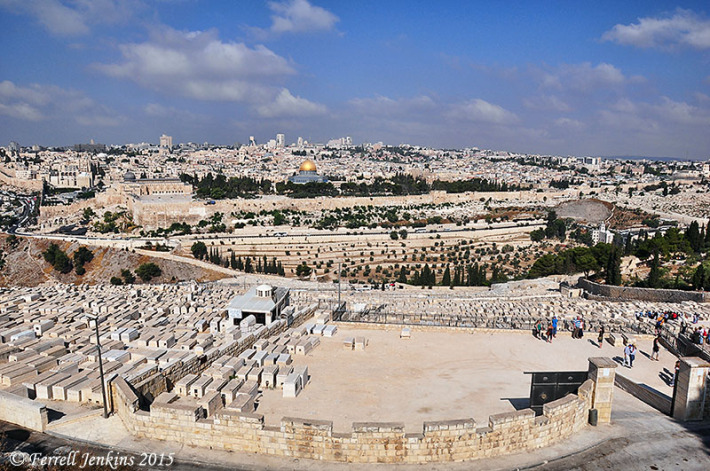
View of Jerusalem from the Mount of Olives. Photo by Ferrell Jenkins.

View of Jerusalem from the Mount of Olives. Imagine the city as it would have appeared to Jesus when he reached the top of the Mount of Olives. Photo by Ferrell Jenkins.

The next nearly complete week is the last week, leading up to the resurrection. John gives more attention to the last week than any other Gospel. Even here we have activities for only six of eight days. This section begins in John 12:1 and continues into John 20. Here is the way I have reconstructed it. Where John does not record the activity I have…

View original post 237 more words
The Annual Meetings # 1

Ferrell Jenkins reports on several professional meetings, which met recently in Atlanta. It was good to see Ferrell again, as well as David McClister, Jared Saltz, Matt Harber, Leon Mauldin, and others at these meetings.

Ferrell Jenkins's avatarFerrell's Travel Blog

Each year in November professional meetings pertaining to the field of biblical studies are held in a major U.S. city. The largest meeting is the SBL/AAR meeting. That is the Society of Biblical Literature and the American Academy of Religion. Together these organizations attract maybe eight thousand persons who are involved in teaching and researching in the fields of Biblical Studies and Religious Studies.

ASOR, the American Schools of Oriental Research, meets separately a few days ahead of the other meeting. This organization attracts those who are teaching and active in the field of Near Eastern archaeology.

The Evangelical Theological Society (ETS) currently meets at the same time as ASOR. I think in some recent years as many as 2000 members attend ETS. This organization attracts scholars who are admittedly conservative in their approach toward the Scriptures. Most of them teach in seminaries or religious schools.

Some international scholars attend…

View original post 397 more words

The new look at Magdala

Ferrell Jenkins’ blog is always worth reading!

Ferrell Jenkins's avatarFerrell's Travel Blog

Magdala was high on my list of places to revisit to see the changes taking place.

The town of Magdala is not mentioned in the Bible, but Mary Magdalene is mentioned a total of 12 times in the four gospels. This place may have been her birthplace or her home. A few late manuscripts mention Magdala (Matthew 15:39 KJV), but earlier manuscripts read Magadan. Magdala is located about 4 miles north of Tiberias on the western shore of the Sea of Galilee.

Josephus had his headquarters at Magdala during the first Jewish Revolt against Rome (A.D. 66-70). He was able to get a group of at least 230 boats to go from Magdala to Tiberias (Jewish Wars 2.635-637). Vespasian attacked the town from the sea and destroyed it.

We first learned of the new excavation planned for Magdala in early 2008 (here). Then in September, 2009…

View original post 347 more words

Pentecost in Jerusalem

Pentecost

Ferrell Jenkins's avatarFerrell's Travel Blog

Last evening at sundown the Jews began to celebrate their modern interpretation of  Pentecost (Shavu’ot). Christians know this from the Old Testament scriptures as the feast of weeks (Leviticus 23:15; Deuteronomy 16:9). Last evening we saw many Jews heading for the Western Wall through the Damascus Gate when we were there. The Orthodox Jews were the easiest to detect because of their distinctive dress.

Pentecost comes 50 days after Passover. It follows a sabbath and amounts to a two-day holiday here in Jerusalem. Those who are not religious may be seen at recreational places enjoying the time off as many persons in America do on any holiday. Some of the religious take the family to a hotel and allow non-Jews to serve them the food they wish. The hotel has a Shabbat elevator. You only make the mistake of getting on it once. It requires no work (= pushing the…

View original post 257 more words

Pay your taxes and do not fear the authorities

Ferrell Jenkins's avatarFerrell's Travel Blog

While reading Romans 13 I came to Paul’s admonition to the saints at Rome, “Would you have no fear of the one who is in authority? Then do what is good.” My mind immediately turned to the mosaic which was discovered during the excavation of the Byzantine public area at Caesarea Maritima.

The context in Paul’s Epistle to the Romans reads this way.

For rulers are not a terror to good conduct, but to bad. Would you have no fear of the one who is in authority? Then do what is good, and you will receive his approval, for he is God’s servant for your good. But if you do wrong, be afraid, for he does not bear the sword in vain. For he is the servant of God, an avenger who carries out God’s wrath on the wrongdoer. (Romans 13:3-4 ESV)

The sign at the site describes the building…

View original post 48 more words

Solomon’s Quarries discovered by American Medical Doctor J. T. Barclay

Ferrell Jenkins's avatarFerrell's Travel Blog

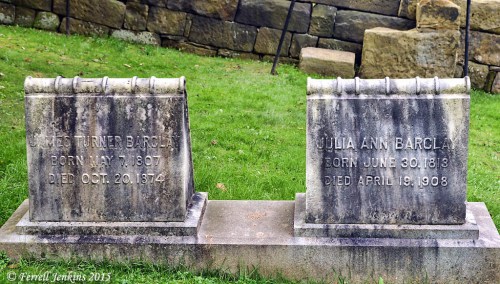
Dr. James Turner Barclay was sent to Jerusalem by the American Christian Missionary Society in 1851 as a medical and evangelistic missionary. During his first trip he stayed until 1854 and  returned for a second stint from 1858 to 1861. Barclay was active in medical work, treating more than 2,000 cases of malaria during his first year in the city.

Grave stone of James T. Barclay, and his wife Julia, in the Campbell Cemetery at Bethany, WVA. Photo by Ferrell Jenkins. Grave stone of Dr. James T. Barclay, and his wife Julia, in the Campbell Cemetery at Bethany, West Virginia. Photo by Ferrell Jenkins.

Barclay wrote a book in 1858 about the city of Jerusalem under the title The City of the Great King; or, Jerusalem As It Was, As It Is, and As It Is To Be. In it he tells about some of his explorations in and around the Old City. In a section dealing with nether Jerusalem he discusses the discovery of what is commonly called Solomon’s Quarry…

View original post 495 more words

Assyrian Nimrud (Calah) destroyed

Tragic.

Ferrell Jenkins's avatarFerrell's Travel Blog

The phrase “Assyrian Triangle” came to be used of three famous Assyrian cities of northern Mesopotamia: Nimrud, Khorsabad, and Nineveh. I think an understanding of this helps when we study Jonah 3:3.

Then the word of the LORD came to Jonah the second time, saying, 2 “Arise, go to Nineveh, that great city, and call out against it the message that I tell you.” 3 So Jonah arose and went to Nineveh, according to the word of the LORD. Now Nineveh was an exceedingly great city, three days’ journey in breadth. (Jonah 3:1-3 ESV)

Parrot says that the word Nineveh might have been understood by those living far away from Assyria by what we now call “‘the Assyrian triangle’ which stretches from Khorsabad in the north to Nimrud in the south, and with an almost unbroken string of settlements, covers a distance of some twenty six miles” (Nineveh and the Old…

View original post 291 more words

“You shall not steal…You shall not covet”

Ferrell Jenkins's avatarFerrell's Travel Blog

“You shall not steal. “You shall not bear false witness against your neighbor. “You shall not covet your neighbor’s house; you shall not covet your neighbor’s wife, or his male servant, or his female servant, or his ox, or his donkey, or anything that is your neighbor’s.” (Exodus 20:15-17 ESV; cf. Romans 13:9)

The Ten Commandments, given to the nation of Israel, were clear about the attitude one should take toward the property belonging to others. Coveting causes one to desire the wife, or the property, of another man.

The reason the donkey and ox of another was not to be coveted or stolen was because these were the man’s means of income. How could he work without his donkey or ox?

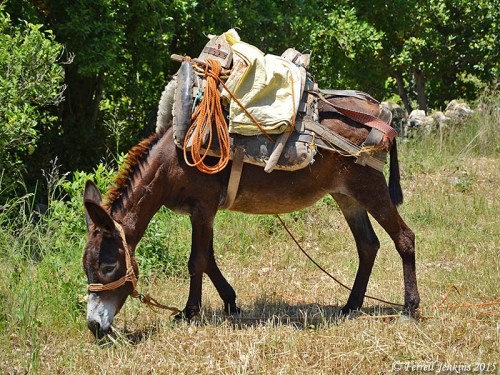
A loaded donkey at Seleucia. Photo by Ferrell Jenkins. A loaded donkey at Seleucia. Photo by Ferrell Jenkins.

It may be that none of my readers own a donkey or an ox, but the principle is clear. You shall not…

View original post 533 more words

Book on the origin of Israel available

This book is still available on Kindle at $2.99

Ferrell Jenkins's avatarFerrell's Travel Blog

Daniel I. Block’s book, Israel: Ancient Kingdom or Late Invention?, is available in Kindle format today for $2.99. The retail price of the hardback is $28.

The publisher (B&H) of the 2008 book describes it as

a collection of essays responding to the radical claims that Israel and its history actually began following the Babylonian exile, and that the history of Israel we read about in the Bible is a fictionalized account.

Contributors are leading Bible and archaeology scholars who bring extra-biblical evidence to bear for the historicity of the Old Testament and provide case studies of new work being done in the field of archaeology.

The book includes the following essays dealing with some of the current discussions in Biblical studies.

  • Israel – Ancient Kingdom or Late Invention? – Daniel I. Block
  • The Value and Limitations of the Bible and Archaeology – Alan R. Millard
  • Contextual Criticism…

View original post 151 more words

Rare hoard of coins from pre-AD 70 discovered near Jerusalem-Tel Aviv highway

Ferrell Jenkins's avatarFerrell's Travel Blog

The Israel Antiquities Authority announces today the discovery of a box containing 114 bronze coins dating to Year Four of the Great Revolt (Jewish Revolt against the Romans). The discovery was made several months ago during work on the new Highway 1 project (between Jerusalem and Tel Aviv).

Coin hoard as it was found in the excavation. Photo Vladimir Nuhin, IAA. Coin hoard as it was found in the excavation. Photo Vladimir Nühin, IAA.

According to Pablo Betzer and Eyal Marco, excavation directors on behalf of the Israel Antiquities Authority, “The hoard, which appears to have been buried several months prior to the fall of Jerusalem, provides us with a glimpse into the lives of Jews living on the outskirts of Jerusalem at the end of the rebellion. Evidently someone here feared the end was approaching and hid his property, perhaps in the hope of collecting it later when calm was restored to the region”. All of the coins are stamped on one…

View original post 324 more words