https://ferrelljenkins.wordpress.com/2016/03/25/only-one-example-of-roman-crucifixion-discovered/
Tag Archives: Jesus Christ
The week leading to the crucifixion & resurrection
The Week Leading to Jesus’ Crucifixion and Resurrection

If we consider the Gospel of John a sort of “Day Planner” for Jesus, we have nearly complete activity recorded for two weeks of the earthly ministry of Jesus. The first is in John 1:19—2:11 where activity for six of the seven days is recorded. I think the omitted day is the Sabbath.
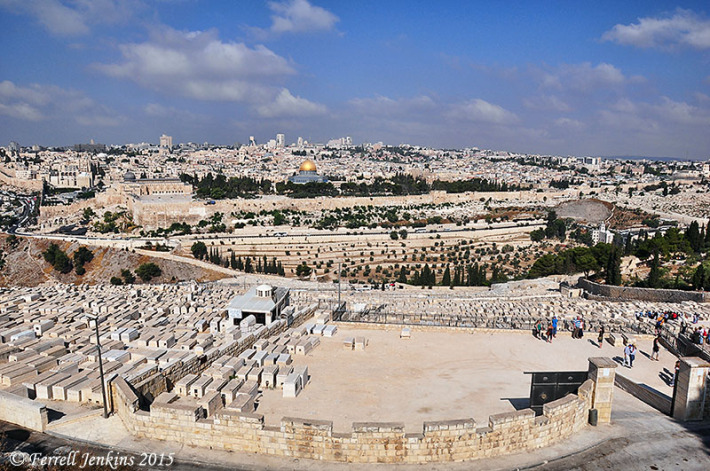
View of Jerusalem from the Mount of Olives. Imagine the city as it would have appeared to Jesus when he reached the top of the Mount of Olives. Photo by Ferrell Jenkins.
The next nearly complete week is the last week, leading up to the resurrection. John gives more attention to the last week than any other Gospel. Even here we have activities for only six of eight days. This section begins in John 12:1 and continues into John 20. Here is the way I have reconstructed it. Where John does not record the activity I have…
View original post 237 more words
A HYMN FOR TODAY – And Can It Be That I Should Gain?
A HYMN FOR TODAY
And can it be that I should gain
An interest in the Savior’s blood?
Died He for me who caused His pain,
For me who scorned His perfect love?
You left Your Father’s throne above –
So free and infinite Your grace –
Emptied Yourself of all but love,
And bled for Adam’s helpless race.
Boldly I come before Your throne,
To claim Your mercy immense and free.
No greater love will e’er be known,
For, O my God, it found out me.
[Chorus]
Amazing love! How can it be
That You, my God, should die for me?
Amazing love! How can it be
That You, my God, should die for me?
Irr. – Charles Wesley, 1738 (arr. Bob Kauflin)
Tune: Bob Kauflin, 1988 (arr. Mathew L. Harber)
#451 in Psalms, Hymns, and Spiritual Songs, 2012
A HYMN FOR TODAY – He’s Risen!
A HYMN FOR TODAY
He’s Risen!
Night is over; the morning breaks.
The sun has risen on this first day,
Just like the morning when Mary cried,
“He’s risen! I’ve seen Him! The Crucified!”
Night is over; how bright the day
That dares to step inside the grave
And shout to all, “Awake and see:
He’s risen! Christ Jesus of Calvary!”
Night is over; Lord, send the day
To lift the veil where death once lay.
Unseal our hearts; we, too, would sing,
“He’s risen! My Savior! My Lord! My King!”
Irr. – C.E. Couchman, 1997
Tune: RISEN! – C.E. Couchman, 1997
#254 in Psalms, Hymns, and Spiritual Songs, 2012
HE’S RISEN! expresses that, for the believer, each first day of the week is as bright with hope as the morning of the resurrection of Jesus Christ. It also links that sunrise to the way the darkness of death in our lives will be banished by our risen Lord. (Mt. 27:66; Lk. 24:1-6; Jn. 20:6-8, 18; 2 Pet. 1:19)
A HYMN FOR TODAY – Come, See the Place Where Jesus Lay
A HYMN FOR TODAY
Come, see the place where Jesus lay,
And hear angelic watchers say,
“He lives, who once was slain:
Why seek the living midst the dead?”
Remember how the Savior said
That He would rise again.
O joyful sound! O glorious hour,
When by His Father’s mighty pow’r
He rose and left the grave!
Now let our songs His triumph tell,
Who burst the bands of death and hell,
And ever lives to save.
The first begotten of the dead,
For us He rose, our glorious head,
Immortal life to bring.
What though the saints like Him shall die?
We share our leader’s victory,
And triumph with our king.
No more we tremble at the grave,
For Jesus will our spirits save
And raise our slumb’ring dust.
O risen Lord, in You we live;
To You our ransomed souls we give,
To You our bodies trust.
O ransomed, let your praise resound,
And in your Master’s work abound,
Steadfast, immovable.
Be sure you labor not in vain;
Your bodies shall be raised again,
No more corruptible.
8.8.6.8.8.6 – Thomas Kelly,1806
Tune: PIETY NEW – Funk’s Harmonia Sacra
attrib. C. J. Stanley, 1851
#250 in Psalms, Hymns, and Spiritual Songs, 2012
Footnote 13 – Martin Hengel, Crucifixion in the Ancient World and the Folly of the Message of the Cross
Footnote 13 – Martin Hengel, Crucifixion in the Ancient World and the Folly of the Message of the Cross (Philadelphia: Fortress Press, 1977), pp. 83, 87, 89-90.
“When Paul spoke…about the ‘crucified Christ,’ every hearer in the Greek-speaking East…knew that this ‘Christ’ …had suffered a particularly cruel and shameful death, which as a rule was reserved for hardened criminals, rebellious slaves, and rebels against the Roman state.”
“That this crucified Jew, Jesus Christ, could truly be a divine being sent on earth, God’s son, the Lord of all and the coming judge of the world, must inevitably have been thought of by any educated man to be utter ‘madness’ and presumptuousness.”
“By the public display of a naked victim in a prominent place – at a crossroads, in the theater, on high ground, at the place of his crime – crucifixion also represented his utmost humiliation… With Deuteronomy 21:23 in the background, the Jew in particular was very aware of this.”
“When Paul talks of the ‘folly’ of the message of the crucified Jesus, he is therefore not speaking in riddles or using an abstract cipher…he deliberately wants to provoke his opponents, who are attempting to water down the offence caused by the cross.”
“Thus in a way the ‘word of the cross’ is the spearhead of his message…it is impossible to dissociate talk of the atoning death of Jesus or the blood of Jesus from this ‘word of the cross.’ The spearhead cannot be broken off the spear.”
Hebrews 12:2 – Fixing our eyes on Jesus, the author and perfecter of faith, who for the joy set before Him endured the cross, despising the shame, and has sat down at the right hand of the throne of God. NASB
Hebrews 13:13 – Let us, then, go to him outside the camp, bearing the disgrace he bore. NIV
Acts 5:41– So they went on their way from the presence of the Council, rejoicing that they had been considered worthy to suffer shame for His name. NASB
1 Peter 2:6– Because it is contained in scripture, Behold, I lay in Zion a chief corner stone, elect, precious: And he that believeth on him shall not be put to shame. ASV
Footnote 10 – Atheist Delusions (2)
Footnote 10 – David Bentley Hart, Atheist Delusions: The Christian Revolution and Its Fashionable Enemies (New Haven and London: Yale University Press, 2009), pp. 111-112.
“We are far removed from the days when one’s baptism could be said to be the most momentous event — and perhaps the most dramatic, terrifying, and joyous experience — of one’s life. …For most of the Christians of the earliest centuries, baptism was altogether of a more radical nature. It was understood as nothing less than a total transformation of the person who submitted to it; and as a ritual event, it was certainly understood as being far more than a mere dramaturgical allegory of one’s choice of religious association. To become a Christian was to renounce a very great deal of what one had known and been to that point, in order to be joined to a new reality, the demands of which were absolute; it was to depart from one world, with an irrevocable finality, and to enter another.
“…the period of one’s preparation for baptism could not conclude until one had been taught the story of redemption: how once all men and women had labored as slaves in the household of death, prisoners of the devil, sold in bondage to Hades, languishing in ignorance of their true home; and how Christ had come to set the prisoners free and had, by his death and resurrection, invaded the kingdom of our captor and overthrown it, vanquishing the power of sin and death in us, shattering the gates of hell, and plundering the devil of his captives. For it was into this story that one’s own life was to be merged when one at last sank down into the “life-giving waters”: in the risen Christ, a new humanity had been created, free from the rule of death, into which one could be admitted by dying and rising again with Christ in baptism and by feeding upon his presence in the Eucharist.”
Atheist Delusions is an engaging polemic which is not only a trenchant critique of the pretensions of modern unbelievers, and a learned exposition of some of the history of the tension between Christianity and atheism, but is also filled with insights on many relevant topics encountered along the path of the development of this story. One need not necessarily accept all the premises advanced, nor use all of its terminology, to grasp the essential nature of the truths expounded here. A good read!
A HYMN FOR TODAY – Ask Me What Great Thing I Know
A HYMN FOR TODAY – Ask Me What Great Thing I Know
Ask me what great thing I know:
What delights and stirs me so?
What the high reward I win?
Whose the name I glory in?
Jesus Christ, the crucified,
Jesus Christ, the crucified.
Who is He that makes me wise
To discern where duty lies?
Who is He that makes me true
Duty, when discerned, to do,
Jesus Christ, the crucified,
Jesus Christ, the crucified.
Who is life in life to me?
Who the death of death will be?
Who will place me on His right,
With the countless hosts of light?
Jesus Christ, the crucified,
Jesus Christ, the crucified.
This is that great thing I know,
This delights and stirs me so:
Faith in Him who died to save,
Him who triumphed o’er the grave:
Jesus Christ, the crucified,
Jesus Christ, the crucified.
7.7.7.7.7 – Johann C. Schwedler, 1741
tr. Benjamin H. Kennedy, 1863
Tune: REDHEAD 76 – Richard Redhead, 1853
#106 in Psalms, Hymns, and Spiritual Songs, 2012
As with some other modern hymnals, “ye” changed to “me” also personalizes the hymn
 ἐκλεκτικός