
Steve Wolfgang with grandchildren, Oriental Institute, University of Chicago
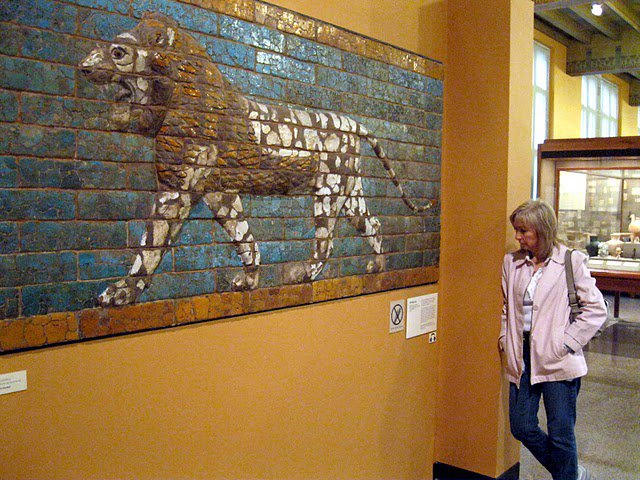
Steve Wolfgang with grandchildren, Oriental Institute, University of Chicago
Ashdod was located along an international highway known as the Way of the Sea, the Way of Philistia, or the Via Maris. This was the important route connecting Egypt and Assyria. We have already discussed, in the past few posts, that the Assyrian king Sargon II captured Ashdod in 712/11 B.C. The prophet Isaiah makes reference to this event in Isaiah 20:1.
The LORD revealed the following message during the year in which King Sargon of Assyria sent his commanding general to Ashdod, and he fought against it and captured it. (Isa 20:1 NET)
Sometime discoveries are made, but get little attention. A discovery at Tel Ashdod in 1963 falls into this category. Tel Ashdod was excavated from 1962 to 1972 under the direction of Moshe Dothan. David Noel Freedman wrote an article in Biblical Archaeologist (26:4, 1963)) about “The Second Season at Ancient Ashdod.” He describes the fragments of…
View original post 615 more words
Ancient wall in Israel matches up with Bible’s tale of Assyrian attack
Ancient wall in Israel matches up with Bible’s tale of Assyrian attack

Archaeologists say they have unearthed the remains of massive fortifications built about 2,700 years ago around an Iron Age Assyrian harbor in present-day Israel. The ruins appear to have a connection to Assyria’s takeover of the region, as mentioned in the Book of Isaiah.
“The fortifications appear to protect an artificial harbor,” Tel Aviv University’s Alexander Fantalkin, leader of the excavations at theAshdod-Yam archaeological dig, said in anews release issued Monday. “If so, this would be a discovery of international significance, the first known harbor of this kind in our corner of the Levant.”
The discovery was announced at the end of the first excavation season at Ashdod-Yam in the contemporary coastal city of Ashdod, just south of Tel Aviv. At the heart of the fortifications is a mud-brick wall measuring more than 12 feet wide (3.6 meters wide) in some places, and 15 feet (4.5 meters) high. The wall is covered in layers of mud and sand that stretch for hundreds of feet on either side.
When they were built in the 8th century B.C., the crescent-shaped fortifications would have defended an inland area covering more than 17 acres (7 hectares).

Age of Sargon II
During the late 8th century B.C., Assyrian King Sargon II ruled the entire southeastern part of the Mediterranean basin, including Egypt and the Middle East. Inscriptions tell of a Philistine king in Ashdod, named Yamani, who tried to organize a revolt against the Assyrian Empire. The Assyrians responded harshly, took control of Ashdod in 711 B.C. and eventually destroyed the city. As a result, power shifted to the nearby area of Ashdod-Yam, the site of the current excavations.
Tel Aviv University said the fortifications appear to be related to these events, although the precise relationship is not yet clear. They could have been built before or after the Ashdod rebellion was put down, either at the initiative of the local defenders or at the orders of the Assyrians.
Based on earlier excavations, the late Israeli archaeologist Jacob Kaplan concluded that the rebels built the fortifications in anticipation of the attack — but Fantalkin said the construction seems too monumental to have been done under such circumstances.
“An amazing amount of time and energy was invested in building the wall and glacis [embankments],” he said.
Staying out of the fight
Sargon II’s harsh action against Ashdod was mentioned in Isaiah 20, as a warning to those who backed the rebellion. “In that day, the people who live on this coast will say, ‘See what has happened to those we relied on, those we fled to for help and deliverance from the king of Assyria!'”
Hezekiah, king of Judah, stayed out of the fight —presumably at the urging of Isaiah.
Fantalkin and his team found more recent ruins on top of the sand of the Iron Age fortifications, dating to the Hellenistic period, between the 4th and 2nd centuries B.C.
+++++++++++++++++++++++++++++++++++++++++++++++++++++++
Read the entire article at http://www.nbcnews.com/science/ancient-wall-israel-matches-bibles-tale-assyrian-attack-6C10953508
Alan Boyle is NBCNews.com’s science editor. Connect with the Cosmic Log community by “liking” the NBC News Science Facebook page
Resources for congregational worship in song
Just another WordPress.com site
It's EVERYBODY'S "Holy Land"
Around the World, or Just in my Thoughts.
Discussing Sites, Peoples, and Events Related to the Bible, Ancient Near East, and Classical Studies
Steve Wolfgang's view of the world from suburban Chicago -- or wherever he may be on any given day
It's about calling.
Steve Wolfgang's view of the world from suburban Chicago -- or wherever he may be on any given day
Executive Director of CSNTM & Senior Research Professor of NT Studies at Dallas Theological Seminary
Steve Wolfgang's view of the world from suburban Chicago -- or wherever he may be on any given day
They hymned their King in strains divine; I heard the song and strove to join.
"I think I can. I think I can. I think I can." -The Little Engine That Could
Steve Wolfgang's view of the world from suburban Chicago -- or wherever he may be on any given day
Comments on the New Testament and Early Christianity (and related matters)

 ἐκλεκτικός